
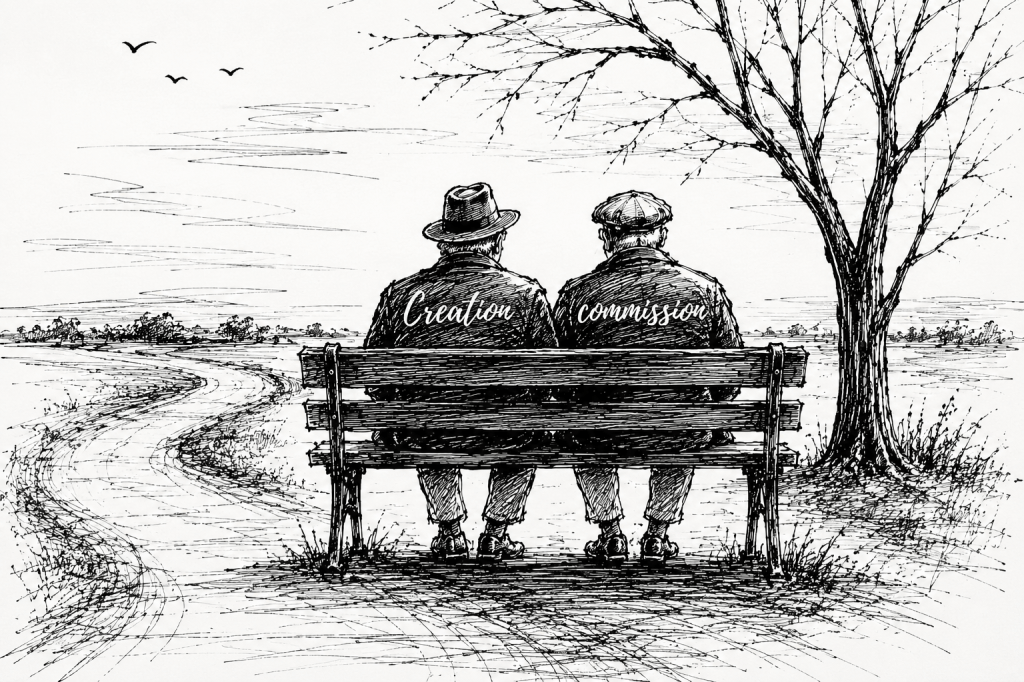
This sermon was preached at Christ Episcopal Church in Melbourne, Florida on Trinity Sunday (Year A). The texts for the day were Genesis 1:1-2:4, Psalm 8, 2 Corinthians 13:11-13; Matthew 28:16-20. What a joy to be back with and at the invitation of my co-conspirator, the Rev. Cynthia P. Brust.
The sermon audio can be heard above.
Old Friends and Bookends
I have your rector’s number.
Just last year, I stood at this very pulpit and lamented about how Mother C had Hoodwinked and Tom Sawyered me into preaching on Trinity Sunday. I even suggested that Trinity Sunday should be redubbed as Porter-is-a-glutton-for-punishment Sunday because I agreed to it.
And yet, here I stand.
In this pulpit.
On Trinity Sunday, again.
If “fool me once” was shame on her, then “fool me twice,” is, well… let’s just say I’ll be writing to the folks at the Revised Common Lectionary to rename Trinity Sunday…
That “infamous” Sunday took place 50 weeks ago on June 15, 2025. What a time it was. Since then, you have completed an entire revolution around the Jesus story, celebrating a cycle of proclamation and worship, with yours truly serving as homiletical bookends. Time has passed, memories were created, and here we sit, like old friends and bookends upon the Simon and Garfunkelian park bench.
On April 3, 1968 – the day before “shots rang out in the Memphis sky” – Simon and Garfunkel released a studio album titled, Bookends. Fresh off the success of their soundtrack for The Graduate, this album was moody, black and white with its sound, and lyrical precision. Side One opens with “Bookends Theme,” the short, instrumental piece which William just played. It then closes with “Bookends Theme – Reprise,” a peppier version of the opening which now includes several lines of lyrics about time and memory. In between theme and reprisal, the listener voyages through “youth, alienation, life, love, disillusionment, relationships, old age, and mortality.”
The Reprise is the same yet different as the opening.
Mature, developed, expansive.
We find ourselves in a similar bookend-situation this morning. Not because I’m preaching two Trinity Sundays in a row or because we’ve completed a liturgical year over the last 50 weeks, but because of the passages we’ve been given. Genesis 1 is our opening theme of creation while Matthew 28 serves as the theme reprised as commission. Both speak of Trinitarian theology, mission, and authority.
I want to jump into the text, but first let’s pray.
The passage from Genesis 1 is so familiar and well-known that we might miss what God is revealing to us about who God is, who we are, whose we are, and what we were created for.
The narrative unfolds with four of the most important words in Scripture: in the beginning God. The opening line of a story matters greatly – it’s where stories can captivate or lose an audience. Let’s see how well-storied you are. I’ll give you the first half of an opening line and you respond with the second half…
A long time ago | in a galaxy far, far away
It was the best of times | it was the worst of times
In a hole in the ground | there lived a hobbit
These lines communicate something poignant and prescient about the tales they tell.
In the beginning God lets us know that this is a story about God, who was there in the beginning and before the beginning and that from the beginning, God is the main character. If we miss that point, we miss everything else.
Three persons are present in creation: God the Father is obvious. The Spirit is there, too, brooding and hovering over the deep like a mother bird over her young. But did you notice the second person? When God said let there be light and it was so, this was the presence of the divine Logos. The Word who would later be the Word made flesh flowing forth from the metaphorical mouth of God as an active agent in creation. Before we ever hear about stars and skies, slithering snakes, and slow-slinking sloths, we see Father, Son, and Holy Spirit in a co-eternal relationship overflowing with love into creation.
In every instance, God spoke something into being and it was so. There was evening and there was morning, it was a numbered day, and it was declared good. There is an order to God’s work, here. God is creating as the Master Designer, bringing order out of chaos, building a Temple-home for his presence and people.
The writers told the story with a liturgical-poetic cadence pleasing the ear. Here is my take on how it might sound to our 21st century ears in the vernacular (an original poem):
Evening came and morning stood:
Word creating light from dark.
Triune God forming creation’s arc,
He declared that-it was good.
Evening came and morning stood:
Heaven stretched across the sky.
The dom’ed firmament resting high,
He declared that-it was good.
Evening came and morning stood:
Wet from dry created sea
Earth sprouting green fecundity.
He declared that-it was good.
Evening came and morning stood:
Sun and moon governing light;
Spher’d sentinels separating day, night;
He declared that-it was good.
Evening came and morning stood:
Deep and high blue teeming,
Fins, feathers, swarming, streaming.
He declared that-it was good.
Evening came and morning stood:
Land-bound creatures filling groun’
Image-bearing beings, creation’s crown
He declared it very good.
All that is, visible and invisible, seen and unseen, was spoken into existence, created out of nothing, by the Triune God.
Creation made for and by the Creator.
Embedded within the narrative is a description and depiction of humanity’s telos, our purpose, our very vocation. On the sixth day, God created image-bearing beings, humanity, and gave us a sacred task. Four verbs describing the work of God for the people of God: be fruitful and multiply, fill the earth and subdue it. Animals had been given the first half, too, but only humans were told to fill and subdue.
Our dominion over creation is neither ours by manmade right nor is it about domination.
Dominion is about assisting creation with flourishing and thriving.
It is about allowing creation to live and act as the Creator intended.
It is about directing the praise of creation back to the Creator.
This means we must reassess our relationship with the created world. We must discern where we are taking advantage of creation in ways that are contrary to God’s will. Our relationship with food, with the earth, with people, with production, with everything must be reimagined so that Image Bearers do not destroy creation or distort the mandate.
The call to be fruitful and multiply will be repeated throughout the biblical narrative. God charges Adam and Eve with the “creation mandate” and it is echoed…
To Noah after the flood;
To those scattered from Babel;
To Abraham when God spoke to him;
To Jacob when God named him;
To the Hebrews enslaved in Egypt;
To Israel exiled in Babylon;
And after centuries of waiting, it rises and reprises in Matthew 28;
Not as a command to fill the earth with image-bearers alone,
But to fill the earth with disciple-making-disciples.
This puts us back on the “hill where it happened.” It’s 10 days before Pentecost and the Triune God is active in creation again. In Genesis, the Trinity co-creates, in Matthew the Trinity co-missions.
On the Galilean hillside, Jesus gave missional marching orders to the disciples. I am convinced that the location matters.
Could this be the site of the Sermon on the Mount?
Was it the hillside where he escaped to pray with the Father while the disciples sailed toward a tempest?
As the backend bookend to their three years together, the location has to speak of continuity and newness,
of call and recall,
of theme and reprise.
The pull is to skip straight to the commission, but we gloss over verse 17 at our own peril. Matthew tells us the disciples have co-mingled worship and doubt.
Just as the father of the demon-possessed boy in Mark 9 exclaimed, I believe, help my unbelief;
Just as the disciples in Luke’s ascension story had joy and fear;
Matthew’s version names worship and doubt without resolving the tension by dissolving one into the other.
This has special meaning for us, today, as we worship the risen-and-exalted Lord because you may have doubts in your own spiritual life. I don’t know who needs to hear it, but the antithesis to faith is unbelief, not doubt. Even unbelief’s shadow side of certainty takes us further afield from faith than does doubt.
Peter had doubts yet Jesus called him out to walk upon the waters.
Thomas doubted after the resurrection yet he touched nail-pierced hands and spear-pierced side.
The disciples worship with doubt yet are commissioned for ministry.
All authority on heaven and earth has been given to me, Jesus says.
As in, he is the King of kings and Lord of lords;
As in, he will ascend and sit at the right hand of the Father;
As in, he will reign and rule over all things;
As in, he is sharing his authority with them;
With the Church.
With us.
With you.
The clause, Go therefore ties the commission back to Jesus’ authority. Because I have authority and am sharing it with you, this is what you are to do. Like the bookend of creation, there are four key verbs in this reprised mandate: Go. Make. Baptize. Teach.
The first verb connects us to creation: go. Some translations prefer the more active “as you are going.” Either way, the Christian life is lived in constant motion like the perichoretic dance of the Trinity. We are called to go to all people, to all nations. Not just to the people who look like you, vote like you, spend money like you, or on every issue agree with you. Someone in this room may be called to go to the literal ends of the earth while others are called to take the gospel to the ends of their neighborhood, to their co-workers, or heaven forbid, to Florida State football fans.
There is an inherent temptation in churches during seasons of gospel growth and missional momentum to move from going out to staying in. No one would ever say that, of course, but you can hear it in language like, “We need to care for the people we have” or “Enough about outreach, what about inreach?” Friends, Christ Church must avoid that temptation.
Look at what God has done in you, for you, and through you over the last 6 years. You must not lose sight of the fact that “The church is the only society which exists for those who are not yet members.” To be a Christian, to be the Church, is to be constantly going out and inviting others in. You have an amazing thing going on here at 190 Interlachen and the call is to move further up, further in, and further out not to sit on your blessed assurance!
As we are going, we are charged with making disciples who make disciples!
The church is not a generic non-profit, welfare, or social organization.
The church is not a luxury yacht where the Rector serves as cruise ship director or activities coordinator.
The church is not the place where the minister ministers and the congregation congregates.
It is the Body of Christ where disciples go and make disciples. It is a battleship amidst the wild waves of this world where people are brought in from the storm, finding haven and peace, only to be sent back out on the cosmic search and rescue mission for lost creatures in a lost creation.
You, therefore, are to be about the business of making disciples. First, this means you should probably be a disciple yourself. Your yes to Jesus is followed by passionately pursuing Christ-like transformation through the power of the Holy Spirit. Disciples must cast off the habits of the old flesh: no grumbling, no self-centeredness, no finger pointing, no creating the church in your own image. Disciples are called to generosity, humility, accountability, and shared ministry.
Baptism and teaching are the means by which disciples are formed. The same Triune God who was active and present in the work of creation is doing the work of new creation in the heart, mind, and life of the believer. When we baptize with water and the Holy Spirit, we invite God to make order out of chaos, to form saints out of sinners, to make daughters and sons of glory.
Baptism is only the beginning. The Episcopal Church’s beautiful baptismal liturgy asks that those who witness these vows will do all in their power to support the newly baptized in their life in Christ. You respond every time with a resounding WE WILL. This is the work of teaching and discipleship. We come to faith in community, we join the community of faith through baptism, and then we strengthen our faith in that very same community. Rector’s Forum, Wednesday Evening Discipleship, and Bible studies are great places to begin this work of discipleship, both as learners and as teachers. Please hear: these are not a la carte options on the menu of consumeristic Christianity; participation is discipleship.
Through the incarnation, crucifixion, resurrection, and ascension of Jesus, Be fruitful and multiply, fill the earth and subdue it becomes go, make disciples, baptize in the Trinity, and teach them.
Jesus closes with a promise and pledge of great comfort: I am with you always, to the end of the age. This is the peaceful and powerful presence of the Holy Spirit at work in our hearts, our homes, and our world. We have not been orphaned by Jesus, instead we have been given direct access to the Father through him and the abiding presence of the Spirit.
Beloved, creation and commission point and propel us forward to consummation, the final bookend. The work which God began in creation, the work which Christ began in you and in the world, will come to beautiful, stunning, overwhelming, and awe-inspiring completion when Jesus returns in power and glory. That is where the story has always been moving!
In the beginning God.
In the middle God.
In the end God.
Father, Son, and Holy Spirit creating all things.
Father glorified by the crucified Son who was raised by the Spirit.
Father, Son, and Holy Spirit commissioning us for ministry.
In closing one year with this bookend, we are opening another year, another chapter of your story, another season of mission and ministry. Christ Church, your mission moment is reprised, not ended. With the Trinity at the center of all that you do, and with your story of God’s faithful fidelity in and through your church, your job is simple: Go. Make disciples. Baptize them. Teach them. And then do it all over again. And again. Lather, rinse, repeat.
One day you’ll be old friends and bookends sitting on park benches, looking at all God has done for you, through you, and in you because his promises are steadfast and sure because his word is trustworthy and true.
And God declared it good. Amen.
 Porter C. Taylor
Awesome as always my friend. Wh
LikeLike