
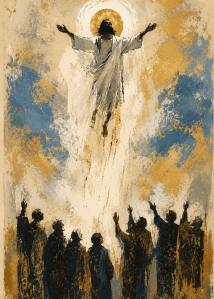
This sermon was originally preached at Christ Episcopal Church in Melbourne, FL for a joint Ascension service with St. David’s by the Sea (my previous parish). This took place on May 9, 2024 and I remain grateful for the beautiful relationship between Christ Church and St. David’s and the collaborative ministry with my co-clerical-conspirator, the Rev. Cynthia P. Brust.
The boys recently introduced us to the movie, Wonka, starring Timothee Chalamet as a whimsical and winsome Willy Wonka and Hugh Grant as a sassy and sarcastic Oompa Loompa. As we watched Chalamet’s portrayal of Wonka, it was hard not to reflect on the two previous actors who brought the famed chocolatier to life on screen.
Johnny Depp offered his rendition in 2005 and in an interview on a talk show, Depp admitted, “I imagined what George Bush would be like incredibly stoned. And, thus was born my version of Willy Wonka.” Gene Wilder’s original performance, in the 1971 film, Charlie and the Chocolate Factory, set the bar for all other Wonkas, as he introduced to the magi of snozzberries, golden tickets, and gobstoppers.
“A little nonsense now and then is relished by the wisest men.”
Charlie and the Chocolate Factory ends with a ride in Wonka’s great glass elevator. Charlie discovers that he will inherit the entire factory, indeed the entirety of Wonka’s chocolate making secrets. Charlie is entrusted with the running of the factory, the care of the Oompa Loompas, and the production of wild and wonderful chocolate creations. As the the glass elevator bursts through the factory ceiling and into the skies, Charlie surveys the entirety of his new empire with Grandpa Joe and Mr. Willy Wonka.
The movie actually features two ascensions: a how and a why. The how is the elevator ascending into the sky and it is the most obvious. Charlie’s ascension to heir and curator of the chocolate kingdom, is the why, and it is the most profound and the one book readers and movie goers should actually pay attention to.
We have a similar situation with Jesus’ ascension.
So much time and ink is spent trying to ascertain the means by which Jesus ascended – does he have wires on his back? Is he wearing a jetpack? – or the location of God’s throne – is heaven really up there? Can the Webb Telescope or the Voyager Satellite from the heavenly throne room?? And all of this attention to the magic of Jesus’ movement misses the monumental point of the ascension.
It is the why that matters, not the how.
As we get into Acts 1, Luke’s second narrative describing the ascension, I can almost hear him opening with a song:
Oompa loompa doompety dophitus
I’ve got a tale for you, Theophilus
Oompa loompa doompety dend
Listen to me and watch Jesus ascend
Ok…so maybe Luke didn’t write that, but we do know that Luke ended his biography of Jesus with a scene depicting the ascension and then he opens his companion volume with a slightly different version of the same scene.
Jesus’ ascension happens 40 days after the resurrection;
40 days after he burst forth from the tomb;
40 days since he trampled down death by his own death.
During those 40 days he first appeared to Mary Magdalene who mistook him for the gardener but who becomes the apostle to the apostles; he walked with Cleopas and his companion (presumably his wife Mary) on their way back to Emmaus; he appeared to the disciples behind locked door; he allowed doubting Thomas to touch his hands and side; he watched 7 of the disciples go fishing on the Sea of Galilee and he helped them with a record catch; he reinstated Peter after a breakfast of fish grilled over a charcoal fire; and now his time has come, once again, to be lifted high, just as he had been six weeks ago.
Lifted high, not in agony but in glory;
Not bearing our sins but bearing our humanity;
Not by his “precious death” but by his “glorious ascension.”
Our first ascension passage, the one from Luke’s biography of Jesus, is actually a compilation of two scenes. In the first half of the passage, Jesus teaches his disciples in the aftermath of his excursion on the road to Emmaus. He breaks open the scriptures for the disciples and shows them how the Old Testament Scriptures shout out his name. He gives them the gospel in the simplest of terms: repentance, forgiveness of sins, and the proclamation of God’s Good News of the crucified and resurrected Messiah to all nations.
And all of this is happening on the day of resurrection!
Luke simply writes, “Then he led them out to Bethany,” but this is not the kind of “and then” that you hear when getting a play-by-play, blow-by-blow download of the day’s activities from a 5-year old. This is the kind of “and then” with 40 days between what happened first and what came next.
Luke’s ascension scene is a bit anticlimactic. After a rousing series of Easter-day Bible studies, Jesus simply blesses his friends and he is carried up into heaven. Luke brings the curtain down on his biography by reporting that the disciples responded to the ascension with worship and blessing God continually in the temple.
Don’t miss that last part, though.
In his literary simplicity, Luke tells us something very important: Jesus blessed his friends and then his friends, in turn, bless God. They have taken up the mantle of leadership; they have started to put into practice the very things they saw their Lord doing with and for them.
They are witnesses of the ministry, crucifixion, resurrection, and ascension of Jesus. Have you noticed that the word “witness” always implies an action? To witness is to see or hear something with the understanding that you are going to do something with what you have seen or heard. If I am a witness in a case, there is an inherent understanding that I will take the stand and share my testimony with others. This is the inference Jesus is making: you are witnesses of these things…and so you will proclaim them aloud and abroad.
Let’s see what Acts has to add to the story…
Luke engages with Theophilus once more and reminds his primary reader of how he had closed his first volume: 40 days of post-resurrection appearances, the promise of the Holy Spirit, and Jesus’ command for his disciples to wait in Jerusalem. But then Luke gives his second accounting of the ascension.
The scene unfolds with the disciples asking a very loaded question:
Lord, is this not the time when you will restore the nation of Israel?
It would be so easy for us to pawn the disciples’ question off as misguided, mistimed, or misjudged. We say to ourselves, “How could they have gotten it so wrong? They have seen the crucifixion and resurrection of the Son of God and they are still fussing over the nation?” Commentators, preachers, and sermon-hearers have been making that very argument for decades if not centuries.
But there’s a slight textual problem: Jesus doesn’t ever say that!
He neither chastises nor challenges them for their query. Instead, he subtly corrects their intended question toward the right answer. First century Israel and second Temple Judaism were rife with hope of a restored nation. God’s chosen people clung to the promise that one day their captivity by way of house arrest would end.
One day the foreign powers would be gone.
One day the temple would be clean.
One day Messiah would come.
One day their nation would be restored.
Jesus understood that hope;
He was raised in the soil of that hope;
He endorsed that hope;
Most importantly: he fulfilled that hope.
Only, the restoration of the kingdom of Israel would look different than simply a cleansed temple and a vanquished emperor. The restoration of the kingdom would begin with the Holy Spirit and here, in Acts 1, Luke starts to unpack for us what that might look like. The restoration of the kingdom includes:
- The Spirit being poured out
- The disciples bearing witness to the ends of the earth
- The nations being offered salvation
- The King returning in power and glory
Jesus instructs the disciples to wait in Jerusalem until they are clothed with power from on high. They will be given the long-awaited and oft-foretold gift of the Holy Spirit. The Spirit is not given as a gift to be placed on a shelf or tucked away and stored under lock and key. Like the little light, are you supposed to hide it under a bushel? NO! The Spirit is active and part of what the power from on high will do is enable the disciples to bear witness to Jesus.
This time when Jesus talks about their witness, he gives an exhaustive list: Jerusalem, Judea, Samaria, and the ends of the earth. The good news of God’s salvation offered freely in and through the person and work of Jesus Christ was, is, has been, and always will be intended for people of every nation, tribe, and tongue. The promised people have always been charged with offering and sharing those promises with everyone, going all the way back to Father Abraham in Genesis 12. It is a public service –nay, it is the public service to which we are all called.
Before he can flesh out a fully-developed theology of missions and evangelism, Jesus ascends. The disciples are caught star-gazing by angels who tell them he will come back the same way he left.
If Luke gives us the WHO – Jesus, WHAT – the ascension, WHERE – a hillside near Bethany, WHEN – 40 days after Easter, and HOW – he was lifted up by divine power, it is Paul who gives us the WHY in his letter to the church in Ephesus.
After his usual and robust opening statements, Paul launches into a meaty prayer over “the saints in Ephesus,” teeming with theological depth and meaning. Paul has heard of their faith and their love for Jesus and so he gives thanks to God for their example and gospel ministry. Paul describes the very hope that Jesus enacted, embodied, and expressed in his earthly ministry: the hope of the glorious inheritance for those who believe and the immeasurable greatness of God’s power. It is this mighty and magnificent power that raised Jesus from the dead, seated him at the right hand of the Father, and which lives inside of you if you are in Christ.
The why of the ascension can be found in the final three verses of Ephesians 1, just after Jesus takes a seat at the Father’s right hand.
Jesus is not just seated upon a throne, he is above all rule and rulers, all authority, all powers and principalities, all dominion, all presidents, kings, queens, dictators, and emperors, and every name. He has ascended not only into the heavenlies, but in glory, power, and might. His name is above every other name and at his name every knee shall both, on earth and under the earth, and every tongue confess that he is Lord.
All things have been put under his feet. What constitutes “all things”? Good question – I’ll let a smattering of scripture answer for you:
The earth is the Lord’s and everything in it;
Heaven is his throne room and earth his footstool;
The cattle on a thousand hills belong to the Lord;
And all things in heaven and earth were created in him, by him, and for him.
It all belongs to him – there isn’t an inch of this earth over which Christ doesn’t shout, “Mine!”
And he is the head of the church. The church is his body and we have been entrusted with the good news of the gospel as we await his coming again in power and great glory to judge both the living and the dead.
The ascension means that Jesus is seated at the right hand of the Father, reigning and ruling over all of creation, filling all things, interceding and mediating on our behalf, inviting us to boldly approach the throne of grace, until he comes again in the fullness of time to consummate the kingdom he has already inaugurated.
And let us be very clear: he isn’t in heaven bearing only his divinity, he is still fully man and fully God. It means that the fully human one, the one who was human the way humanity was intended to be, is in the seat of power next to the Father. Our frail, fickle, and feckless humanity was assumed by Jesus that it might be redeemed and, therefore, our representative, our older brother who bore our sin and shame now bears our redeemed humanity.
That’s the who, what, where, when, how, and why of the ascension, but there’s one final question to answer, and members of CEC you know what question Mother Cynthia would be asking right now…why don’t you teach the St. David’s folks: so what?!
For us tonight, however, the question isn’t so what as much as it is for what and now what?!
If you were paying attention – and I hope you were! – we started laying the foundation for this back in our discussion of Acts.
As Jesus answered the disciples’ question about restoring the kingdom and prepared to ascend, he gave very specific instructions:
Once you have been clothed with power from on high, you are to go and be my witnesses. Again, this is an active kind of witness, not passive. And they are not called to be local witnesses only to the people who look like them, sound like them, vote like them, or spend money like them, but to take their testimony, their stories of what God has done, is doing, and will do, as far and wide as possible.
Jesus says, “Jerusalem, Judea, Samaria, and ends of the earth.” This would include the religious elite, the faithful Jews living in the area, the Samaritans who are really half-Jews and enemies of God’s people in their minds, and then the gentiles living everywhere. If all of heaven and earth are Jesus’ inheritance, then his name should be preached and proclaimed in all places and in all times to all people.
If you are here tonight then you are witnesses of these things. Not only that, the Holy Spirit has already been poured out, over, and throughout the church and so you have been clothed with power from on high. Therefore, you are charged, commissioned, commanded to go and gossip the goodness, to share the good news of Jesus with all whom you meet. Ascension Day isn’t about the physics of how Jesus ascended but the why: to reign and rule over all as he entrusts and commissions us with his power, his glory, and his grace.
 Porter C. Taylor