
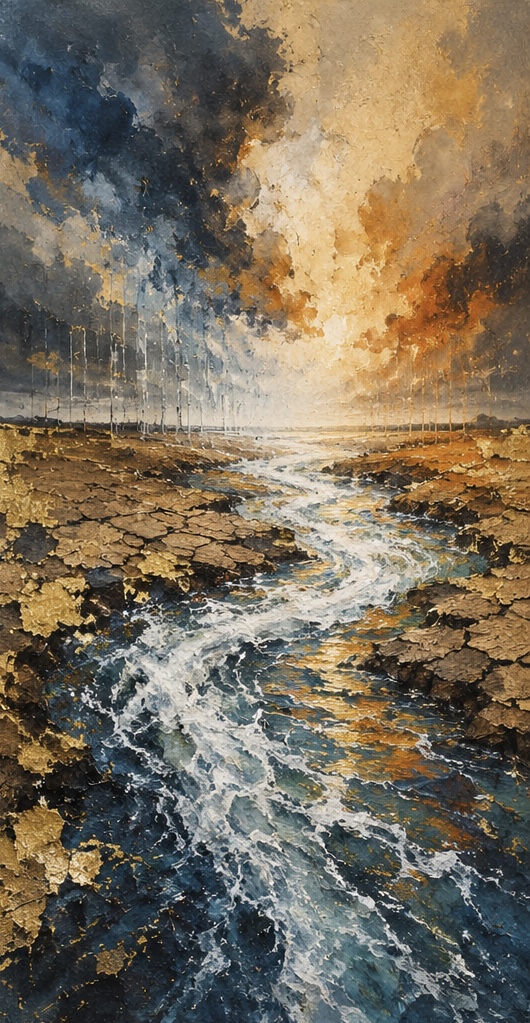
This sermon was preached at St. Andrew’s Episcopal Church (Fort Pierce, FL) on the Day of Pentecost, May 24, 2026. For this sermon, I selected Numbers 11:24-30; Psalm 104:25-35, 37; Acts 2:1-21; and John 7:37-39 from the lectionary options.
Is the LORD’s Power Limited?
We are a week away from the beginning of yet another Hurricane Season.
The Diocesan Office typically sends out an annual reminder to coastal parishes: make sure you have an evacuation plan, find people to batten down the hatches if a storm approaches, stock up on water, paper, and plastic products, buy a Generac if you can afford it…Oh, and be safe!
As we prepare for the 2026 edition of Hurricane Season, many of us remember the statistical anomaly that was 2004. Two storms hit the Treasure Coast in September that year: Francis on the 5th and Jeanne on the 26th. Neither storm was particularly large – category 2 and 3 at the time of landfall. What made the storms unique was their landfall occurred at the same place: Sewall’s Point.
The Treasure Coast was still surveying the damage from Francis when Jeanne made another direct hit.
Havoc was wreaked by the wind.
The rain.
The storm surges.
Francis was massive and moved slowly, hammering the coast with relentless rain and powerful winds. Jeanne was deadly before rotating clockwise and hitting Florida with floods after Haitian mudslides.
The destruction was catastrophic.
$18 billion of combined damage.
Over 3000 lives lost.
The storms were so great, in fact, that the World Meteoric Organization retired both names from future use. It was a true watershed moment along the Treasure Coast. There was life before Francis and Jeanne and there was life after.
Beaches, dunes, and coastline were reshaped.
Homes, roads, and bridges destroyed.
Lives changed forever.
And all due to relentless rains, wicked winds, and wild waters.
Water is probably not the Pentecost image you brought to church this morning. Everyone is wearing red and thinking of tongues of fire, but before fire we have flowing water.
Before the Spirit descended in flame, she hovered over the deep.
Before the believers were set ablaze, Jesus said “come and drink.”
Before Pentecost, we have Sukkot.
Our passages this morning focus on two of Israel’s seven feasts. I want to begin with Jesus’ words in John 7 before looking forward to Acts and backward to Numbers.
John begins with the phrase, “On the last day of the festival.” Being the ever-attentive students of Scripture that you are, you should have immediately thought, “What festival is this?” I’m so glad you asked.
This is Jesus’ third visit to Jerusalem in John’s biography. The next time Jesus visits will be roughly six months later as he enters in triumph only to exit on the cross. This timing matters. Jesus is in the home stretch of his recorded ministry. The opposition is growing. His face fiercely set toward the cataclysmic clash with death and darkness.
The festival in question is Sukkot, the Feast of Tabernacles. Sukkot was a 7-day feast commemorating God’s provision during Israel’s 40 years wandering the wilderness. Jews built makeshift tents to remember how God tabernacled with them. Leading as pillars of cloud by day and fire by night, God dwelt in their midst. His peaceful, powerful presence was felt and known by the people.
Additionally, Sukkot was the fall festival when Israel implored God to bless their land with rain.
Israel wasn’t offering up vague religious platitudes to an unknown deity or ‘thoughts and prayers’ on social media. The promised people were praying to their promise-making and promise-keeping God to water the Promised Land.
There is an element of the Sukkot festivities which you won’t find in Leviticus, Numbers, or Deuteronomy but which very much shapes the text of John 7. According to the Talmud (Jewish law) every day of Sukkot included the water-drawing ritual. The priests and faithful would gather water from the Pool of Siloam into a golden pitcher. With great shouting and the tune of the shofar, they brought the water to the Temple and poured it on the altar.
It was an act of praise and thanksgiving to God, returning to him what was already his in expectation and anticipation of salvation.
Israel’s history with God is woven with water. A 7th century Jewish poet wrote a liturgical poem for use during Sukkot. Used on the last day, the poem calls upon God to remember Israel just as he remembered Abraham, Rebekah, Isaac, Leah, Rachel, Moses, and others with water. The prayer for harvest rain is based on God’s past faithfulness and divine memory. And every year the rains came. The seeds were planted, the fields were watered, and the crops were grown.
John tells us that this is the great day, the final day of the festival, the day when everything builds to a stunning crescendo and the hopes and dreams of Israel reach a fever pitch of praise and adoration before her God.
It is on that day, the great day, that Jesus waxes about water.
Of course it grabs their attention.
Of course it makes the religious leaders mad.
Of course it gets him into trouble.
He is no longer speaking about the Pool of Siloam and the altar in the Temple, he is talking about the Holy Spirit being poured out upon all people because he is the Living Water, the water of salvation, the one who is mighty to save!
Do you see it now?!
Jesus is telling those with ears to hear and eyes to see that…
He is the fulfillment of Sukkot;
He is the enfleshment of salvation;
He is the very water that they have been praying for!
And every year Israel celebrated the harvest about seven months after Sukkot. This was the feast of weeks, also known as Shavuot, also known as Pentecost. It is our backdrop to Acts 2.
The disciples have been gathering in the Temple for ten days since Jesus ascended. With co-mingled fear and joy, they have been proclaiming the good news of God in Christ. On the 10th day, or the fiftieth day since Passover, they joined all of Israel for the commemoration of God giving the law to Moses on Mt Sinai.
And when I say “all of Israel,” I mean tens of thousands of pilgrims streamed into the city. It has been estimated that the Temple Mount could hold 250,000 worshippers. Jerusalem was bursting and buzzing as the people prepared to give thanks to God for his provision of both law and harvest.
Before the Spirit descends or Peter preaches, this background to Pentecost is essential. And it takes us to Numbers 11.
In our passage, God speaks to Moses about taking some of Moses’ anointing and giving it to the 70 elders. Leadership may be lonely, but it is not a lonesome burden. To lead or to live with God is to be in community, paired and partnered with others in ministry. Moses has learned that he cannot, should not, must not do it alone.
But what led to the sharing of anointing, you ask?
Israel’s grumbling, of course.
They were complaining about manna of all things. Rejecting the gracious gift of God, they preferred their three hots, cots, and meat pots from Egypt. The irony here is rich: they originally received manna because they complained to Moses six weeks after the parting of the Red Sea that they were starving. God rained down bread from heaven. As the redeemed people, their economy was based solely on God’s bountiful provision.
Now they are complaining about that very same provision. How quickly they forgot slavery, abuse, and oppression. “Why did we ever leave Egypt?” they cried.
In rejecting the gift, they rejected the Gift Giver.
n forgetting their circumstances, they forgot their covenant making-and-keeping God.
In wanting Egypt’s empire, they refused God’s economy.
Moses takes the complaint to God. He is agog and aghast when God says that he will give Israel so much meat that they will have it coming out of their noses for a whole month and they will grow to hate it. Moses scoffs at this. How can you possibly give that much meat to 600,000 people for a day, let alone a month, out in the desert??
We need to pause here. How often do we respond to God with the same incredulity? How routinely do we view a call from God through human eyes and limitations?
You can’t possibly do that, Lord.
Not here – not in this economy – not with these people – not with this leader.
Lord, you don’t know how things really are.
We are guilty of believing that God can’t really do more than we can ask or imagine, despite all the evidence to the contrary.
You have to love God’s reply: Is the LORD’s power limited??
This was not rhetorical.
This was the same God who appeared in the burning bush.
The same God who unleashed the 10 plagues upon Egypt.
The same God who passed over Israel.
The same God who parted the Red Sea and made a way when there was no way.
The same God who led as pillar of cloud by day and fire by night.
The same God who rained down manna upon his people.
This was the God of Abraham, Isaac, and Jacob!
Friends, we worship a God of abundance not scarcity. He says the cattle upon a thousand hills belong to him and the earth is his and all that is in it. God promises Moses that his word would be accomplished.
If it is God’s will then it is God’s bill;
Because where God guides, God provides.
Our passage is located between the promise of provision being made and kept. The sharing of Moses’ anointing with the elders is a demonstration of God’s power for his people. If God can anoint 70 others, he can provide for his people in the wilderness.
And God’s word is steadfast and sure, trustworthy and true. The elders gather at the Tent of Meeting, as the LORD directed, and they are anointed and begin to prophesy. But two of them are absent. Eldad and Medad remained in the camp with the people where they prophesied with power. The LORD’s power is not limited – it reaches even beyond the tent.
Joshua hears this and is horrified, but Moses knows the LORD is being glorified.
Joshua wants the Spirit to be dispersed from a central office in a good and orderly fashion. Clearly he was an Episcopalian! But Moses knows the Spirit goes where the Spirit flows and overflows.
Are you jealous for my sake?
Would that all the Lord’s people were prophets and that the Lord would put his spirit on them!
Moses gives us a peak at coming attractions: the LORD will put his spirit on his people as prophets, priests, and pilgrims. Moses says it, Joel prophesies it, Jesus promises it, Acts fulfills it.
The Spirit is shared in Numbers but poured out on Pentecost.
The harvest rains prayed for now overflow onto God’s people.
The fire which burned-yet-didn’t-consume now falls on the disciples.
Pentecost is the fulfillment of ancient promises! John even told us in our passage that the Spirit had not yet been sent because Christ had not yet been glorified. In Acts 2, however, with the God being glorified in Christ crucified, raised, and ascended, the prophesied and promised Spirit is shared among Jesus’ followers, filling them to overflowing.
Would that all the Lord’s people were prophets and that the Lord would put his spirit on them!
Some people didn’t understand. Like their ancestors in Numbers, they question the power of God. They rejected the gift and therefore the Gift Giver. They assume the disciples are drunk. You can hear God’s earlier question: is the LORD’s power limited?
Filled with the Holy Spirit, heart blazing and bursting with the power of God, Peter stands up and preaches. This proclamation of the gospel, this gossiping of the good news, roots the Church’s witness in the cross and resurrection. The same Spirit which hovered in creation, the same creation which was promised by Joel, the same Spirit which was poured out that day, is the very same power which raised Jesus the Christ from the dead.
3,000 people came to faith that day because the LORD’s power is not limited. People heard the good news in their own language. Empowered by the Holy Spirit, they stepped into the flow of living water.
Please don’t miss this, beloved…
Jesus is telling you that he is the Living Water.
He is inviting you to drink deeply from his wells.
And he is calling you to go out and share it with others.
Would that all the Lord’s people were prophets and that the Lord would put his spirit on them!
The powerful presence of God has been unleashed in the world and we are called to follow the Spirit to the ends of the earth. The living water is flowing and overflowing, and unlike our hurricanes, its force brings life not death, new creation not destruction, edification not erosion, invitation not limitation.
The Lord has poured his Spirit upon you that you would become his prophetic and priestly pilgrims in the world, building bridges of grace as agents of reconciliation. Pentecost is about what God has done for us and what he intends to do through us.
You have been anointed, set apart for mission and ministry, with the same Spirit that raised Jesus from the dead! The LORD’s power is not limited!
After Eldad and Medad prophesied, the LORD fulfilled his promise. The Israelites found themselves in a veritable mountain of quail. A day’s journey to either side and three feet deep. The smallest portion that anyone gathered was 10 homers – a homer is 26-52 gallons so 10 homers would be between 260-520 gallons.
They were stockpiling, saving up for a rainy day, because they still believed God’s power and provision were limited. Even as they saw the LORD’s word being fulfilled, they craved the gift rather than the Gift Giver.
And that is the real danger in front of us. Whether it’s quail in the wilderness, harvest rain after Sukkot, or tongues of fire on Pentecost, our tendency is to save up, shore up, and stack up our pockets, wallets, or accounts with more. But that’s not how God’s economy works.
Once you have received the water, once you have drank deeply from Christ’s well, you are then charged to share it with others, with everyone you know. To riff on D.T. Niles, Christianity is one beggar telling another beggar where to find the water.
Beloved, our promise-making God is our promise-keeping God. The word of the LORD is fulfilled, fruitful, and faithful as the wind rushes, the water rages, and the fire blazes. The Lord’s power is not limited! Come Holy Spirit, let your fire fall and fill us to overflowing that others might be filled. Amen.
 Porter C. Taylor