
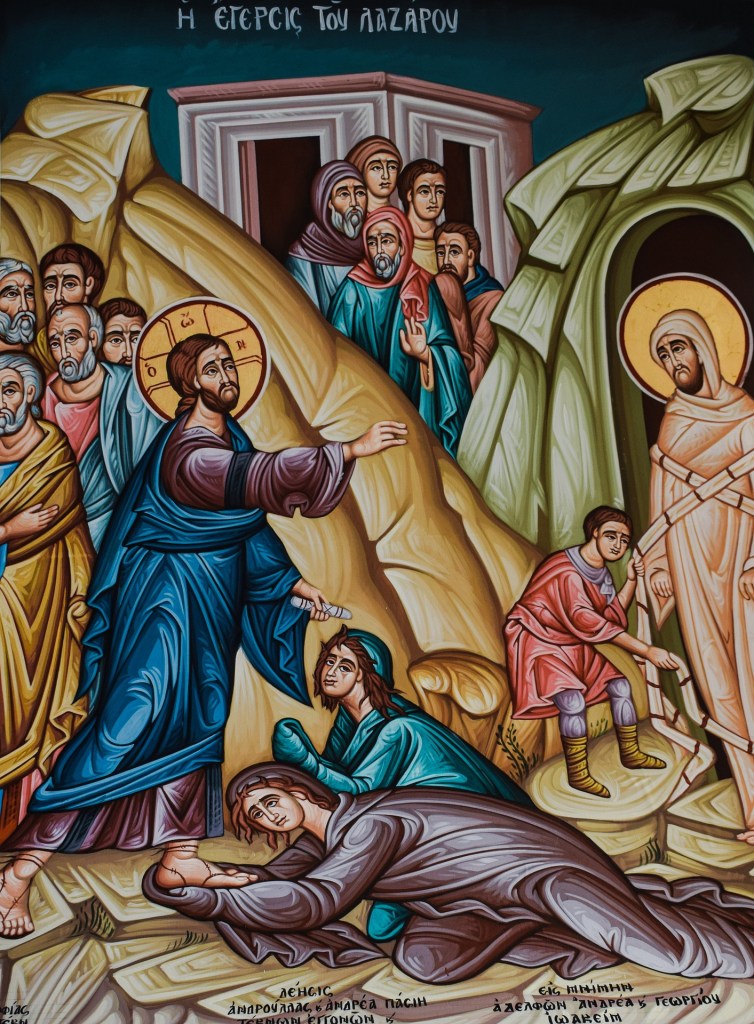
This sermon was delivered on March 26, 2023 to my parish, St. David’s by the Sea. The occasion was the Fifth Sunday in Lent (Year A). The audio version is provided below.
Before starring in Murder, She Wrote, the late dame Angela Lansbury starred in the 1971 classic Disney movie, Bedknobs and Broomsticks. Her character, one Miss Price, an apprentice witch in World War II England, sought to become a full witch and to provide a meaningful service to both crown and country in face of the Nazi threat. Her first “service” was to provide a home for 3 London children: Charlie, Carrie, and Paul, as they evacuated the city for fear of German bombing.
The actual service rendered by Price and the children is a stand against a small Nazi invasion in their coastal town. Before the local militia is able to join the scene and fight, Lansbury employs the most significant spell in the world: substitutiary locomotion. What is this spell? It is a spell designed to bring inanimate objects to life. It is Mystic power that’s far beyond the wildest notion/It’s so weird, so feared, yet wonderful to see!
Even if you can’t recall the movie, surely you have scene this rousing scene:
Lansbury is in a museum full of war relics: armor, weapons, battle costumes, flags, and more. She uses her spell and suddenly the museum is astride with coats of armor, horseless war horses, weapons, instruments, flags, and the like, all marching to defeat the German invaders. An army of the inanimate and dead made animate and alive, the scene is playfully though eerily reminiscent of Ezekiel 37 and the valley of dry bones.
Try though we might, there is no spell, no engineered mystic power, no man-made mechanism or lab-created organism or human institution on the face of the earth which can bring the dead back to life. There is no known power except for one: Jesus Christ.
On this Fifth Sunday in Lent, the final Sunday before the Sunday of the Passion and the commencing of Holy Week, the lectionary offers us up a heavy and necessary dose of hopeful fortification for the things to come. After the pomp and circumstance of next week’s procession of palms, we will be thrust into the depths of the crucifixion, into the agony of the cross and tragically tremendous terror that is the fallenness of humanity. It will be so easy for us to enter into the narrative and lose sight of the fact that Jesus is not helpless in his hour of need, but rather the Powerful One has allowed himself to be powerless that humanity’s perpetual propensity for sin might extinguish and exhaust itself upon his life and body.
Our theological fortification this morning, therefore, comes to us in the form of resurrection. Hollywood has been trying to re-create this power in its own way, attempting to bring inanimate objects to life on the screen or on the page; whether it be the resurrection stone in Harry Potter, substitutionary locomotion in Bedknobs and Broomsticks, or James Bond’s quip that resurrection is his hobby. Echoing the story of Pharaoh’s magicians in Exodus, humanity has been trying to replicate the ability to bring the dead to life ever since Jesus burst forth from the grave.
And every iteration has been woefully lacking and insufficient.
Because the power of the Holy Spirit knows no boundaries, it has no limitations, it cannot be constrained or constrained, it cannot be replicated or reproduced.
In Ezekiel 37, we come across a frightening and gruesome scene: the Spirit takes the prophet Ezekiel to a valley of dry bones. The description here is important. Dry indicates a complete lack of life, totally dead, there are to be no cries of “it’s merely a flesh wound” escaping from these bones.
There weren’t just a few; there were very many and they weren’t just dry, they were very dry.
The drama is building.
We are to understand this valley as being filled with a vast multitude of bones utterly devoid of any life or life-giving force. This makes the question put before Ezekiel even more absurd: “Mortal, can these bones live?”
You can almost imagine Ezekiel doing his best Rosemary Clooney and Danny Kaye impersonation: Mr. Bones, Mr. Bones, how do you feel Mr. Bones? Rattling!
Ezekiel is told to prophesy to the bones, to tell them to wake up and come to life. Ezekiel is to command inanimate objects to a dynamic state of being, but rather than using some made up spell; rather than telling the bones to find their own truth inside of themselves; rather than explaining to the bones that if they would simply become the best version of themselves by doing more, achieving more, or spending more, Ezekiel speaks the Word of the God to them and they begin to form. In front of his very eyes, Ezekiel is witnessing an otherworldly miracle: bones becoming enfleshed and embodied.
But there was one problem: no life. No life, captain! The bones were now bodies but they had not life in them. Unlike the force in Star Wars which can be wielded, harnessed, and controlled, it is only the breath of God which animates and activates, which revives, resuscitates, and resurrects. It is only the breath of God, the holy ruach, the Holy Spirit who can bring the dead to life.
The amazing thing about the whole episode is not the sights or the sounds in front of Ezekiel, but the meaning behind them: Israel, God’s chosen people, are the valley of dry bones. Through rejection, betrayal, neglect, and apathy, Israel’s bones had grown brittle, dry, and lifeless. But God is not the God of the dead but of the living and he gives life, new life, to us, through his word and Holy Spirit, that we might live and move and have our being in him.
Israel had become a people without hope, they felt cut off from God because they were no longer living in the promised land, no longer living in the presence of God, no longer feeling the positive effects of being the chosen people. Instead, Israel felt like the Psalmist in Psalm 130: from the depths of woe I raise to thee a voice of lamentation! The hopelessness is founded in a central truth: If God were to note what we had done amiss, that is, if God were to count all of our sins, to reckon our misdeeds, misbehaviors, and mischievances against us, no one could stand before him. No one could stand before his holiness, his utter and complete otherness, and live to tell the tale. For God alone is holy and we are in need a savior.
But the Psalmist had hope. Even in the depths of woe and the pits of despair, hope was to be found because the Covenant Maker was also the Covenant Keeper. The Psalmist recognizes that with YHWH there is both forgiveness and mercy, that with God there is plenteous redemption. In and through God, our sins are forgiven, we do not receive the punishment we deserve, and instead we are offered grace, such amazing grace, to wait for the LORD as the watchmen wait for the morning.
The final step of our pre-Holy Week fortification comes in John 11 where we encounter Jesus in the final weeks of his life. We are told immediately that Jesus has a unique relationship with the sisters Martha and Mary and their brother Lazarus. He loved each of them, in fact, Mary even anointed his feet with expensive perfume and wiped his feet with her hair. So when word is sent to Jesus by the sisters whom he loved that his beloved friend Lazarus is ill you have to imagine him coming to their aid immediately; you are invited to expect or assume that Jesus will drop everything to save his friend.
But he doesn’t.
John plays with our assumption, and certainly with the assumption of his own day, that the law of reciprocity or quid pro quo was in tact and that perhaps Jesus owed it to Lazarus on account of his sister’s worshipful acts of their love for Jesus.
This is a subtle lie for us to reject as well. Reading your Bibles more, praying more, coming to church more, or giving more money to the church will not result in shorter hold times when you ask God for something, they will not earn your more favor or more love or more blessings. Not sure who needed to hear that this morning.
Jesus does not come immediately because this illness does not lead to death; rather, it is for God’s glory, so that the Son of God may be glorified through it. God’s glory will be revealed and Jesus will be glorified through the revelation of God’s glory in the coming verses. This has been the thrust of John’s Gospel: signs pointed toward Belief. Always and only belief. John tells that of all the signs performed by Jesus, he has recorded these that his readers might come to believe “Jesus is the Messiah, the Son of God, and that through believing you may have life in his name.”
By this point in the Gospel, we have read of 6 such signs:
Turning water into wine at Cana
Healing the royal official’s son
Healing the paralytic
Feeding of the 5,000*
Walking on water
Healing the man born with blindness
We should have known that this 7th sign would be the biggest and bestest.
Jesus and the lads finally make their way to Bethany, but before they even reach the house they are confronted by Martha. Martha is waiting for Jesus and she lets him have it: Lord, if you had been here my brother wouldn’t have died. Martha takes the death of her brother and drops it on Jesus’ desk, she lays it at his feet, and tells him that it wouldn’t have happened if he had been there. Mary will later echo the exact same sentiment. These two sisters, these women of faith, these women who loved Jesus, tell him that this isn’t right, that he could have done something, that he should have been there and Jesus’ doesn’t correct or rebuke them.
This is lament.
Lament is the appropriate response to loss;
Lament shaking your fist at God and saying “This isn’t right”;
Lament founded on trust, on the belief that God can do something to right the wrong, to make the sad come untrue.
Mary and Martha lament because they trust in Jesus, they believe he can do something about it, and they express the sorrow of their loss.
The interaction between Martha and Jesus is worth its weight in gold. Martha laments and Jesus tells her her brother will rise again. Martha believes in the resurrection at the last day, that is resurrection in the there and then, but she has no concept of resurrection in the present day, that is resurrection in the here and now.
Jesus then makes the most amazing proclamation: I am the resurrection and the life. Death holds no sway over him, it has no power. Death is not the final word, simply the final enemy to be defeated. In saying that he is resurrection and life, Jesus is most assuredly telling Martha that he is the Son of God, that he is Israel’s Holy and Anointed One, that he is the one who has come to reign upon David’s throne forever, ushering in God’s eternal kingdom.
But the story doesn’t end with this pronouncement. We have more lament–this time from Mary–and we see grief. The Jewish observers are mourning, Jesus is greatly disturbed and agitated, and we are given the shortest verse in the Bible, “Jesus wept.” Why did he weep? I mean, why did he begin weeping at this point in the narrative and not when he heard the news of Lazarus’ death or when he reached the tomb? John is not explicit on this account, but here is my take:
Jesus weeps for his friend, Lazarus.
Jesus weeps because Lazarus’ sisters and friends are weeping.
Jesus weeps with us in the face of death.
Even though he knows resurrection, new life, and plenteous redemption are right around the corner, even though he knows that death does not have the final word, even though he knows that he will trample down death with his own death, Jesus shares in lamenting, mourning, grieving, and weeping.
Lazarus is dead. How dead is he?
In the words of Lin Manuel Miranda, he’s super dead.
He’s very dead.
He’s “four days in the tomb and he stinks” dead.
He’s “there’s no coming back from this” dead.
But Jesus reveals God’s glory by praying out loud and commanding Lazarus to rise and come out, by commanding death to relinquish its grip on him.
Jesus’ power is far beyond what Pharaoh’s magicians can conjure;
far beyond what Hollywood can replicate with computer graphics;
far beyond physical healings or miracles explained and “debunked” by “intelligent” humans.
It is far beyond our wildest notions; it’s feared and wonderful to see.
Jesus has power over death. Over death. He can call the dead to life; he can command graves and tombs to give up the dead. Who has the power? Only God!
But friends, we are powerless.
We are powerless over sin.
We are powerless over death.
We have no power in ourselves to save ourselves.
As sinners, we have no power to order our unruly wills and affections
None of us can add a single second to our lives by worrying or planning or doing or achieving.
And yet we are to be a people of profound and holy hope.
If the Spirit of him who raised the valley of dry bones from the dead…
If the Spirit of him who brought the Psalmist out of the depths of woe…
If the Spirit of him who raised Lazarus from the dead…
If the Spirit of him who raised Jesus from the dead…Dwells in YOU! Then you too will be given life! y
You will be raised, rescued, redeemed, and resurrected. And this isn’t power for the then and there, once you have died, but for the right here and the right now as you live as a people of hope, as disciples of the Risen One, as the body of Christ in the world.
We may not have power in ourselves to help ourselves, but through the Holy Spirit we have been given resurrection power, we have been given the power that brings the dead to life, that tells the grave to cough up its dead, that transforms a valley of dry bones into a vast army of the living God.
What is Jesus calling forth in your life? Where do you need resurrection power in your life?
Jesus is calling you out of sin into righteousness and out of death into life. We are dead in our sins and trespasses, utterly unable to help ourselves, but Jesus is mighty to save, with him there is plenteous and plentiful redemption. He is calling you to lay your burdens down, to lay your sins and misdeeds down, and to stand before him as a redeemed one.
What is Jesus calling forth in this church? Where do we need resurrection power in our church?
I wonder if the reshuffling brought forth by the pandemic and the realization that we are living in a post-Christian world hasn’t had a positive effect on the church: we were a valley of dry bones who have been brought to life. Jesus has called us forth to be his living ones, his redeemed ones, his called ones, his sent out ones. We have been given hope, and a future, and resurrection life…and we have now been invited to go and revive faith in those who had it, restore hope for those who lost it, and give new life to those who never knew it.
We are going to see resurrection embodied and enfleshed over the next week, but may we be fortified as people filled with his powerful presence that we might be powerfully present to those around us in the name of Jesus.
In the movie, Miss Price was searching for the five words that could animate inanimate objects. There are no magical spells or manmade formulas that can accomplish this, but Jesus gives us seven words that have power of sin, Satan, and death by which he calls forth life:
I am the resurrection and the life.
Amen.
 Porter C. Taylor