
This sermon was originally preached at my parish, St. David’s by the Sea, on Maundy Thursday (Year) – April 6, 2023.
In the recent hit movie, Jesus Revolution, Kelsey Grammer plays Chuck Smith, pastor of Calvary Chapel in California. Initially, Calvary Chapel was a small, tired, and fledgling church with little energy, less vision, and even less desire to change their behaviors and attitudes. They had forgotten their mission. The portrait was clear: without a change of heart, an infusion of vision, and an outpouring of the Holy Spirit this church would die out.
One of the pivotal scenes in the movie involves a meeting between three church elders and the pastor. The elders are outraged by the recent influx of hippies into the church. The most vocal elder essentially tells Smith that playtime is over, that it’s time to divert time and energy back to the properly-attired and pledging parishioners who were there before the hippie invasion.
Another elder points out that hippies don’t wear shoes. He laments that “they are ruining the new shag carpet in the church!” The theater burst into laughter only it shouldn’t be funny. The board was more concerned about protecting shag carpet than they were making space for people seeking Jesus. The scene ends with the lead elder verbally putting Smith in his place.
But this pivotal moment is followed by one of the most powerful scenes in the movie:
The elder comes to church the next Sunday only to find a long line of hippies outside the sanctuary. Imagine his shock! His shock only increases once he discovers the reason for the wait: in response to the threatened shag carpet, Smith was washing each of the hippies’ feet before letting them enter. The meaning is plain: it was more important, more gospel-centric to welcome strangers than to varnish artifacts or sacred cows.
In the Kingdom of God even hippies get their feet washed!
Pope Francis has regularly made headlines as he washes the feet of inmates at a prison in Rome every Maundy Thursday. He washes the feet of the least, the last, the little, the downtrodden, and the people at whom we turn up our noses. He has been criticized widely for washing the feet of women and Muslims.
Chuck Smith and Pope Francis weren’t doing anything original. They took their cues from Jesus, the enfleshment of servanthood and self-sacrificial love.
Foot washing is scandalous.
It is risky, dangerous business.
It will get you into all sorts of trouble with all sorts of people, religious and otherwise.
But tonight is about more than just foot washing.
It is about the pledge of eternal life;
It is about participating in the Paschal mystery;
It is about life, and death, and the hope of resurrection.
Maundy Thursday is charged with so much historical electricity, such thick theological meaning that you can’t take a step or two without bumping into a significant biblical theme. It’s like a one-pot meal: Passover, Eucharist, sacrificial lambs, foot washing, stripping the altar, pain, passion, servitude, glory, forgiveness, and divine love all mixed together.
These elements swirl around the question Jesus asks his disciples: do you know what I have done to you? Sitting atop the entirety of the Maundy Thursday lessons and liturgy is our loving Lord, the lamb of God slain for the sins of the world, and he is asking us: do you know what I have done to you? For you? What I want to do through you?
We read the Exodus passage every Maundy Thursday as it chronicles the night which continues to be different from all other nights for Israel.
Every year the youngest child asks that question: Mah nishtanah halaylah hazeh mikol haleilot?
Every year families set the table and leave a seat open with expectation for Elijah.
Every year the Jewish people remember with gratitude the night that God passed over.
Every year they finish their Seder and say with hope, “Next year in Jerusalem!”
Passover is the central story to Israel’s history, her relationship with God, and her identity as the chosen-and-redeemed people. Everything which came before and everything which has come after will point forward and backward to the night the YHWH passed over the houses of the Hebrew children.
YHWH tells Moses that a specific lamb must be chosen. Not the sickest or sickliest lamb of the flock; for this sacrifice the LORD God prescribes a perfect, year-old male.
No blemishes.
No diseases.
No infirmities.
Only a lamb full of life and with the ability to generate more and more life. Only that kind of lamb will do because if sacrifice doesn’t cost us something then it isn’t a sacrifice.
The lamb was slaughtered, eaten, and its blood smeared on the doorposts and lintels of their homes. The meat of the lamb gave life to their bodies, the blood of the lamb guaranteed that life-not-death would reside in the homes of God’s people.
Life came through death.
The blood of the lamb was the sign of protection.
The lamb’s blood was a covering; a sacrificial covering over YHWH’s people.
This was not the first time that YHWH had covered his people. When Adam and Eve sinned against YHWH in the Garden and were ashamed of their nakedness, YHWH covered them. They had tried to cover themselves with fig leaves but that covering would not, could not hide their guilt so YHWH kills an animal and covers his people with animal skins. We cannot hide our guilt from God.
This is not the last time that Israel would be covered and cleansed through sacrifice. After Passover came Yom Kippur, the Day of Atonement, when the blood of the lamb was sprinkled on the Mercy Seat in the Holy of Holies for the forgiveness of sins. This would be repeated by high priests year after year, but there would be a day when a once-and-for-all atoning sacrifice would be made by the one who was both Great High Priest and paschal lamb…
What, then, did YHWH do to his people on Passover?
YHWH redeemed his people that night. He rescued them from their enemy, leading them to safety that they might worship him in the desert. He remembered and kept his covenant with his people that night. They were delivered from the jaws of death and led into life.
It is for this reason that Israel was commanded to observe Passover as an ordinance, a perpetual remembrance of what YHWH had done to them;
It is for this reason children ask why tonight is different from any other;
It is for this reason that imagery of the Paschal lamb has remained in the forefront of Israel’s mind for thousands of years;
And it is for this reason that the atmosphere of 1st century Jerusalem was charged, the air teeming with expectation and anticipation, as Jesus sat down to dinner with his disciples.
Just days earlier, Jesus had entered the city in messianic triumph. The crowd believed, hoped that the conquering king had come. And then Jesus did what was expected of any would-be messiah: he cleansed the Temple and called the religious leaders of Israel to task for their hypocrisy and stiff-necked-ed-ness.
John doesn’t tell us about the meal Jesus shared, but Paul recounts it in 1 Corinthians. It was a meal on or near the Passover. The hopes and dreams of Israel loomed large in the fore: hopes of Messiah, hopes of redemption, hopes of Jerusalem becoming Zion once more, hopes of God’s glory filling the temple again, hopes of Rome’s vanquish, hopes of covenant being kept once and for all.
In the midst of those hopes and longings, Jesus takes bread and says, “This is my body.” He is the bread of life, the bread of heaven, the bread which will always satisfy, broken for the life of the world. Then he took the cup, “This cup is the new covenant in my blood.” Blood had been spilled for centuries as a sign of the covenant. The sacrificial spilling of innocent blood meant forgiveness of sins. Within the context of this supper, it meant sanctification, deliverance, and redemption, poured out for the life of the world.
Jesus tells them to eat and drink as a remembrance of him, to him. Paul goes further to say that we, the church, are to do this to proclaim the Lord’s death until he comes again.
What did Jesus do to them in the meal?
He incorporated them in his redemptive plan, his redemptive mission, his redemptive act. He shared with them the food of the messianic feast, the lamb’s high feast, the paschal banquet table before he died so that they might remember and celebrate it after his resurrection. The Passover Lamb, the lamb of God whom John the Baptizer beheld, offers himself up for the life of his followers, for the life of the world.
But John wants our attention not on bread and wine but on towels, feet, and washing. During supper, Jesus got up from the table, took off his outer robe, laying it down as he would lay down his life, and began washing their feet. This is not a cleansing-from-dirt foot washing which would have happened upon their arrival. No, Jesus took the form of a servant or a slave and knelt down at his disciples’ feet within the context of an ongoing conversation about his death. All of them, including Judas the betrayer, would be washed and cleansed. The superior got down on hands and knees before the inferior, the Son of God and Son of Man made himself subservient to his followers.
And Peter is scandalized.
Wouldn’t we do the exact same thing? We’d say, “No, you can’t wash us, Jesus!” Quoting Poldark, wouldn’t we say, “T’int right, t’int fair, t’int fit, t’int proper.” We would tell Jesus we aren’t worthy or he’s too important for such a task. But that misses the point! This isn’t about deserving the servitude of Jesus based on the “weight of our own merits”–for we have none!–but recognizing that we desperately need Jesus to “pardon our offenses.” Once Peter finds out that he won’t have a share in Jesus without the washing…he wants his whole body washed. Oh that we would have the bold faith of Peter! Jesus then tells him that “one who has bathed does not need to wash, except for the feet, and is entirely clean.”
The foot washing means “that the Son of God is stooping down from his heavenly throne to wash us clean from our transgressions.” Jesus is cleansing the disciples of their sins and guilt within the context of the meal wherein Israel celebrated her sacrificial covering. The invitation from Jesus for us to wash others is important but it is of secondary importance when compared to the connection with his impending death. John set this up for his readers in the first verse: “Jesus knew that his hour had come to depart from this world and go to the Father.” Everything in John 13 must therefore be read in light of Jesus willingly laying down his life: the meal he shared, the command he gave, and the action he embodied.
Do you know what I have done to you?
Through the Passover, he has redeemed his chosen people, delivering them out of Egypt, constituting them as a holy nation and kingdom of priests, setting them apart for worship and holiness.
Through the Last Supper, he has invited his disciples into the incoming, in-breaking, and inaugurated kingdom. He has made them co-laborers in the kingdom, co-conspirators of messianic hope and fulfillment.
Through the washing of feet, he has cleansed them of their guilt, washed them of their sins, and set for them an example by which they were to be known moving forward: self-sacrificial love.
And through our worship tonight we commemorate those actions, we celebrate those events, we keep them as a perpetual ordinance and remembrance, and we share in them as his body on earth.
The Greek word for this is anamnesis; it is the dangerous and dynamic in-crashing of the past and future into the present. It’s what happens when you get a whiff of a long-lost scent or hear the notes of a personally-significant song and you are immediately transported back to a different time and place in our own life…only tonight you aren’t leaving the here and now but rather ushering the then and the will be into this space, this place.
Anamnesis helps us remember. Hanna Lucas puts it this way, “Anamnesis is the cure for chronic amnesia that besets our minds, our bodies, and our wills. We do not remember our Lord, we do not remember how to hear creation speaking of Christ, we do not remember our own nature aright. This amnesia afflicts the fallen world we live in and everyone around us, and we constantly need God’s grace to wake us from its narcotic lullaby.”
Tonight we remember what Jesus has done to us because so often we are forgetful.
Tonight is the night before our Lord Jesus was killed; tonight is the night unlike any others, different from all others; tonight is the night of glory and shame; tonight is the night of divine love poured out.
Unlike Jesus, we are walking away from this service and going back into our daily lives. Our Lord left the Upper Room and went to a garden where he was betrayed and a hillside where he was executed. We have to follow the way of the cross back into our homes, our relationships, our everyday lives knowing that we have been forever changed by this night.
As forgetful people we need anamnesis to remind us of who we are, whose we are, and what he has done for us. Therefore, we keep celebrating the story, proclaiming his death until he comes again. We make our annual journey through his life, death, and resurrection with the assured hope that one day we will no longer do this but will reign and rule with him, a day when death is no more, when tears and mourning are no more, when sickness, sin, and suffering are no more. There is nothing that we can do for Jesus other than to offer him the totality of our lives, lives which already belong to him, lives which we pour our to him as an offering and on behalf of others.
We keep telling the story by embodying the story through words and deeds on behalf of others that they might believe! We proclaim the greatness of the Lord, our souls tell out all that he has done. The Psalm is our guide tonight, so too is the new command in John 13. Our cross-shaped presence in this world must be marked by gospel proclamation, gospel living, and gospel loving. That is, we need to confess with our lips and believe in our hearts that Jesus is Lord and we need to love one another, washing the feet of everyone we meet: women, hippies, Muslims, drug addicts, alcoholics, adulterers, notorious sinners, and more.
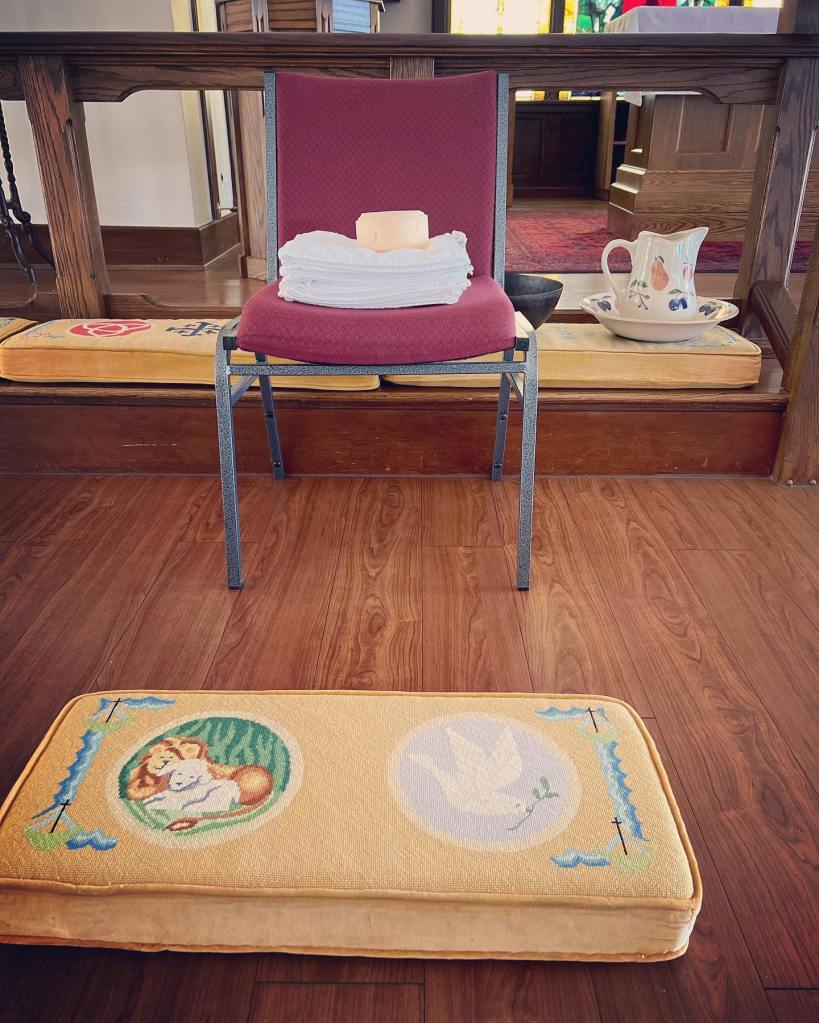
Do not forget what the Lord has done to you! Beloved, you are about to be invited into a foot washing. I want to be careful because this is not mandatory or obligatory, but rather an invitation. And it is not just an invitation to have your feet washed but an invitation to share in the servitude, sacrificial cleansing, and death of our Lord. It is an invitation to remember what the Lord has done for you! May we never forget.
 Porter C. Taylor