
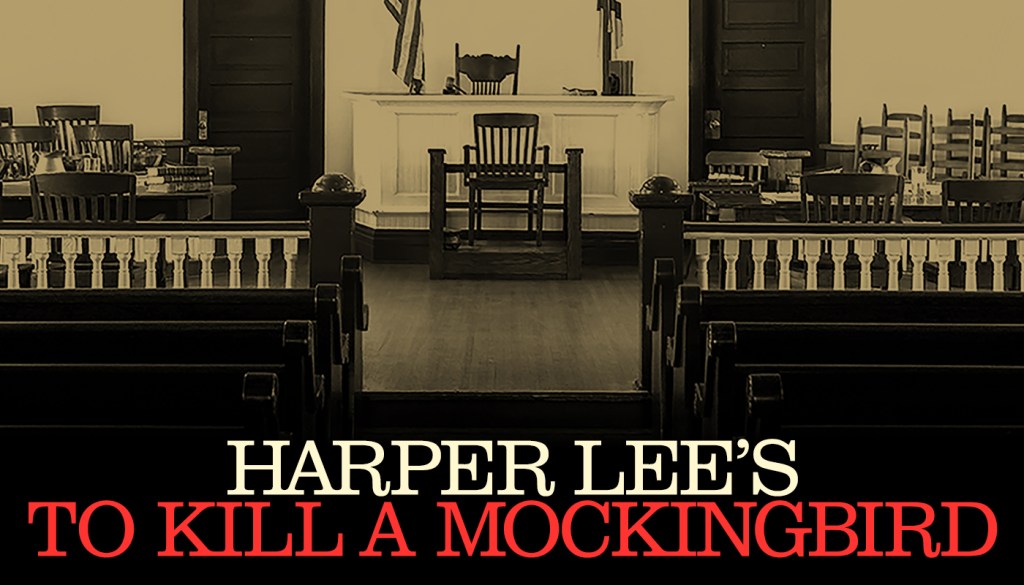
Image taken from The Hobby Center.
This sermon was originally delivered on April 2, 2023 to St. David’s by the Sea where I am the rector. The audio can be heard above.
All Rise.
And you assumed I was going to say, “Please be seated.” Today is no day for assumptions. You may, of course, be seated.
Rebecca and I took Jet to see Aaron Sorkin’s adaptation of Harper Lee’s classic, To Kill a Mockingbird last weekend. The play is a must see, a powerful portrait of our country’s painful past with and present reality of racism.
In the opening scenes, an adult Scout stood in the middle of the Maycomb County court room of her memory. As the judge, bailiff, lawyers, plaintiff, defendant, and spectators took their places, Scout began a rousing monologue about the phrase which begins every trial.
After the bailiff commands the courtroom to All Rise, Scout says:
Back then I imagined we were being summoned to do more than just stand.
I imagined when the bailiff called “All rise” that something large was required of us.
Something stunning, magnificent and rare.
The phrase All Rise is repeated throughout the play, including the final two words before the curtain drops, as Scout invites the audience to take action.
This morning is an All Rise moment.
This morning we are being invited, no commanded, to All Rise.
Not just to stand up but to take action;
Not just to stretch our legs but to be stretched beyond our comfort zones;
Not just to offer thoughts and prayers, but to be a crucified people.
This morning, it is highly likely that you expected to wave your palm fronds, sing some songs, and hear a sermon, but you probably weren’t expecting anything to be asked or required of you.
This is how Palm Sunday feels every year…
We always expect the Triumphal Entry and every year we are surprised when the crucifixion tags along. It’s like a punch to the gut, a theological 2×4 knocking the wind out of us. We came for the pomp and circumstance, forgetting that we were going to be left with the passion, with the pain of a bloodied and beaten savior atop a cross on calvary.
The pain climaxes when we discover just how complicit we are in the whole ordeal.
Our liturgy began in the garden as we remembered Jesus’ triumphal entry into Jerusalem, the holy city on the hill, the meeting place of heaven and earth, riding on in majesty and humility. We were all too happy, giddy even, to All Rise and proclaim with Israel:
Hosanna to the Son of David!
Blessed is the one who comes in the name of the Lord!
Hosanna in the highest heaven!
They waved – we wave – palms with vigorous joy;
They hoped – we hope – that the King has come to claim his throne;
They longed – we long – for God’s promises of old to be fulfilled;
They anticipated – we anticipate – the day when all sad things come untrue.
The holy city was already in a state of frenzy as people prepared for Passover, one of the holiest days of the year, but that frenzy turned into turmoil with the news that the prophet from Galilee, believed by many to be the coming Messiah, had entered the city.
Jesus entered through the east gate or the Golden Gate. The Golden Gate had been prophesied by Ezekiel who saw the glory of the Lord coming from the East and then being shut, writing “This gate shall remain shut; it shall not be opened, and no one shall enter by it; for the LORD, the God of Israel, has entered by it.” Matthew quotes the prophet Zechariah, saying “Your King is coming to you” and this is an everlasting king, a king who is bringing peace, a king come to redeem, restore, and save; “Hosanna” means “God save us!”
The glory of the Lord, the word made flesh, the God incarnate, the once and future king came to his holy habitation and entered with shouts and songs of joy. Hopes, expectations, and longings were being fulfilled because maybe, just maybe, Israel was finally being put to rights.
But while the crowd cheered – while we cheered – Jesus wept over Jerusalem because he knew what was coming.
Between the Triumphal Entry and Judas’ decision to sell Jesus out, Jesus had gotten himself in trouble with the religious elite. He threw his temple tantrum, cleansing the Temple and disrupting their commercial enterprise. He gave a series of woes to the Pharisees, calling them white-washed tombs, hypocrites, and blind guides.
Judas thus agrees to hand the Son of Man over in exchange for 30 pieces of silver. We find it easy to disparage Judas, because we would never sell Jesus out to the highest bidder. Surely we would never betray Jesus for silver or gold or popularity or guns or political correctness or keeping the peace or not being offensive…
…or would we?!
We aren’t given much time to linger on Judas’ decision, however. The story moves quickly to the Last Supper, to the meal that Jesus shared with his friends near the Passover. The imagery here is so significant: on the original Passover, God provided protection, covering, and atonement for his people through the shedding of a lamb’s blood. The Passover lamb meant life for Israel through death. Jesus tells his followers that the bread of the meal is his body, the wine his blood, he would be the sacrificial lamb, the paschal lamb, the lamb who was slain for the sins of the world.
The disciples could not comprehend the full meaning of Jesus’ words while at table with him. Jesus tells them that they will all desert him before it’s over, but bold and impetuous Peter promises that he will remain faithful…and we all know how long that lasted, how it ended in heartbreak and sorrow for Peter.
Jesus takes the disciples to dark Gethsemane so he can pray, but they can’t even keep watch with him for an hour! Jesus prays that the Father would let the cup pass him by, that the Father’s will would be done and not his own. Jesus, in every way human like us, knows what is to come and he asks if there is another way, but salvation for the world comes by one way only: the shedding of innocent blood. Jesus doesn’t try to negotiate with the Father, but instead, in the words of Paul, Jesus humbled himself and became obedient to the point of death–even death on a cross. He gives himself up, he offers up his life for the life of the world.
And this is where our involvement level subconsciously shifts:
We were there outside Jerusalem, raising palms in praise of our King;
We were there in the Upper Room, celebrating with messianic hope;
We were there in dark Gethsemane, watching as he was betrayed with a kiss and arrested
And we were there, observing as he went to one trial after another, first with the religious elite and then with Pilate
We were happy to be full and active participants in the Triumphal Entry and the Last Supper. But when the going got tough with Jesus’ betrayal, arrest, and interrogation we quickly traded in our active participation for a badge which reads “Innocent Bystander.” We became like Peter, saying “I do not know the man.”
This, my friends, is the terrible tension of the Sunday of the Passion: there are no innocent bystanders or mere spectators when it comes to the Passion of the Christ; you cannot be a casual observer or unbiased passerby…we are all complicit, all of us guilty.
Too often Christians cast “the Jews” as the bad guys in a move to let themselves off the hook, but the text does NOT say that. “The Jews” refers to the religious leaders of Israel and we are invited to read ourselves into that part. It would be so much easier to blame those people for killing the Son of God. To say that the Jewish people killed Jesus is a form of anti-semitism.
The Jewish people didn’t kill Jesus…humanity did…we did.
You played that role in the passion narrative. You cried out, “Let him be crucified” with the crowd because You. Are. The. Crowd. We crucify our Lord regularly by our behavior, by our betrayal, by our sins, by our idolatry, by our apathy, by our perpetual infidelity.
We are complicit.
We are the responsible ones.
We are the crucifiers.
And the narrative offers us no respite from the pain of our sin…yet. We see the innocent and sinless Son of the Father being executed in exchange for Barabbas, an insurrectionist whose name means “son of the Father.” We were told to All Rise as the crucifixion procession reached its destination: Golgotha, the place of the skull, the place where Messiah would die. We all rose to bear witness to what humanity’s manifold sins and wickedness look like when extinguished and exhausted upon a human body. We are helpless as we see the crown of thorns dig into his flesh, the scourging, the beating, the spitting, and the mocking; we are forced to watch the nails being driven into his hands and feet; we can do nothing as the spear pierces his side, as he cries out to his father, as he breathes his last. [PAUSE]
The holy and innocent one was killed on the cross. He who was without sin became sin, executed as an enemy of the state. The King of the Jews, the King of Israel, the King of the Cosmos is killed by his own creatures, by us. What started as a beautiful garden liturgy has ended in horror, tragedy, and death. But there is a balm in Gilead. Matthew gives little hints of the resurrection, most specifically when the religious leaders go to Pilate and remind him of what Jesus had said, how he had promised to be raised from the dead. We are given a glimpse of resurrection, but our story ends with pain and sorrow.
We are left with the death of an innocent.
With the killing of a mockingbird.
We are stung by the realization that we have done this terrible thing.
We have made this happen.
And so with Peter we weep bitter tears.
The Sunday of the Passion isn’t about palms or donkeys or songs, beloved, it is about the cross. And in the shadow of the cross we come to the sickening understanding that we can sing, “All glory, laud, and honor” and then cry out, “Let him be crucified,” days later.
Of crucifixion, we are both capable and culpable.
Today is an All Rise moment.
For us, just as with Scout, All Rise will mean that we are being summoned to do more than just stand, that something large will be required of us, that we are called to something stunning, magnificent, and rare.
It would be pastorally negligent of me to continue preaching about the death of an innocent victim without mentioning the deaths of innocent victims in Nashville, Tennessee this week. And not just Nashville. Uvalde. Parkland. Sandy Hook. Sisters and brothers in Christ: we live in a nation that has a significant gun problem. No amount of calling it a “people problem” will change the facts:
In the first 3 months of 2023, there have already been 16 school shootings. That’s 1 a week. There were 51 last year.
426 children have been killed by guns in 2023.
Gun violence is now the leading cause of death among children and teens. More than car accidents, cancer, suffocation, or poisoning.
There have been 134 mass shootings in this country this year.
10,558 people have died from gun violence in 2023.
And a “Christian politician” has claimed that if Jesus owned assault rifles his government wouldn’t have killed him.
And all we have done is offer “thoughts and prayers” while arguing over constitutional amendments, individual rights, and governmental overreach. Shame on us. Shame on us as the church. We sound like the Pharisees, rebuked by Jesus, who were more committed to tithing on mint, dill, and cumin than they were on pursuing justice and mercy. This country has turned guns into idols and we are suffering for it, sacrificing innocent lives in the process. Nothing is getting our attention, nothing is changing, it has become the “copy and paste” tragedy which keeps striking and there is no end in sight.
We have grown numb and indifferent to the shedding of innocent blood; we don’t care about death. Sure, we care about it because it’s on our news feed, but we don’t care enough to do anything. It’s not just gun violence. It’s the growing disparity between rich and poor. It’s the ongoing racism in our country; it’s agism and sexism and every other -ism we have envisioned to separate Us from Them. It’s the fact that people around the world, around the country, around the state, are living in poverty, squalor, fear, insecurity, and destitution. Dying without dignity, gunned down in broad daylight.
And we the church, the very body of Jesus, have been going along to get along for fear of All rising and taking a stand and offending someone. No more! The scandal of the cross, the good news of grace, is that Jesus died for the sins of the whole world; he bore the weight of our sins that we might become the glory of God.
As Christians, as followers of the Crucified One, therefore, we should be the first ones All Rise, to care, to shake our fists and say, “this isn’t right” and then to do something about it!
As theologian Herbert McCabe said, “The commandment “You shall not kill”…says not merely that you must not actually murder, but that you must CARE that people get killed.
You must not be indifferent to blood. You must not carry on the traditional respectable life, absorbed in the worship of your gods, while throughout the world people are being killed by the horrible pain of hunger and the diseases that go with it or as the “collateral damage” of war and violence.” Or by guns.
As a cross-shaped people who follow the Crucified One, we need to defend the defenseless, stand in solidarity with the crucified and suffering ones. We need to rise and stand with those who are being killed and hurt and shot at and maimed and downtrodden by society. We need to beat our swords (or guns) into plowshares. We need to repent and lament, we need to seek justice, we need to love mercy, and we need to walk humbly with our God.
This is the way of Jesus.
This is the way of the cross.
This is the way of the Church.
So, my friends, I invite you now to All Rise.
All rise and take a stand against the atrocities of this world, against the false gods we have set up and to whom we sacrifice regularly;
All rise and confess our complicity and culpability;
All rise and lament over the killing of innocent lives;
All rise and cry out to God and beg his mercy for our idolatry of death and violence;
All rise and become people who take action, who take a stand, who do something more than offer thoughts and prayers.
In short, All Rise to be the Church, dear ones.
All Rise that we may we be the crucified hands and feet of the crucified savior.
For surely he is the son of God.
All. Rise.
 Porter C. Taylor