
This sermon was originally preached at Church of the Good Shepherd in Augusta, GA where I serve as rector.
There are roughly 171,476 words in the Oxford English Dictionary. Most linguists agree that the English language contains between 500,000 and 1,000,000 words. And I think we used every single word this morning!1
In the background I can hear Eliza Doolittle from My Fair Lady complaining, “Words, words, words! I’m so sick of words!”
And despite all of these words, our ability to describe emotions is linguistically limited.
John Koenig argues, “there’s a huge blind spot in the language of emotion…We have thousands of words for different types of finches and schooners and historical undergarments, but only a rudimentary vocabulary to capture the delectable subtleties of the human experience.”2
In his Dictionary of Obscure Sorrows, Koenig creates new words to describe the indescribable. Some words were “rescued from the trash heap and redefined, others were invented from whole cloth, but most were stitched together from fragments of a hundred different languages.”3
Here are a few of Koenigs’ words that paint a poignant picture:
- Nighthawk – a recurring thought that only seems to strike you late at night – an overdue task, a nagging guilt, a looming future – which you sometimes manage to forget for weeks, only to feel it land on your shoulder once again, quietly building a nest.
- Justing – the habit of telling yourself that just one tweak could solve all your problems – the right haircut, the right job, the right school, the right salary, the right fill in the blank. It leaves you feeling perpetually on the cusp of a better life.
- Hanker sore – finding a person so attractive it makes you mad.
I want to focus on Koenig’s word “sonder” this morning. Sonder as a noun is awareness that everyone has a story; the realisation that each random passerby is living a life as vivid and complex as your own. To sonder is to have the sense that we are surrounded by people who aren’t tumbleweeds or extras in our narrative but the main character of their own story.
Our two gospel readings today give us a wonderful chance to practice our ability to sonder. We are presented with characters to whom we rarely pay enough attention. I want us to look through the lens of these “minor characters” as we wander toward the cross. As we turn the Passion story over in our hands to view it from different vantage points and perspectives, a multilayered picture of Jesus will emerge.
Our motto for this exercise is simple: I sonder as I wander.
Jesus and his entourage leave Jericho and begin making their final approach to Jerusalem. The march from up Jericho to the Mount of Olives is gruesome – a massive incline going up to the summit. The reward from the top is a view of the holy city on a hill, Jerusalem.
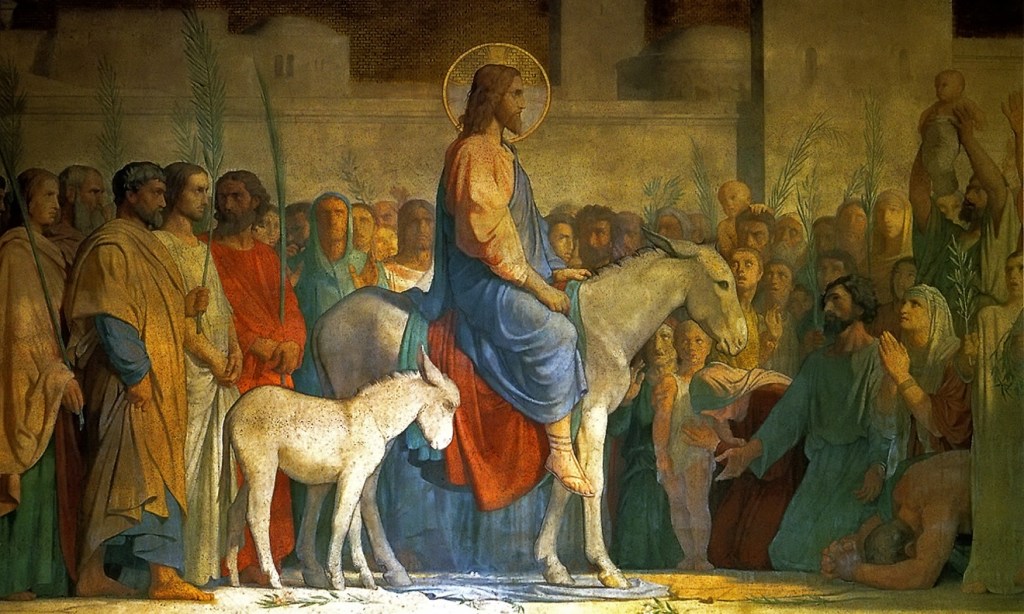
Pausing atop the mount, Jesus sends two disciples into the village. Their mission: impossible is to find a colt which has never been ridden and will be given to them freely. Notice the disciples are sent out twosie-by-twosie just as they were earlier in the gospel to teach and heal. You cannot be a Christian alone!
The pair find the colt just as Jesus said they would. The owners come out and want more information about why these strange men are “borrowing” their animal. They are assured by the answer, “the Lord needs it.”
Jesus’ reputation certainly preceded him throughout Galilee and Judea. These owners must surely have known about Jesus or else why would they give him their unridden donkey? If they were unfriendly or indifferent toward this emerging kingdom mission, then their answer would have been a resounding “no.”
I sonder as I wander.
“On the outskirts of Jerusalem the donkey waited.”
So begins the poem entitled “The Poet Thinks About the Donkey,” written by Mary Oliver. She sonders about the donkey which Jesus rode majestically and triumphantly into Jerusalem. Oliver closes with the line: “I hope, finally, he loved the man who rode so lightly upon him, as he lifted one dusty hoof and stepped, as he had to, forward.”
This colt carries the King of kings;
His load is the Lord of lords;
His burden is the Blessed One.
In carrying Jesus, we see the whole of creation participating in the Paschal Mystery.
Isaiah tells us that:
The wolf will lay down with the lamb;
The leopard will lay down with a goat;
The lion and calf will eat together;
Zechariah promises the King will come on a colt.
And so he did.
Before our palms and hosannas, let’s pause. For the owners, this would always be the day their Lord borrowed their animal.
Perhaps the colt’s riding days were over because every other load was meaningless after carrying the Crucified and Resurrected One. Perhaps the owners became people of the cross and resurrection.
I sonder as I wander.
The Blessed One thus rides into town astride his rent-a-colt. The people gathered understand what is happening: the coming King begins his slow entry into Jerusalem amidst a gathering crowd of the joyful, the faithful, the hopeful. Cloaks are spread, leafy branches are cut, and shouts of “Hosanna” resound. Hosanna literally means “God save us!” and this verse comes from Psalm 118 depicting the coming of Israel’s Messiah.
Their king has come home at last; hail the conquering hero! The holy and anointed one has come to the holy and anointed city.
This is the opposite of Caesar who acts as our south star or malotype. Jesus rides in lowly pomp and humble majesty upon the back of measly donkey. Caesar entered conquered cities as part of a warrior’s procession with chariot and war horse. Jesus is doing something different – he is a different kind of leader than the Caesars, Herods, and Pilates of this world.
The disciples finally get it! They begin to proclaim Jesus’ mighty deeds of power with overt messianic language. But the Pharisees are angered by their display. You can almost hear them say, “That’s not how we do it here.” They’re angry because Jesus threatens the law and life they hold dear.
Jesus disobeyed by healing on the sabbath and raising the dead to life;
His disciples announced him as the messiah;
Eventually he will come back from the dead himself;
What will they make of that?
I sonder as I wander.
In reply, Jesus says, “I tell you, if these were silent, the stones would shout out.”
Like the colt, even the stones would join their voices in praise for what God has done, is doing, and will do in Jesus. All of creation participates in salvation history as the sinful disorder of creation is reordered by the Creator.
It would be such an easier story if we could just stop here as Jesus enters Jerusalem.
The crowds are cheering, the shouts of messianic joy and expectation go up. The energy is electric, like welcoming a soon-to-be champion on the 18th green. We all want palms instead of passion, cheers instead of jeers, convenience instead of crucifixion.
We want that. We long for that.
But we don’t get the sweet ending with a bow tied nice and neat today. We aren’t given the fairy tale version with “happily ever after” at the end.4 Instead, Palm Sunday presents us with the horrifying picture of humanity’s evil poured out upon a single individual. We are shown the sinless and spotless one who is led like a lamb to the slaughter.
After our procession inside, we moved straight from the triumphal entry to the Last Supper. We are now on the cusp of Passover.
The disciples and the crowds think that it is a passover like every other year, a Passover commemorating the first Passover. Jesus alone knows what is in front of him; he knows that this is a once-and-for-all kind of Passover.
“This was to be the moment of God’s new Exodus, God’s great Passover, and nothing could stop Jesus going ahead to celebrate it.”5
In Luke’s version of the Last Supper, Jesus presents a clear picture of what this meal means. There is no way to misunderstand this message, try though we might.
Jesus is betrayed by his friend, abandoned by his followers, deserted by his disciples, forsaken by his father, abused by his enemies, and executed by the state.
Sacrifice and Servanthood.
Sabotage and Sorrow.
Son of Man and Son of God.
What started off with shouts of “Hosanna!” has ended in deafening silence after the cries of “Crucify him.”
Jesus knows all of this and…
He still breaks bread with his friends.
He still promises them a kingdom inheritance.
He still serves his soon-to-scatter sheep.
He still loves and leads them like a shepherd.
Peter denies Jesus three times. What gave him away? How did a servant woman and two men know he was with Jesus? Maybe it was his accent or his clothing, perhaps it was his demeanor or the fact that he was trying to keep his distance. It could even be that they had seen him with Jesus before.
But those individuals all knew it to be true and yet Peter denied them, denied Jesus, three times. And what did they think when one of Jesus’ closest followers refused to acknowledge him? Were they convinced of Jesus’ alleged wrongdoing or did they come to faith after the stone was rolled away?
I sonder as I wander.
The rooster crows and Jesus looks directly at Peter. That piercing gaze. Not of anger but of knowing; not of judgment but of recognition. How bitter those tears must have tasted for poor, poor Peter.
How far he had fallen;
How hard he had failed;
How distraught must have been.
I sonder as I wander.
Simon of Cyrene makes an appearance. An innocent bystander forced to be Jesus’ caddie by carrying the cross because our Lord was too weak. Perhaps on a visit to the holy city with his family, Simon’s life is changed forever as he walks the second 9 with the paschal lamb knowing what will happen to “the master” when they get “there.” I sonder as I wander.
The thieves appear on either side of Jesus. One with taunts and jeers; the other with faith and hope. We know one received the promise of Paradise. But what about the first? Did he repent and recognize Jesus as Lord or did he remain rigid in his self-righteous anger? We are invited to be like the thief who asks for mercy rather than the thief who taunts and blames Jesus.
I sonder as I wander.
After his death, one of Jesus’ disciples collected and buried the body. Joseph of Arimathea was part of the religious leaders but he did not agree with them. But he was watching and waiting for the Kingdom of God with anticipation and expectation. Joseph cuts against the grain of the religious leadership by embracing Jesus. It was Friday, but did he know Sunday was coming?
I sonder as I wander.
“The women who came with him from Galilee” went and saw where the body was buried. These women will be the first ones to find the tomb empty, the first ones who herald the resurrection, the first ones to proclaim, “He is risen!”
I sonder as I wander.
All of these stories, all of our stories, are transformed through the glory of Jesus.
Palm Sunday is an invitation to examine our hearts. A chance to see that the same mouths which shout “Hosanna” also cry out, “Crucify him.” An opportunity to understand that we are both part of the crowd celebrating the Triumphal Entry and the murderous mob demanding the death of the son of God.
On Palm Sunday, we are invited to:
Let our Lord borrow our talents and gifts for his purposes;
Walk with Jesus unto calvary;
Acknowledge that we are followers of Jesus;
Take up our cross, deny ourselves, and follow him;
Plead for his kingdom instead of taunting him;
Embrace Jesus even when the world tells us not to;
Come to the tomb on Friday knowing it will be empty on Sunday.
The One who rides into the city with cries of Hosanna and palms;
Is the same One who is enthroned upon the cross on Friday;
And is the same One who burst forth from the grave on Sunday.
What parts of your life need raising?
What gates and doors in your hearts, minds, emotions, imaginations, or dreams need to be flung open to allow the King of kings and the Lord of lords to enter?
With whom do you need to share the Good News of God in Christ?
Where do we need Jesus’ Triumphal Entry in our church and in our city?
While our words fail to fully capture the glory and majesty of the passion or the heights and depths of God’s love for us, we have been given the Word made flesh who rides in lowly pomp upon a humble beast to die for us all.
I sonder as I wander to the cross at calvary;
I watch the faces in the crowd discover his blood for thee;
Every life finds its meaning in the weight of his glor’y;
I sonder as I wander to the cross at calvary.
NOTES
This is the first installment of The Obscure Sorrows Quartet. Last year’s Holy Week sermons were called The Power Quadrilogy.
- Palm Sunday is the wordiest liturgy in the prayer book with the Liturgy of the Palms and the Passion narrative.
- The Dictionary of Obscure Sorrows, xi.
- The Dictionary of Obscure Sorrows, xiii.
- It would be really easy here to focus on the well-known details of the crucifixion, but we have to wait. Sweating blood, the disciples falling asleep, even the words upon the cross, they all must wait until Thursday and Friday. Palm Sunday is about the 40,000 foot view rather than the microscope.
- Tom Wright, Luke for Everyone (London: Society for Promoting Christian Knowledge, 2004), 229.
 Porter C. Taylor