
This sermon was originally preached at St. David’s By-the-Sea in Cocoa Beach, Florida on Sunday, September 15 2024 for the Seventeenth Sunday after Pentecost (Proper 19B). The lessons assigned were: Proverbs 1:20-33; Psalm 19; James 3:1-12; Mark 8:27-38.
In July of 2015, Nigel Richards performed a feat so astounding it sent the internet into a frenzy. At the time, Richards was the 5-time winner of the US Scrabble championship and 3-time winner of the World Scrabble Championship. So what could he possible accomplish that would grab the attention of outlets such as NPR, CNN, and even ESPN? He won the French-language Scrabble championship.
Richards’ French triumph is so mesmerizing because he doesn’t speak French!
Oui, you heard me correctly. Richards cannot string even a basic sentence together in French, nor can he give you the definitions of the words. In fact, he used a translator to thank the French crowd for their support. According to a friend, “He can say ‘Bonjour’ and count from one to ten, so he can give the score to his opponents.”1
French Scrabble has a whopping total of 386,000 playable words, more than double that of English Scrabble. Richards memorized the French Scrabble dictionary. Every. Single. Word. And he did so And he did so in just 9 weeks.
To put it in perspective, if you combine the word counts for my 300-page dissertation and my 650-page co-edited volume, you would still be 21,000 words short of the French-language Scrabble dictionary.
Richards’ has a math core brain and an incredibly powerful memory. He combines his memorization skills with his knowledge of math and ScrabbleScrabble rules. He uses words to score as many points as possible. Most competitive Scrabble players adhere to the “20-20-20-Bingo” strategy where you aim for 20 points a turn until you get a Bingo (worth 50 points) by using all of your tiles in the same move.
Stefan Fatsis, renown Scrabble expert and author of the NYT Bestseller, Word Freak, described Richards’ French victory this way: “Tiger Woods at his peak – and then Tiger saying, ‘I think I’ll also take up tennis,’ and then win Wimbledon the next year.'”2
Richards’ trophy case includes:
2 French championships
10 UK Opens
12 Singapore Opens
15 King’s Cups
5 US championships
And although only one other person has has won the world championship twice, he has won it 5 times!
Simply put, Richards is the most decorated Scrabble player on earth. He has been hailed as the Scrabble Machine, the Scrabble Grandmaster, the Word Wizard, and the Lebron of Scrabble. According to Scrabble aficionados around the globe, Richards is the GOAT, the greatest Scrabble player of all time and it’s not even close.
This idea of greatness and identity, of achievement and grandeur, is intertwined throughout our Gospel lesson. Mark has brought us to the beginning of his narratival hinge this morning, that is, the place, point, and person upon which his entire biography of Jesus turns. Our lesson represents the first half of this hinging-movement. The second half is the Transfiguration in chapter 9, but for some absurd and asinine reason the Lectionary compilers have skipped this story altogether.
I don’t make the news, I just report it.
Our particular passage can be split into two acts. In Act 1 we find Jesus and the disciples in Caesarea Philippi answering the pop quiz of “who do you say that I am?” In Act 2, we find Peter, the one who just aced the pop quiz, receiving a failing grade on the theoretical exam.3
Mark’s description of our first scene in Caesarea Philippi is sparse on details.4 Mark is rushing us forward with his rapid pace, so we can get to the “main event” which is the Transfiguration, a precursor to the crucifixion, two 20-point words. Both 20-point words.
Jesus has taken the disciples on a field trip to Caesarea Philippi. We need to understand the religious and political significance of the geography to fully appreciate Peter’s prophetic pronouncement.
Caesarea Philippi was situated approximately 25 miles north of the Sea of Galilee. In 20 BC, Caesar Augustus gave the territory, then known as Paneas in honor of the Greek god Pan, to Herod the Great. Herod built a city there and then built a white marble temple in honor of Augustus. Herod died 16 years later and one of his four sons, Philip the Tetrarch, took over the territory. Philip was an ego-less man of deep humility, and so he did what every humble leader does: he renamed the city after himself! Caesarea Philippi was his capital until he died in 33AD.
Caesarea Philippi was absolutely teeming with temples and monuments to gods and deities. It had: The Temple of Augustus; The Grotto (or Cave) of Pan; The Court of Pan and the Nymphs; The Temple of Zeus; The Court of Nemesis; The Tomb Temple of the Sacred Goats; and The Temple of Pan and the Dancing Goats.
And this is where Jesus took his friends on a field trip!
Talk about a sacrilegious vacation!
Caesarea Phillipi was the original Sin City – what happens in Caesarea Phillipi stays in Caesarea Phillipi
It was the original Las Vegas, Sin City, what happens in CaesareA Phillipi stays in Caesarea Phillipi.
The disciples weren’t pagans, nor were they Greco-Roman gnostics, nor did they belong to the cult of Pan. They believed in YHWH, the God of Israel, the King of the UniverseKing of the Universe. To be in that idolatrous place must have been an uncomfortable experience for good Jewish boys on some level. The disciples definitely were not in Kansas anymore. With the exception, perhaps, of Rome, they had ventured as far behind enemy lines as possible.
It is here, in this place of pagan worship and nationalistic devotion that Jesus asks the question: who do people say that I am? Jesus’ question was already charged to begin with, but when you consider the location in which it was asked, it becomes dangerously loaded.
The disciples have seen Jesus cast out demons and teach with authority. They have watched him punch holes in the darkness. They have witnessed him healing the sick, giving sight to the blind, speech to the deaf, and life to the dead.
People have been talking.
The disciples are well aware of the rumors swirling across Galilee, Judea, Jerusalem, and Samaria during their travels with Jesus. They accurately report what they have heard: Elijah, John the Baptizer, or one of the other prophets.
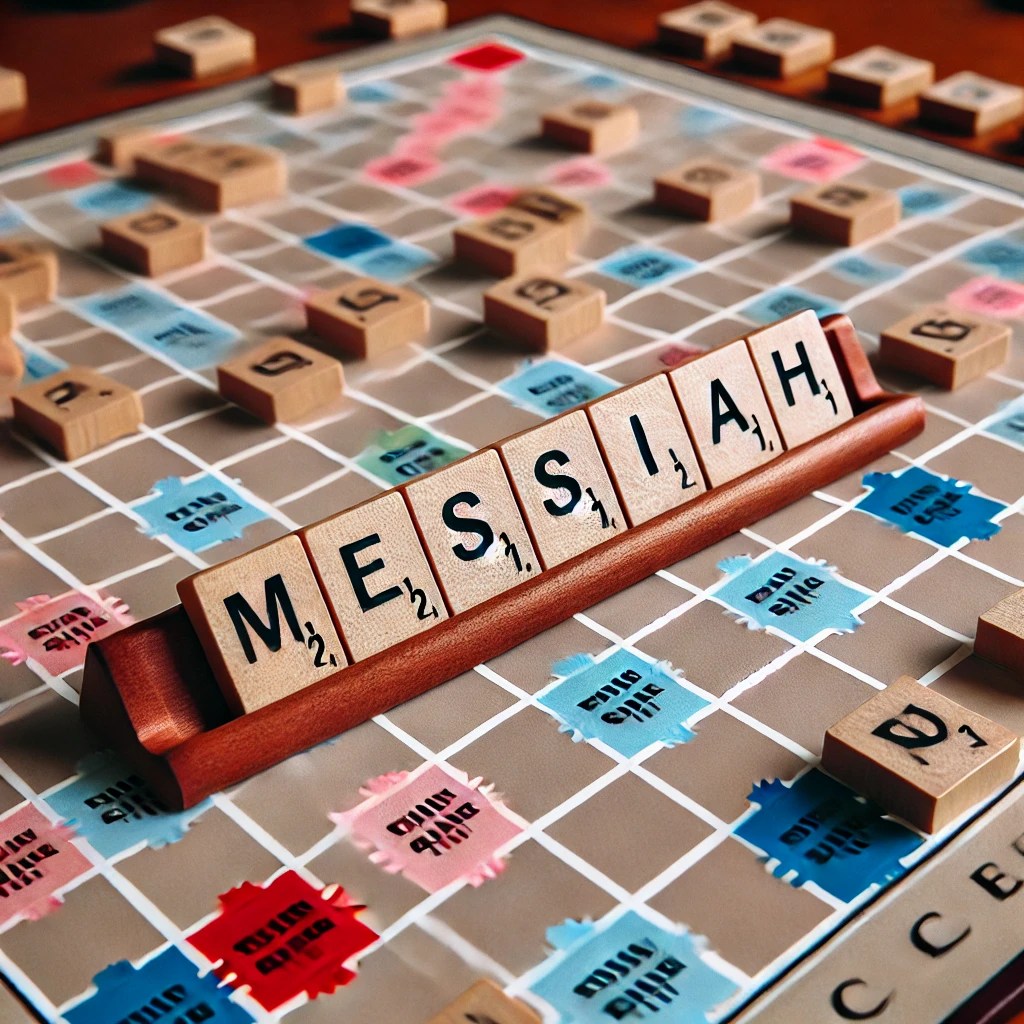
Imagine a Scrabble board with me. Instead of English-language or French-language, this is Theology Scrabble. The disciples lay down their first three words: “Elijah,” “Baptizer,” and “prophet.” In Theology Scrabble, all three are 20-point wordswere words.
“Elijah was a mighty prophet who never died and Israel was awaiting his return as a sign that the kingdom of heaven was near; many believed John the Baptizer was the returned Elijah.”5 Israel was awaiting the prophet, the one who was promised by God to be greater than Moses, the one to whom all of Israel had to listen when he came.
The “people” were seeing Jesus through a prophetic lens. These are three significant and not-all-together-wrong suggestions. But all of them are incomplete. So, Jesus turns his question onto the disciples. He says, who do you say that I am?
Things. Just. Got. Interesting.
The pop quiz has been administered. Who is going to be bold enough to answer the Teacher’s question? Who is going to risk their reputation and standing, and in Caesarea Philippi, no less?!
We didn’t need to hear this story to know that it would be Peter. It was always going to be Peter. Bold and brave Peter gets this one right. You are the Messiah, he says.
Peter hits the jackpot with Moschiach in Hebrew or Christos in Greek. He has just played all seven of his Theology Scrabble tiles at once and he gets the Bingo bonus and the triple word bonus, and triple letter bonus. Even before seeing Jesus transfigured in radiant dazzling light, even before beholding the crucified-and-resurrected Christ, Peter understands that Jesus is the messiah, the holy and anointed one of Israel.
This Jewish term indicated and identified:
The one for whom Israel had been waiting;
The one who would keep the covenant and restore Israel;
The one through whom the broken things would be made new;
The one through whom the sad things made untrue.
Again, the context is everything! The cave or grotto of Pan, which Jesus and his disciples are near, had another name in the Greco-Roman world: the gates of hell. In the cave, there was a chasm filled with water so deep that no one knew how far down it truly went. Given the absurd and awesome magnitude of this cave, the locals began referring to it as the gates of hell for surely it was the passageway to the underworld.
The gates of hell have not, will not, cannot prevail against Christ and his church. The church as the never changing gospel despite the fickle and feckless wayward wanderings of an ever changing world.
Rome cannot overpower the church.
Caesar, Pan, Zeus, Hades, and Poseiden cannot overpower the church.
Satan himself cannot overpower the church.
The church is solid and stable because it is built upon the One who will reign victorious over sin, suffering, and death.
Peter sees Jesus with a spiritual vision which has escaped everyone else up to this point…
But it’s all about to come crashing down for dear old Peter as Jesus begins to unpack for his disciples the uncomfortable reality about what must happen to the Messiah: suffering, rejection, and execution. Peter cannot handle this type of speech so he pulls Jesus aside and rebukes him.
The Jews believed that God’s Messiah, his holy, anointed, and chosen one would come to usher in the Jubilee of Jubilees. There was a strong belief that this individual would restore Israel by vanquishing foreign oppressors and reclaiming the throne.
What Israel and Peter have missed however, are Isaiah’s comments about the Suffering Servant in chapters 52-53. The year of the LORD’s favor isn’t about military conquest or political prowess…it was healing, exorcisms, resurrections, sight for the blind, freedom for the captives, release for the prisoners…all of the things that Jesus has been doing since he burst onto the scene in Galilee. Without the connection between the Suffering Servant and the Messiah, they had no framework for understanding Jesus’ comments.
While Peter won that round of Theology Scrabble with the word Messiah…he didn’t know its full meaning! Nigel Richards was touted as being “more French than the French” in 2015, but he only memorized the words and not their meaning. Peter has just done the same thing.
Jesus rebukes Peter’s rebuke, telling him that his mind is on earthly, temporal, human things rather than on divine things. Unlike Peter, Jesus has set his heart set on the will of the Father and his gaze fixed on the cross that is looming so ominously in his future.
Our hinge is hinging, if you will, and we move from messiah to crucifixion. Jesus reengages the crowd, along with his disciples, and offers them a three-part progression describing, as Rebecca Taylor puts it, the best way to be human.
Jesus says: If any wish to come after me, let them deny themselves and take up their cross and follow me.
To come after Jesus is the goal of the Christian life. We’re here this morning because we’re all striving after Jesus. But how do we do it?
We deny ourselves. This is another 20-point word. The word used here to deny oneself is the same verb Jesus uses when he tells Peter that he will deny him three times. It is to reject, disown, repudiate, renounce. The first step in following Jesus is giving up your pride, your preferences, your sins, your bad habits, your control. You are emptying yourself – the 20-point word for this is kenosis – and instead you are putting on the mind of Christ.
Take up their cross. Criminals were forced to carry the crossbeam of their execution tool and this is the 20-point word which Jesus uses, stauros. To take up your cross is to put on self-denial and walk in the way of God’s love. It is surrender and while some may walk to martyrdom, all of us are walking past death into the kingdom life which Jesus has prepared for us, world without end. Jesus says his yoke is easy and burden light, so this cross has to be promises rather than punishment.
Follow me. This is not a sauntering stroll, a mindless meander, or a tiptoeing trollop through the tulips. Jesus uses the verb which means to follow or to become one’s disciples. It is active and dynamic, intentional and deliberate. It is not following for a minute or a few yards but a long obedience in the same direction, one foot in front of the other, following the leader wherever he may go.
We see this expounded upon and fleshed out in the baptismal covenant:
We deny ourselves by renouncing Satan, the flesh, the world.
We take up our cross by taking on the promises of God.
We follow Jesus by entering the covenant community.
Hopefully you spotted the problem with Scrabble by now:
Scrabble is all about points and words without meaning. We have become quite adept at playing theology Scrabble without amending our lives. We know the rules of morality and we hold others to a high standard while excusing our own sins; we know the important theological words without knowing their meaning; we know about Jesus rather than knowing him fully; we think that if we play our tiles right and get all of the bonuses then will be in-like-Flynn. That is, I’ve I say my prayers, read my Bible, pray the Daily Office, pay my tithe, show up to Church, and join a ministry then I am going to heaven.
All of the 20-point words, Bingo plays, and triple point words can’t save your soul. The highest scoring word in Scrabble is Oxyphenbutazone and if you play in the right place you would earn 1778 points. Even that can’t save your soul.
But there is good news: we have been given a word that will save us and it is the word made flesh, the divine logos, God incarnate. The good news of our promise making and promise keeping God is that we cannot save ourselves, that Jesus died for our sins while we were enemies of God, and that he invites us to follow him into everlasting life.
Jesus didn’t call us to play Scrabble but to costly discipleship. It is costly because it requires your life. Jesus didn’t call us to count points, memorize words without meaning, or to worship the rules and rubrics. Instead, he called us to amend our lives, transform our minds, and render our hearts to him. He invited us to come after him as he journeys to the cross, the tomb, and the right hand of the Father. The Word has spoken authoritatively and definitively over you: you are loved, redeemed, forgiven, and reconciled to God. Thanks be to God for his life-saving word!
NOTES
- https://www.cnn.com/2015/07/22/world/french-scrabble-champion-nigel-richards/index.html
- NPR French Scrabble
- If the lectionary compilers had been better at their job (gasp), Act 3 would have been the first practical exam in the form of the Transfiguration. The real practical exam for Peter was another failing grade when he denied Jesus three times.
- While his gospel writing buddy, Matthew, spends more time giving details about Peter and his prodigious pronouncement, Mark only has eyes for Jesus.
- The Rev. Dr. Porter C. Taylor, “Barbenheimer,” August 6, 2023.
 Porter C. Taylor