
This sermon was originally delivered at St. David’s By-the-Sea in Cocoa Beach Florida on September 8, 2024. The lessons were from Proper 18B (Proverbs 22:1-2, 8-9, 22-23; Psalm 125; James 2:1-17; Mark 7:24-37)
In 1994, legendary country singer, Alan Jackson, famously announced: the whole world’s gone country. Country music seems to fall in and out of vogue, ebbing and flowing like the twang of a steel guitar, and right now country is very much in. In fact, earlier this year, pop star Lana Del Ray exclaimed that “the music business has gone country.”
Last month, country music watched its newest star perform at its most iconic venue. Austin Richard Post, a.k.a. Post Malone, performed at the Grand Ole Opry. With tattoos on his face, “platinum on his teeth, and wagyu on his grill,” he describes his look as “a Kmart George Strait.” His teeth aren’t the only thing platinum: he currently has 45 certified platinum songs and 9 songs certified diamond, the most ever.
Back in 2015, Post made two predictions. First, on the social media app formerly known as twitter he wrote: When I turn 30 I’m becoming a country/folk singer. Second, Post and his producer Charlie Handsome, predicted his “reverse Taylor Swift crossover” when Handsome said his 6th album could be country.
His latest album, F-1 Trillion, was both his sixth studio album and his first country album. Like Babe Ruth, the 29-year old called his shot. He even “arrived” a year ahead of schedule.
Say what you will about the album, Malone’s country sound has staying power. In fact, the lead single for the album, “I Had Some Help” featuring Morgan Wallen, was just named Billboard’s song of the summer.
Like much of country music, Posty has a deep salvific undertone coursing through his lyrics.
In a song featuring Jelly Roll (of previous sermon fame for his song “Somebody Save Me”) Malone sings about “the outcasts and the sinners, the ain’t never been no winners,” for “the lonely” and those “ain’t never felt at home.” The song is called “Losers” and he’s not talking about the record-breaking 2024 Chicago White Sox, he’s talking about Everyman. In a later tune he belts outs, “Thank God there’s still salvation / For a guy like me who still needs savin.’”
What an apt description of the Christian life: sinners in need of saving, losers in need of winning, outcasts in need of salvation!
So this sermon is for the losers, the outcasts and the sinners, the ain’t never been no winners.
This sermon is for the second chancers, ragamuffins, and hot messes.
This sermon for folks like you and me who need salvation, who cry out, “Somebody save me.”
We enter the fray of Mark’s Gospel once more, this time beginning with Mark 7:24, immediately after last Sunday’s lesson. Last week Jesus took Israel’s religious leaders to task for their hypocritical cleanliness codes and ritual regulations.
In today’s passage, Jesus leaves the Pharisees and scribes from Jerusalem who attempted to ambush him and he ends up in the region of Tyre. Here’s what you need to know about Tyre: Tyreans were not Jewish, they were Gentiles. Josephus describes the Tyreans as some of the Jews “bitterest enemies.” Worse than that, the notoriously godless Queen Jezebel, the woman who introduced Israel to Baal worship, was from Tyre where her father was the priest-king.
Jesus is once again behind enemy lines.
Jesus doesn’t want anyone to know where he is because as he gets more publicity, the dark powers of Satan, the religious leaders, and Rome grow more inclined to permanently silence him.
Jesus enters a Gentile house which would have made him unclean. A woman approaches him; she is a Gentile and therefore unclean. Lastly, her daughter has an unclean spirit. To use a theological term: that’s a triple whammy.
She is the biblical definition of outcasts, losers, never been no winners. She begs for salvation. She cries out for somebody to save her girl.
If we remember last week when we heard about the codes, rules, commandments, and ordinances pertaining to ritual purity, we understand that Jesus has just broken a significant number of those rules by merely being in the house around these unclean foreigners. For the Pharisees (and the disciples) there is absolutely no reason that Jesus should be talking to this Syrophoenecian woman.
Hasn’t Jesus ever read the Old Testament or the law?
Spoiler alert: that’s part of the beauty of this story!
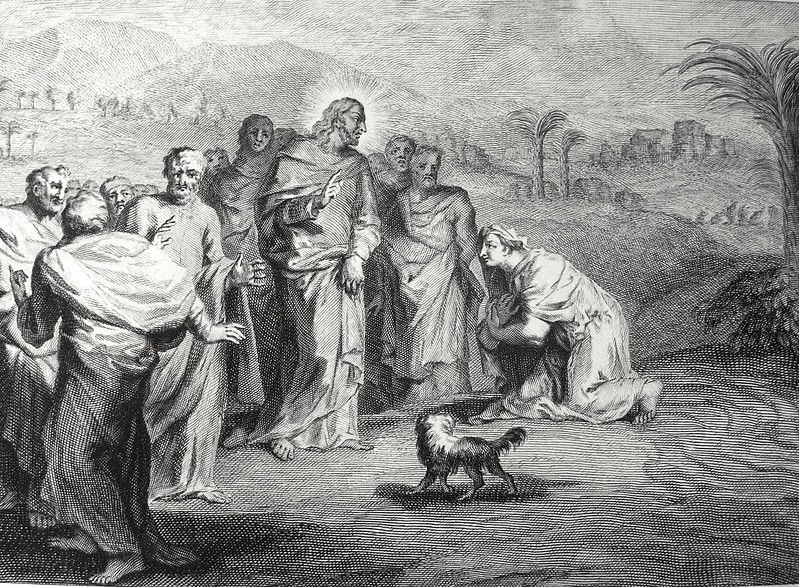
The Syrophoenecian woman comes and bows down at his feet. Mark doesn’t give us her name but that’s not to make her less important to the story, it is done in order to highlight how much of an outsider she is to the family of God. She prostrates herself before Jesus and while we could interpret this as an act of desperation, it is actually an act of worship. It is strikingly similar to the woman formerly known as “the bleeding woman” whom Jesus healed: this woman trusts who Jesus is based on the miracles he has already performed among the Jews and the Gentiles. And she trusts that he can do it again for her daughter.
Jesus’ reaction, however, is surprising. Instead of saying yes immediately, he says, “Let the children be fed first, for it is not fair to take the children’s food and throw it to the dogs.” This is an odd response. We need to substitute some words then it will make more sense. “Children” refers to Israel; “food” refers to the gospel; “dogs” refers to the Gentiles. At first glance, Jesus is saying, “Israel needs to be fed first, it isn’t fair to take Israel’s gospel and give it to the Gentiles.” This seems harsh and out of character for Jesus, especially because the Old Testament suggested otherwise.
There are numerous interpretations for this passage. Perhaps Jesus was being sarcastic, giving her the old “wink, wink, nudge, nudge” routine as he says this. But the text references no such body language. Or maybe Jesus intended NOT to heal her daughter because she was a loser, an outcast, a Gentile, but she persuaded him with her wit and charm. This doesn’t work either because Jesus has already performed miracles in Gentile territory.
The most obvious answer, according to a theologian with whom I agree, Rebecca Taylor, is that Jesus isn’t being sarcastic or racist, he’s acting like a good rabbi, inviting the woman to participate in a dialogue. It’s as though Jesus is pushing her, encouraging her toward the right answer, the one he knows she already has. Further up and further in, as Lewis would say.
Jesus shouldn’t even be talking to her let alone being in the same space as her and yet he responds to her request and to her rebuttal. Jesus is treating this Gentile woman the same way that he has treated his disciples, the woman at the well, and the woman who bled.
His opening remark isn’t a barrier but an invitation to explore faith and God. It is the promise that she is not an outcast but beloved.
This is one of those times the NRSV gets it wrong: they start her response with “Sir,” but it is actually, kyrie meaning “Lord.” This Gentile woman knows who Jesus is and she has the faith and trust to persist until he heals her daughter. The woman retorts that even the dogs get the crumbs under the table (Episcopalians say we are not worthy to gather up the crumbs under thy table). The food may have been intended for the Jews but the Gentiles are still eating it. This is consistent with the arc of salvation history–YHWH told Abraham the nations of the world would be blessed through Israel. The Gentiles have always been intended recipients of the Gospel!
Jesus tells this mother that her faith has made her daughter well. At the intersection of her faith and God’s mercy, the girl finds healing. Jesus is merciful to this unclean foreigner – this outcast, sinner, loser – by engaging her, by elevating her, by treating her as an equal, and by responding to her faith with healing. This healing story of the Syrophoenecian’s daughter expands the reach of the Gospel clearly and explicitly into the Gentile world. It’s as though Mark and Mark’s Jesus are saying: you thought poor hand hygiene was bad enough to enrage the Pharisees…wait until they find out Jesus is letting the Gentile losers into the kingdom of God…
Jesus is yet again expanding our concept of neighbor and of who can become a kingdom person.
James addresses this question further when he writes, “My brothers and sisters, do you with your acts of favoritism really believe in our glorious Lord Jesus Christ?” Apparently they were elevating the rich and further marginalizing the poor. They were judging people based on their wallets, treating people as outcasts and losers based on how many shekels they had. Surely that doesn’t happen any more? Proverbs says that the LORD pleads the case of the poor; Jesus says blessed are the poor, but the church members looked down on them.
James goes further: when we break one part of the law we break the whole law. Do we love our neighbors as ourselves? And I don’t mean the ones who vote the same way as us, or who spend money the same way, read the same books, have the same view on guns, take the same paper, support the same teams…I mean the ones who are entirely different from us: the ones who voted for our candidate’s opponent, the ones not from America, the ones who have no money, the ones who have different skin color, the ones who believe there is no God…the ones we consider losers, outcasts, sinners. Do we love them? If we don’t love them then we are guilty of breaking one of the two great commandments.
Let’s hop back to Mark with the second part of the Collect in mind: so you never forsake those who make their boast of your mercy. Jesus moves on from Tyre into the region of the Decapolis. This is not the first time we have heard of this place. Meaning “ten cities,” the Decapolis was mentioned earlier in Mark 5 when Jesus cast the legion of demons out of the Gerasene demoniac. The man formerly known as the demoniac, another outcast, is now healed and wants to follow Jesus. However, Jesus tells him instead to go. Jesus says, “Go home to your friends, and tell them how much the Lord has done for you, and what mercy he has shown you.” Where does this man go? To the Decapolis, Gentile country, enemy occupied territory. And he goes proclaiming the good news, boasting of God’s mercy.
We should not be surprised, then, that people bring Jesus a deaf man with a speech impediment – yet another outcast in need of healing – because everyone knows about Jesus by this point due to this man’s big mouth! Despite Jesus’ attempts to stay low-key, his miracles and mighty acts cannot be silenced, hidden, or ignored. The actual healing is important, of course, but it’s the man’s response that is truly significant for us…
Jesus tells the observers to be quiet “but the more he ordered them, the more zealously they proclaimed it. They were astounded beyond measure, saying, ‘He has done everything well; he even makes the deaf to hear and the mute to speak.’” They are boasting of God’s mercy. They are proclaiming his powerful works.
How has God been present and merciful in your life?
When have you experienced God’s love, protection, or provision?
When have you seen God act in the world?
Have you told someone else about it?
Each of us has experienced events which cannot be described apart from God’s presence. Perhaps it was healing or comfort in the face of grief or provision and protection. Whatever it was…you know what I’m talking about.
We cannot let this become an “us versus them” sermon where we are winners and others are losers. The reality is that we were all losers, enemies of God because of our sins, and by his gracious mercy and merciful grace, we have been saved, cleansed, rescued, redeemed. The beautiful scandal and scandalous beauty of the gospel is that all of the losers are getting in.
In the kingdom of God, the poor become rich, the weak become strong, the “wrong ones” become the right ones, outsiders become insiders, the unclean become clean, orphans become adopted, the dead are brought back to life, “losers” become winners.
Our invitation from Jesus this morning is the same one he issued to the Gerasene after healing him: “Go home to your friends, and tell them how much the Lord has done for you, and what mercy he has shown you.”
Those who have experienced God’s mercy are encouraged and expected to tell others about it. It’s one thing to say, “The Bible says,” but it’s far more powerful to say, “This is how God has shown up in my life.”
Think of the chain of events: Jesus heals the demoniac in Mark 5. He sends him on his way to the Decapolis to boast of God’s mercy. In Mark 7 we come back to the Decapolis where Jesus is now known, he heals again, and again they go out boasting of God’s mercy. This is how the Kingdom of God works: God uses ordinary men and women, sinners, ragamuffins, and losers like you and me, who experience God’s mercy, to then enact and announce God’s mercy.
Our call as a church is to become a holy place where people meet Jesus, a holy ground where men and women encounter the Living God, a holy people who boast in God’s mercy by telling others what God has done for us, and anointed and empowered by the Holy Spirit to show others who Jesus is.
At the end of “Losers,” Post puts it this way:
You might be lonely, but you’re never alone
You’re right here where you’re supposed to be
For us that “supposed to be place” isn’t a barstool, it is the foot of the cross where the ground is level, it is the arms of the father opened wide, it is the presence of Christ crucified and resurrected..
Without his merciful forgiveness and loving presence, we would still be losers, sinners, ragamuffins dead in our sins rather than gazing up at the savior from the foot of the cross.
This one’s for the losers, the outcasts and the sinners, the ain’t never been no winners.
This one’s for the second chancers, ragamuffins, and hot messes.
This one’s for folks like you and me who need salvation, who cry out, “Somebody save me.”
 Porter C. Taylor