
This sermon was originally preached at St. David’s by the Sea in Cocoa Beach, Florida on the Seventeenth Sunday After Pentecost (Year A). The lectionary texts were Exodus 16:2-15; Psalm 105:1-6, 37-45; Philippians 1:21-30; Matthew 20:1-16 .
Life isn’t fair.
This probably isn’t news to you. Some of us have said it before. Most of us have heard it. And we’ve all experienced it.
It’s not about what you know but who you know.
We live by the Golden Rule. Not that one but this one: he who has the gold makes the rules.
The rich get richer, the poor get poorer, and the middle class is disappearing. The corrupt aren’t stopped, liars and cheaters are in public office, scoundrels sit on boards, the innocent are punished, the guilty walk free. Justice feels like a rigged game; it isn’t about weighing evidence and facts, but about spinning the best story to convict or acquit regardless of the truth.
What, then, is fair?? In this world…
Fairness is whichever way the wind is blowing;
Fairness is whatever benefits me in that moment;
Fairness is a “choose your own adventure” book;
Fairness is subjective, it is relative, it may be true for you but not them.
Our concept of “fair” is so pliable, so bendy-and-flexible, so politically correct that fairness has become fair-weather.
In the TV show, Yellowstone, Kevin Costner’s character, John Dutton, describes it this way…“Let me tell you what fair means. Fair means one side got exactly what they wanted in a way that the other side can’t complain about. There’s no such thing as fair.”1
One side got exactly what they wanted in a way that the other side can’t complain about…
Our lessons depict the concept of fairness from various angles and perspectives. Ultimately, our passages are about grace, showing us that grace isn’t fair. Grace is scandalous, it is glorious, it is good news. To comprehend the unfathomable gift of grace, we must understand our desperate need for grace.
We pick up the exiting, exodusing Isralites shortly after their triumph over Egypt. After dancing on the Red Sea shores and being led in song by Miriam, the Israelites set out. They came to a place called Marah. They were thirsty but the water was bitter. What did they do? They complained. They were so good at complaining that all 13 OT uses of this verb occur within the wilderness narrative.
But God would provide. God instructed Moses to throw a piece of wood into the water, making the water sweet, not bitter. The people drank and were satisfied. Eventually, they packed up and left.
They then wandered into the wilderness of sin. Poetic irony. In verse 1 we’re told this is the 15th day of the month; it has been exactly one month since Passover. Just 4 weeks since YHWH parted the Red Sea and defeated Egypt.
For those keeping score, in their first month of freedom, the redeemed people of God:
Complained about having now way out;
Accused Moses of attempted murder;
Complained about water;
Complained about food;
And accused Moses of attempted starvation.
Are we beginning to see a theme emerge?!
The grumbling isn’t limited to one or two Israelites, either. Nor to a single tribe or family. It has infected the entire congregation.
Notice the complaint in verse 3: “If only we had died by the hand of the Lord in the land of Egypt, when we sat by the pots of meat and ate our fill of bread, for you have brought us out into this wilderness to kill this whole assembly with hunger.”
There are two complaints (life and food) and one accusation (starvation).
- It would have been better for God to have killed us.
The redeemed people throw the Passover, and therefore redemption, in God’s face. YHWH spared the Israelites from the plague of the first born and set them free, but now they complain about his life-giving-grace. Their life and redemption are tied together by his faithfulness. If YHWH had killed Israel then the covenant would be rendered null and void.
- We had meat cauldrons and bread in Egypt.
“They had forgotten the slavery of Egypt…Slaves do not eat much meat, yet here the ‘meat cauldron’ looms large in their memories.”2 They misremember the terms and conditions of their slavery; while the Egyptians who built the pyramids may have eaten like the elite, the Hebrew slaves did not. Slavery was not like the spa or the Ritz. Slavery wasn’t even the Golden Corral where it’s an endless-all-you-can-eat buffet. Slaves ate what they could cook, make, harvest, grow, or pastor.
They then hurl their accusation: You have brought us here to starve us to death!
This is the second time they have accused Moses of the worst crime imaginable. There is no benefit of the doubt, no gray area here. “They impute to Moses the worst motives.”
To complain against Moses and Aaron is to complain against God. Moses and Aaron were God’s ambassadors, his prophetic and priestly representatives, his hand-picked leaders. Verse 8 says as much: your complaining is not against us but against the LORD. God is not simply the recipient of these complaints; they “cast aspersion on his justice, goodness, and power.”3
The word for complaining is also the word for grumbling. It is an unholy murmuring, a dissatisfied and distrusting, “half-muted” noise raised against God. It is infectious, contagious, and cantankerous. Grumblers focus on the negative, with a skewed perception of fair, and are blind to God’s generous goodness.
The Israelites have become fair-weather-followers. It was easy to have faith when the LORD passed over and the Red Sea parted, but when the going got tough, their faith got going.
This story of grumbling ends not with retribution or rebuke, however, but with grace and glory. It would be easy to assume that God will punish the Israelites for their lack of faith and their discontented disposition. Why is that easy? Because that is how we would handle it. We are so good at projecting our own feelings and actions onto God. When we do this, when we create God in our own image, our “God” becomes spiteful and vindictive, prejudiced and petty, unloving and hateful. No wonder people don’t worship, follow, or believe in him!
Here’s a free test to see if you’ve created God in your own image: does he hate the same people you hate?
God responds to the grumbling with compassion instead of anger;
With grace instead of defensiveness;
With a generous goodness instead of correction.
Upon hearing his people cry, God tells Moses that he will provide for them beyond their wildest imaginations. Not only is he going to provide, but in verse 9 he tells the people to “draw near” because he’s heard their complaints.
Even when we are dissatisfied, discontent, and disgruntled–perhaps especially when we are dissatisfied, discontented, and disgruntled–our loving God beckons us to draw closer to him; nearer to him; more intimate with him.
God doesn’t tell us that our emotions are too big or that we need to calm down or that we need to regain our composure and get our acts together before coming to him.
He tells us to come.
To draw near.
To know and be known by his tender and compassionate heart.
God tells Moses that he will rain down bread from heaven. Each day the people will have enough for that day. There will be no need to stockpile grace or hoard goodness, no worry that the store will run out or that you need to go while supplies last. The LORD of heaven and earth is going to feed his people because he knows their needs. On the sixth day, however, you are to gather enough for two days so you can keep the Sabbath holy by not working.
This concept of gathering just enough assaults our modern sensitivities, cutting against the grain of conventional wisdom, doesn’t it? In our dog-eats-dog world where the first shall be first and you need to get yours before someone else does, where everything is a non-renewable resource, the idea of only getting enough for the day stings a little bit. God is always enough, he always satisfies.
We pray for this on a daily basis when we say the Lord’s prayer: give us this day our daily bread. Why just this day? Because God’s supply never runs out. A scarcity mindset tells you to get as much as possible and save it for a rainy day. But we worship the God of abundance not of scarcity, there are no rainy days with the LORD. God is always enough, he always satisfies.
Before we leave the Israelites, I want to point out three things.
First, God’s provision will “confirm God’s saving purpose for Israel.” This is a direct response to the accusation that they have been brought to the desert to die of starvation. The same God who rescued them is the same God who will sustain them.
Second, the name manna literally means what is it? This is the original “whatchamacallit.” In our family this could also be known as a dodad, a thingamajiggy, or, my favorite, a whosiwhatsit. The word for “what is it” is man hu. Get it? The name is the question and the answer is the name.
Third, God says the people will see his glory as they gather the manna in the morning. The glory of God was routinely manifested in physical form: burning bush, pillar of cloud by day and fire by night, the angel of the LORD, and here we see the glory of the LORD revealed in the cloud and in the flaky, bready, manna-y substance on the grass. The Israelites did nothing to earn, merit, achieve, or deserve such bread from heaven. It was freely given. God displays his glory through his graciousness.
Where else do we see the glory of God revealed? In and through Jesus! That’s your cue to turn to Matthew 20.
Look at the last verse of Matthew 19 and the last verse of our passage (16): the last shall be first and the first shall be last. This little bookend shows us exactly what this passage is about. This is not a parable about 21st century economic practices, labor laws, or pay scales. We can get so bogged down by the imagery and looking for a like-for-like, A-to-B correlation with our modern lives that we completely miss Jesus’ message. Don’t confuse a parable’s imagery for a parable’s message; parables paint powerful word pictures rather than creating a carbon copy or a facsimile.
The point of this story is simple: the generous goodness and the gratuitous grace of God. As R.T. France points out, God’s “generosity transcends human ideas of fairness.”4 We will be left scandalized by this parable, but only once we’ve had the blessed “aha moment.”
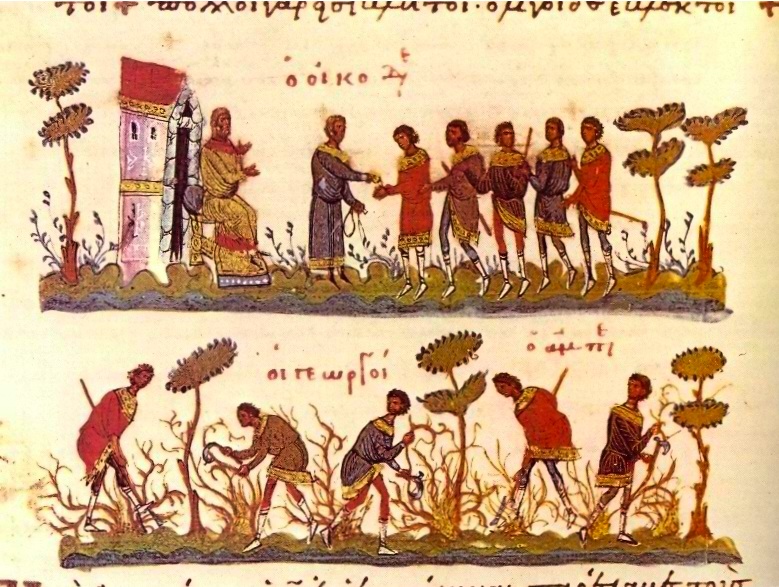
The details of this parable are well-worn and well-known: A landowner hires laborers for his vineyard throughout the day. Beginning early in the morning and carrying on until the final hour of the workday, the landowner hires more and more workers. The first laborers are promised a denarius, the daily rate for a laborer. Each time after this, the landowner hires his helpers with the agreement that they will receive “whatever is right.” In the Kingdom, all who accept the landowner’s invitation are hired!
Things run smoothly until pay time. With a last-in-first-out mentality, those who were hired at 5 o’clock are given a full denarius. This is overwhelmingly generous. One might say foolishly generous! Perhaps even folly. A full day’s pay for only an hour of labor!
Our worldly standards tell us that the next workers would get a denarius plus. Work more, get more. Instead, they get a denarius and then the workers hired before them get a denarius and on and on until we reach the group of workers who have been in the vineyard since the beginning of the day. You have to imagine this first group being caked with sweat and dirt, completely exhausted from a long day in the vineyard and they receive the same pay.
They grumble. Exhibiting the same attitude as the post-Exodus and pre-Promised Land Israelites, they demonstrate the same posture as the older brother in the Parable of the Prodigal Son. They think they have done more, worked harder, and performed better and they should therefore be compensated accordingly.
And don’t you just love the landowner’s response? Or are you envious that I am generous?
Which character did you identify with? Whose side were you on?
Jesus is subtly, softly, wooing us, his hearers, to see our true hearts.
‘It is frightening to realize that our identification with the first workers, and hence with the opponents of Jesus, reveals how loveless and unmerciful we basically are. We may be more “under law” in our thinking and less “under grace” than we realize. God is good and compassionate far beyond his children’s understanding!’5
We are perfectly fine with grace being an amazing gift, we might even sing about it with our Episcopal golf clap until we see that someone has put in less time or less effort than we have. Then we are affronted, offended, scandalized. Like the first laborers, the older brother, and the wandering Israelites, we grumble against the gracious landowner.
We have erroneously thought that the Kingdom of God operates as a meritocracy or based on years of service. The true, beautiful, and good news is that it’s not about what we have done but what Jesus has done for us. “Grace works by raising the dead not by rewarding the rewardable.”6
We have severely misunderstood and underestimated the generous goodness of God’s grace!
As Andrew McGowan argues, this parable shows us that “participation in God’s reign will not conform to our expectations or standards….We are members of God’s people because we were called, whether in childhood or old age, whether in likely or unlikely ways, and whether we seemed deserving or not; for God has little interest in what we deserve, but—thankfully—much more in what we need.”7
Rebecca and I stayed at an all-inclusive resort for our honeymoon. We were such babies, only 21 and 22 years old, and we had never experienced something like that before. Rebecca kept asking me to call the front desk, “Is x, y, or z included in the all-inclusive?” And every time we were amazed by the answer, “Yes, that’s included.” That’s how this grace thing works, friends! Only you didn’t pay the price for the all-inclusive grace, God did!
The grace and glory of God are most fully revealed and embodied through Jesus in the cross as he bears the weight and punishment of our sins so we don’t have to! We had racked up a debt which we could not pay, but the Son poured himself out on the cross in our stead.
Life isn’t fair because God’s grace isn’t fair, beloved, and that is the best news imaginable! In God’s gracious economy, “No-one receives less than they deserve, but some receive far more.”8
This isn’t cause for grumbling, but a holy invitation to proclaim the grace and glory of God as far and as wide, as high and as low, as vast and as broad as possible. This isn’t an opportunity to stash grace away in our spiritual bank accounts lest the river run dry or the manna grow moldy, but rather the catalyst prompting us to go out and tell every soul we know where to find the manna, the denarius, the bread, the grace.
God of grace and God of glory,
Let the gracious gift of your salvation be our glory evermore! Amen.
NOTES
- https://medium.com/morning-musings-mag/no-such-thing-as-fair-2178481999ef
- R. Alan Cole, Exodus: An Introduction and Commentary, vol. 2, Tyndale Old Testament Commentaries (Downers Grove, IL: InterVarsity Press, 1973), 137.
- R. Laird Harris, Gleason L. Archer Jr., and Bruce K. Waltke, eds., Theological Wordbook of the Old Testament (Chicago: Moody Press, 1999), 475.
- R. T. France, Matthew: An Introduction and Commentary, vol. 1, Tyndale New Testament Commentaries (Downers Grove, IL: InterVarsity Press, 1985), 292.
- Ibid, 293.(Stein, p. 128).
- Robert Farrar Capon.
- Andrew McGowan, “Into the Vineyard.” https://abmcg.substack.com/p/into-the-vineyard-the-last-will-be
- France, Matthew, 292.
 Porter C. Taylor