
This sermon was originally preached at St. David’s by the Sea in Cocoa Beach, Florida. The lectionary for Proper 18A was Exodus 12:1-14; Psalm 149; Romans 13:8-14; Matthew 18:15-20.
In a recent article for The Atlantic, opinion writer and social commentator David Brooks shares that he has been obsessed with two questions for the last eight years:
Why have Americans become so sad?
Why have Americans become so mean?1
Brooks first addresses the issue of increasing sadness with quick precision: Rates of depression, anxiety, despair, drugs, alcohol, and suicide are rising. Adults have fewer close friends, couples divorce more regularly, people get married much older (if at all), and the rate of teenagers expressing “persistent feelings of sadness and hopelessness” has skyrocketed.
He then outlines the increasing meanness in our country. “The words that define our age reek of menace: conspiracy, polarization, mass shootings, trauma, safe spaces.” Our society has grown increasingly polarized and fractured. We live in an us versus them, if you aren’t for us then you’re against us world. We lack training in “how to treat others with kindness and consideration.”
For Brooks, the antidote is simple: we need to do a better job at moral formation. Such moral formation has three basic goals:
- Help people learn to restrain selfishness – i.e. it’s not about you!
- Teach basic social and ethical skills – i.e. how to behave
- Help people find a purpose in life – i.e. everyone has a purpose
Brooks traces the demise of moral formation alongside the parallel rise of both moral relativism (you do you and I’ll do me) and humanism (sin became a four-letter word). Morality has become privatized. Truth is now an internal feeling rather than a universal reality.
It’s not just Brooks. A parishioner sent me a comic strip this week featuring a young boy and an older gentleman sitting on a front stoop.
Gentleman: When I was your age all my heroes were cowboys.
Gentleman: Hopalong Cassidy, Red Ryder, Roy Rogers, The Lone Ranger, Gene Autry…
Gentleman: Now they’re all gone.
Boy: Who are your heroes now?
Gentleman: Anyone who shows kindness and compassion to others.
Life has become a competition to win.
Kindness has deteriorated.
Compassion is for the weak.
I want to use one of Brooks’ quotes as the doorway to matters of faith. He writes: “Mere religious faith doesn’t always make people morally good, but living in a community, orienting your heart toward some transcendent love, basing your value system on concern for the underserved—those things tend to.”
Our lessons this morning make similar claims. Brooks identifies the problem and sketches an antidote, but our passages from Exodus, Romans, and Matthew put flesh on the bones. Our passages depict living as a community of character based on the life and love of Christ–helping us to answer three fundamental questions:
What does it look like to live as a community of character?
How are we called to behave?
What is the meaning of this life?
Let’s dive into Exodus. We read this passage every year on Maundy Thursday. It describes the first Passover in rich, vibrant detail. It is a treasure-trove for ritual, covenantal, sacramental, and liturgical language. This morning, however, we are viewing it from a different angle. In harmony with the other lessons, we are invited to see both what God has done for his people and how his people are called to respond.
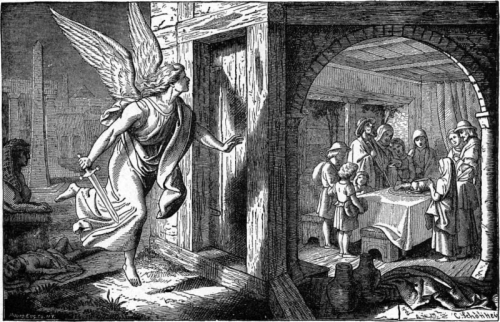
Through Moses’ mediating leadership, YHWH has unleashed 9 plagues upon Egypt, each yielding the same result: Pharaoh’s heart hardens. So YHWH is going to drop the 10th, final, and ultimate plague: the killing of the firstborn. It will affect both humans and animals. For Egypt it will be crippling and devastating. It would have debilitated the children of Israel, too, but God provides a protective covering for them.
Notice in verse 1 that God spoke to Moses and Aaron. We so often take this for granted, but the Bible is built around the idea that God speaks. We believe that God speaks to his people, through his people. Because we worship the God-who-speaks we are therefore called to become a people who listen.
In verse 3, and throughout the rest of our passage, the focus is not on individuals but the whole community. While God spoke to Moses and Aaron, his words are intended to edify and instruct the entire assembly. The Israelites are instructed to take a year-old male lamb, either a sheep or a goat, and bring it into the house for four days.
They are going to care for the lamb;
They are going to cuddle the lamb;
And then they are going to slaughter the lamb.
Embedded within God’s proclamation of protection, power, and passing over is the inherent promise of community building. Look at verse 4 and you’ll see it: “If a household is too small for a whole lamb, it shall join its closest neighbor in obtaining one; the lamb shall be divided in proportion to the number of people who eat of it.” Not every household could eat a whole lamb on their own. Not every household had a lamb to eat to begin with. Given that the whole lamb was to be eaten (no mutton left behind, as it were), households were called to combine-and-consume.
Two extremes are thus excluded here:
- On the one hand it makes clear there is no place for rampant individualism or egotism on Passover. Essentially, God’s instruction makes it clear: it’s not about you! It’s about community, it’s about the whole people of God, it’s about him!
- On the other hand, Passover is not the time to invite your best friends over for a barbecue. You are to join your closest neighbor to celebrate the ritual meal. On this night, the night that is different than every other night, preferential and exclusionary treatment of others is rejected.
Because God shows no partiality, and because his redemption is for the whole people, you are therefore called to care for and share with your neighbor rather than only the people you like! The same is true for us. Within the body of Christ, we are called to build relationships with all Chrisitans and we are to avoid creating our own holy huddles, frozen chosen, or grumble groups.
Instructions are then given both for the shedding of the lamb’s blood and the eating of the lamb’s flesh. All of Israel will slaughter the lambs at twilight on the fourteenth day. Again, this is not a selfie-event for the individual but a momentous occasion for the entire congregation of Israel, to be experienced in and as a community.
The blood is to be smeared on the doorposts and lintels; the flesh is to be roasted over the fire. The entire lamb is to be consumed, everyone given their portion.
There will be enough for all because with God there is always enough!
No scarcity mindset here, because God’s grace is sufficient, his mercy abundant!
They are to eat with loins girded, sandals on, staff in hand, ready to go.
This is the night that YHWH passes over;
This is the night that he has provided for rescue;
This is the night that groups of people begin to become a people, the people.
The eating of the roasted lamb is intended to nourish the people of God on the eve of their journey out of Egypt and into the Promised Land; it is their last supper before being rescued and redeemed. The blood, as we are told in v. 13, is to be a sign that YHWH will pass over, and therefore save, the houses of Israel. The pouring-and-schmearing of blood is to be the protective sign of YHWH’s salvation. Indeed, there is power in the blood!
This is neither the first nor the last time innocent blood will be shed to spare and cover God’s people. God shed animal’s blood in the Garden of Eden as he lovingly clothed his chosen-and-fallen humans with animal skins after their sins. In the fullness of time, as God fulfills the promise in Genesis 3, God will shed his own blood on the cross as Jesus offers his life for the forgiveness of sins.
Verse 14 reminds us that this is an ordinance for the entire community. Israel is to observe this meal every year as a festival to the LORD. The very language suggests community, togetherness, solidarity, connection. Passover would become one of Israel’s pilgrim feasts. After the Isralites wandered in the wilderness, Passover was observed in Jerusalem. Israel flocked to Jerusalem to collectively celebrate YHWH’s deliverance of his whole people. Among the many rich theological truths contained within, Exodus 12 is both God’s gracious invitation to an entire community and the call to the community to care for one another.
Matthew 18 provides a different angle in our examination of this community of character. Last week I quipped that Peter pulled Jesus aside for “Matthew 18 moment” and now that we are in Matthew 18, I need to explain the joke. In the 90’s and 2000’s, many evangelical Christians described the act of rebuking or correcting another Christian as a Matthew 18 moment. Intended as a private affair, one Christian would tell another Christian just how wrong they were. Matthew 18 became synonymous with church discipline. Probably not funny unless you lived it like I did. 😉
To be clear: Matthew 18 is not about church discipline because it is not about authority or ecclesiastical structures. Instead, it is about living life together. It is about the responsibility of all disciples to care for one another in matters of spiritual sickness and health. Matthew 18 describes the healthy community of disciples living together as a body. We have to read our verses (15-20) within the context of the whole chapter. In the first 14 verses, Jesus instructed the disciples to care for every member of their community and he taught them that God’s heart is bent toward redemption, restoration, and rescue as seen in the parable of the lost sheep. The background of our tiny passage, therefore, is mutual caring and the ministry of reconciliation.
The language in verse 15 is personal. It doesn’t say that “someone” should go and point it out but that “you” should do it. The phrase “against you” doesn’t appear in every manuscript; some ancient texts simply say, “If your brother or sister sins” and leave it there. We are going to treat the simpler form of that verse–if your brother or sister sins, period. Jesus is inviting you, his disciples, to take on the ministry of reconciliation, regardless of whether you were on the receiving end of the sinful behavior. “You” cannot pass the buck because Jesus is speaking directly to “you.”
Notice, also, the significance of the language “brother or sister.” It would be so much easier if Jesus used language like us/them, right/left, Florida/Florida State (welcome back CFB), but he doesn’t. Jesus is not talking about family ties by blood but rather the familial relationships within the community of God. The family of God is formed not by blood but by obedience to God’s will. The conflict at hand, then, is not between good versus evil or us versus them, but with one brother or sister attempting to restore another.
The goal is restorative reconciliation, not retributive justice. To be properly reconciled is to be healed and restored within a relationship. Think about the Truth and Reconciliation Commission after apartheid in South Africa. Under the leadership of Mandela and Tutu, South Africans engaged in a process of truth-telling pointed toward healing. Here, the desired outcome is for the one who has sinned to be restored to a right relationship with other disciples and the whole community of faith. We can see this most clearly in the phrase “regained that one.” For just as God seeks the lost sheep to bring them into the fold, so too do Christians seek their lost brothers and sisters to bring them back into the family.
This is not a permission slip to begin judging how other people are living or to clean up someone else’s side of the street. You are still responsible for your own behaviors and actions, but when you see a brother or sister acting in a way that is contrary to the Gospel, you have a responsibility to lovingly point them back in the right direction because as one suffers, all suffer.
Jesus then makes an interesting statement: if the sinner refuses to listen to the disciple, disciples, or the church let such a one be to you as a gentile or a tax collector. Some scholars think that this is a divine imperative to cast such a sinner out, to excommunicate them from the family of God. While Jesus has previously stated that he has come to the lost house of Israel, it is clear in Matthew’s gospel that his mission and purpose are more wide-ranging. The Syrophonecian woman is told that she has faith; Levi, aka Matthew, was a tax collector who became a disciple; the outermost courtyard of the Temple in Jerusalem was known as the Court of the Gentiles and it is where Jesus did much of his public teaching.
Israel cared for Gentiles and tax collectors! Jesus’ isn’t telling you to cast a sinner out! He is calling you to help restore such a brother or sister because Gentiles and tax collectors are not beyond the pale of his salvation!
Don’t forget: we are all Gentiles who, by the grace of God, have been adopted and made both children and heirs! It is neither an accident nor a coincidence that Jesus makes these remarks after giving the parable of the lost sheep..
We all like sheep have gone astray;
We all need the Good Shepherd;
We all need to be restored to the flock!
Finally, the power to bind and loose is not the power to judge and condemn. Tempting though it may be, that power belongs to Christ alone. The call for us is to restore and reconcile. Because Jesus’s heart overflows with mercy and abounds with grace, therefore we are enabled to bind up the broken, heal the sick, search for the strays, bring back the lost, and strengthen the weak. This is not a task built upon retribution but a process soaked in prayer, covered in the name of Jesus, and teeming with divine love.
In Romans 13, Paul has the same sense of urgency that we found in Exodus. Instead of girded loins, sandals on, and staff in hand we are told that it is already the time to wake; that we are closer to salvation; that the day is near. Because Christ is coming back, therefore we are to put Christ on, casting off our evil desires, our sinful devices, our corrupt habits. We are to love one another, genuinely, because the only law that holds sway over us as Christians is the law of love. Jesus gave that new command on Maundy Thursday, by the way, to love another.
It would be really tempting to pursue some generic form of kindness and political correctness in response to Brooks’ article, but that is not the call of the church. As the body of Christ, as the community of his little ones, we are not called to kindness but to extending the kindness and compassion of Jesus. We are not called to “nice-ness” or any other wishy-washy ideas, but rather to share Jesus’ love for the world, a love which he demonstrated and made known upon the cross as the paschal lamb gave himself up for us, body broken and love poured.
The church is called to be a better community, a peculiar people, a community of character. The local church is a training ground for Christian formation.
To be a community of character is to be…
A people who listen for and obey God’s word;
A people who care for others–neighbors and strangers alike;
A people committed to the works of restoration and reconciliation;
A people who forgive because we have been forgiven;
A people who pray;
A people gathered in Jesus’ name.
Gird up your loins, my friends. Take your staff in hand and put your sandals on your feet. The mission field awaits and the fullness of time is drawing near!
NOTES
The title for this sermon was taking from Stanley Hauerwas’ brilliant book by the same name.
1. All quotes in the opening paragraphs are taken from Brooks’ article which can we read here.
 Porter C. Taylor