
This sermon was originally preached at St. David’s by the Sea in Cocoa Beach, Florida on September 3rd for the Fourteenth Sunday After Pentecost (A). The lessons were Exodus 3:1-15, Psalm 105:1-6, 23,26, 45c; Romans 12:9-21; Matthew 16:21-28.
One of my “guilty pleasures” is re-watching NBC’s hilarious sitcom, The Office. Steve Carrell stars as Michael Scott, the fun-loving, socially-awkward, cringe-worthy Regional Manager of Dunder Mifflin Paper Company in Scranton, Pennsylvania.
In one of my favorite scenes, Michael gathers everyone into the conference room to brainstorm ideas for a television commercial. One of his salesmen, Andy Bernard, excitedly offers his rendition of the “best ad ever.” He sings, “Give me a break, give me a break, break me off a piece of that…” and then he freezes having forgotten the final words. While Andy struggles, fellow salesman Jim Halpert seizes the opportunity and forbids anyone from supplying the answer.
In his desperate search for words, Andy swings and misses three times. He first tries, “Break me off a piece of that Apple sauce, Chrysler car, and Football cream.” Later he comes up with Lumber tar, Snickers bar, and Grey Poupon. In the episode’s final scene, Andy offers a few more options before “getting it.” He tries, Claude Van Damme, hair for men, poison gas, and nutrasweet before landing on “Fancy Feast.”
Break me off a piece of that fancy feast!
In honor of Andy, I’d like to try an experiment. I’m going to call out the opening portion of a famous quote or tagline and I want you to respond. The only rule is this: Answer with gusto!
Break me off a piece of that…KitKat bar.
Scooby Dooby Doo…where are you?
To infinity…and beyond!
A spoonful of sugar…helps the medicine go down.
How about this one from 1988: Read my lips…no new taxes.
Changes in latitudes…changes in attitudes.
You get the point!
This is known as call and response. It is something that musicians use, particularly Jazz, Gospel, and R&B. Teachers use call and response in the classroom to get students’ attention. Our liturgy is call and response. And this morning, our lessons show us call and response within the life of discipleship.
Let’s try one more before we get started. It’s a really hard one:
The Lord be with you…and also with you…Let us pray:
Lord Jesus, you have called us together to worship you this morning as your body. You are calling us again, through the liturgy and lessons, the songs and sermon. Grant us the courage to respond to your call and the strength to go wherever you may send us. For your name’s sake. Amen.
Turn in your Bibles to Exodus 3. We have a lot of ground to cover. The lectionary compilers thought it wise to give us the start of the story last week, the call of Moses today, and the first Passover next week. Last Sunday, Moses was a baby and today he is 80-years old.
We know Moses was adopted by Pharaoh’s daughter and raised in the royal household. He was a Hebrew living amongst the Egyptians, an outsider with the insiders. He was a person of privilege while his people were abused and mistreated. When Moses was 40, he witnessed an Egyptian beating a Hebrew slave and he killed the Egyptian and hid him in the sand. The next day he went out and tried to stop two Hebrews from fighting but one of the two said, “Who made you King? Are you going to kill us the way you did the Egyptian?” Pharaoh caught wind of the whole episode and sought to kill Moses so he fled to Midian, where he met his wife, Zipporah, and her father, Jethro, a priest. He became a shepherd and lived there for 40 years.
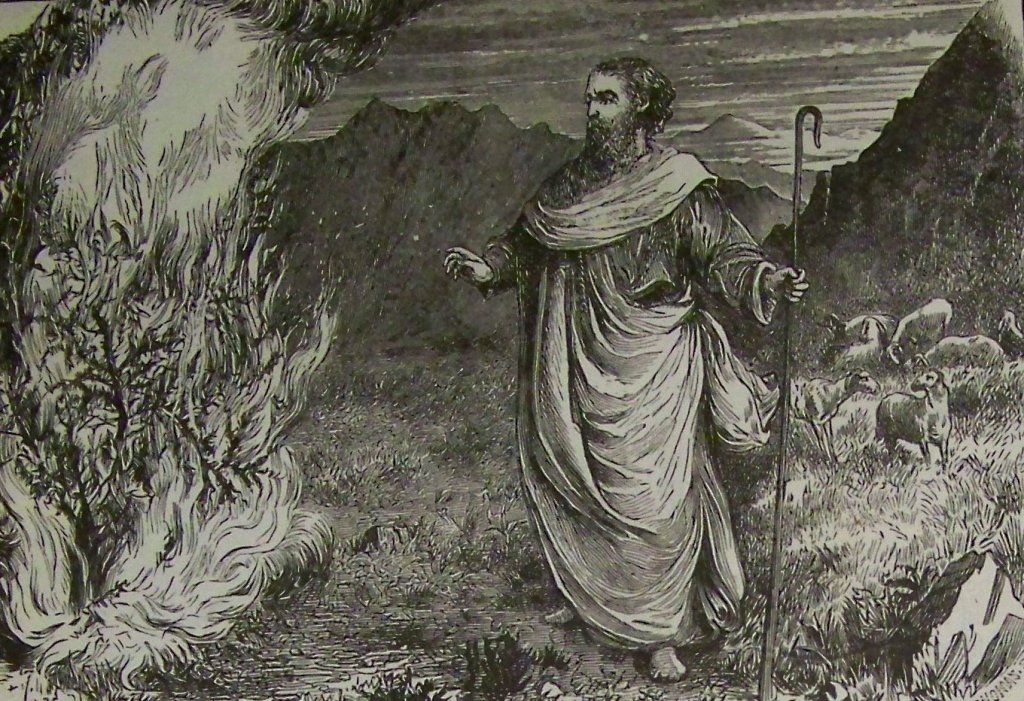
Moses took his father-in-law’s flock beyond the wilderness to the slopes of Mt. Horeb, the mountain of God. The astute biblical reader will recall that Horeb is another name for Sinai. As Moses leads the flock around Sinai, his eye is caught by the strangest sight: a bush that was burning but was not consumed by the blaze.
More than killing the Egyptian or fleeing Egypt, this is the single greatest decision of Moses’ life to date. Experts postulate that humans make an average of 35,000 decisions a day. Allow me to do some quick math: 35,000 decisions a day is 12,775,000 decisions a year. Multiply that over 80 years and you get over 1 billion decisions in his lifetime.
And his all-important, history-altering decision is rather simple: do I ignore the burning bush or do I go and take a closer look?
Moses decides to look. He has no idea, no concept of what he will find. All he knows is this isn’t normal. And isn’t that how God works? When you’ve had great moments in your spiritual life, when you’ve experienced the closeness and tenderness of God, hasn’t it happened when you least expected it?? God shows up in the least likely spaces, indeed Christ plays in 10,000 places. Moses responds to the presence and prompting of YHWH, even before who knows what or who it is!
Once God sees that Moses has turned aside and drawn closer, God calls out to him, calling him by name. God knew Moses before Moses ever knew God. You, my friends, were known by God before you ever knew him. God knows you intimately. He knows your deepest thoughts, your strongest fears, your most burning desires. He knows the number of hairs on your head, he knit you together in your mother’s womb. You are known by God and you will be known by God, world without end. Amen.
The sequence here is important:
God calls and then Moses responds.
God commands and then he identifies.
In reply to God’s call, Moses offers the response of faith: Here I am. This is the response of Abraham and Jacob four centuries earlier. Samuel and Isaiah will respond the same way hundreds of years after Moses. When God calls there is only one answer: here I am.
Moses is told to take his sandals off because he’s on holy ground. The presence of God is holy, it is other, but keep in mind that Moses has only heard a voice. He has yet to discover who is speaking to him out of the burning, blazing bush. That God speaks should shape our entire understanding of who God is, who we are in him, and whose we are. God spoke to Abraham. God spoke to Moses. And God still speaks today.
The ANE had a plethora of gods, so too did Egypt. People believed these gods to be powerful but impersonal; transcendent but not imminent. The Voice, however, identifies himself as “the God of your father, the God of Abraham, the God of Isaac, and the God of Jacob.” This title recalls the big events from the Patriarchs: the covenant with Abraham; Sarah giving birth at 90; the sacrifice of Isaac atop Mt. Moriah; Jacob wrestling with God; Joseph and the technicolor dreamcoat.
The God of Abraham, Isaac, and Jacob was a concept that Moses would have been highly familiar with given that his father in law was a priest! And we know that Moses understood who this God was because he hid his face! This is not the last time that Moses will have his face hidden from God, nor is the the only time that someone has to hide or be hidden from God’s presence in Exodus because his holiness is so truly awe-some.
Beginning in verse 7, God does four things: he acknowledges a problem, outlines a solution, commissions a servant, and promises a fulfillment.
1. He acknowledges a problem. Notice the language here. God is the primary actor, he is the first mover. This entire paragraph is a description of what God has done, is doing, and will do. God has seen the misery of his people; he has heard their cries, and he knows–and remember that to know is to experience–he has experientially-known his people’s sufferings.
When you’re going through something that no one else knows or you feel alone…God knows.
When something happens to you that no one else sees…God sees.
When you cry out to God because you’re angry, stressed, anxious, fearful, hurting, worried, or in need of help…God hears.
These verses teach a great deal about who God is. The God of Israel is not a graven image or a wooden statue or a man-made idol. The God of Israel is active and living, transcendent and all-powerful, intimate and iminent.
The God of Israel speaks.
The God of Israel sees.
The God of Israel hears.
The God of Israel acts.
2. He outlines a solution. God tells Moses he’s coming down from heaven to redeem his people. Yes, God shows sympathy, empathy, and compassion toward his children…but he is also going to do something about it!
He is going to deliver them from their oppressors.
He is going to put an end to their sufferings.
He is going to fulfill his covenantal promises.
He is going to redeem his Promised People from Egypt and lead them into his Promised Future in the Promised Land. Not just any land, either. It is a good and spacious land, flowing with milk and honey, and it is the land that God promised Abraham.
3. He commissions a servant. How will God accomplish this? Look at verse 10: Now go, I am sending you to Pharaoh to bring my people out of Egypt. Moses is called by God to be his servant-deliverer; he will represent God to Pharaoh, he will lead Israel as God leads him. It all sounds so good, but Moses responds to his commission not with the response of faith, but with a defense of self-deprecating doubt.
Moses begins making excuses. Our passage captures the first two excuses, but if you look at chapter 4 you will find four more: “the people won’t listen to me, they won’t believe me, I’m not an eloquent speaker.” Finally he says, “To heck with it: can’t you send someone else?!”
Perhaps you have made similar excuses to God’s call on your life. Perhaps you have said that you are too old or too young, too inexperienced or too educated, too inarticulate, too simplistic or ordinary, too shy and introverted, too uncomfortable talking about faith, too rich or too poor.
Friends, God called Abraham when he was 75 and told him to walk 1,000 kilometers; God promised an heir who wouldn’t come until Sarah was 90; God called Moses when he was 80 years old; they were all well beyond their prime according to worldly standards. God uses the weak, the down and out, the ones without any potential because he is “demonstrating the power of his promise.”1
4. Finally, he promises a fulfillment. Because his power and his promises are enough, therefore, Won’t he do it?! In response to his excuse of who am I? God assures Moses that he will be with him. He also says, “this shall be the sign for you that it is I who sent you.” What is the sign? The burning bush! The flame that blazes but does not consume. The fire is the sign that God is he who says he is and he will do all he has promised. The fire is the sign of calling and office, promise and fulfillment, power and presence, love and glory. The promise will be fulfilled when Moses leads his heavenly father’s flock back to the slopes of Sinai to worship.
In response to his accusation of who are you? God gives Moses his name: I am who I am. In Hebrew it is YHWH. In Greek it is ego eimi ho on. In John’s Gospel, Jesus makes his 7 famous “I am” statements (there are actually 8 if you count them properly) and when he says I am the bread of life, the light of the world, the door, the good shepherd, the resurrection and the life, the way the truth and the life, and the vine, he is using the same language: ego eimi. Jesus is the I am!
The immortal and invisible, the infinite and omnipotent, the immutable and immovable God gives his name to a mere mortal and tells him to share it with others. Who is this God? The Great I am! The God of Abraham, Isaac, and Jacob. The covenant maker and covenant keeper. The God who has drawn near. The God who has come down to deliver and redeem.
We now have a context for Jesus’ prediction of his death and Peter’s rebuke in Matthew 16. Jesus describes his future suffering and it ought to remind us that God heard and saw the suffering of Israel. Remember how God promised to come down to redeem Israel from Egypt? Now God has come down from heaven in Jesus, emptying himself, to redeem his people through his own suffering. Who is our God? The God who suffers; the God who is crucified.
Peter cannot comprehend this. A suffering messiah? Absurd! If only Peter had paid attention to Isaiah 52-53 and realized that Isaiah’s Suffering Servant was the Messiah! Notice that Jesus foretells his death and resurrection, but it would appear that Peter latches onto the suffering and dying portion of the prediction. So Peter has his own “Matthew 18” moment with Jesus, pulling him aside for a private “come to Jesus” talk. While Exodus gave us self-deprecating excuses from Moses, Matthew shows us short-sighted rebukes from Peter.
Jesus’s response is telling: get behind me, Satan! You have your mind now on divine things but on earthly things! Nothing and no one will keep Jesus from marching to Jerusalem and climbing up on the cross to redeem and deliver the world. No one can prevent it, nothing’s going to stop it, because the mission of God moves on.
Jesus then says, “If any wish to come after me, let them deny themselves and take up their cross and follow me.” This has become one of the most misused and abused verses in Scripture. We think it means something cute and quaint like this is my cross to bear or wear a cross around our neck and call it discipleship.
Just as with the burning bush, the Cross is a sign of calling and office, promise and fulfillment, power and presence, love and glory.
In the Roman Empire, the cross meant shame, suffering, humiliation, and death. Those who were to be crucified would walk to their execution sight with the horizontal cross beam tied around their arms. They were the walking dead, everyone who saw them knew that they were the worst of the worst. Jesus isn’t being flippant here. He is calling his friends to a thick and robust grace, to what Bonhoeffer calls a costly grace.
This is discipleship that will cost you something because it runs contrary and counter to the ways and wisdom of the world. While suffering and persecution may ensue, the call to take up the cross is a call to love. Jesus poured out his love for his people on the cross; he suffered with those who suffer, standing in solidarity with the least and the last.
What does this have to do with you? I’m so glad you asked!
Jesus is inviting you this morning with the words: take up your cross and follow me.
How will you respond? You already know what the response should be, but let me briefly describe what it might mean to take up your cross so you can answer whole-heartedly.
Our passages have a similar outline and focus, and that’s because they are both commissioning stories. Essentially, they both say, “Now Go, I’m sending you.” In both Exodus and Matthew we have Call, Response, Commission, and Assurance. Both passages offer a sign, in Exodus we have the burning bush and in Matthew we are given the cross.
They are signs of calling and office. You have been called to follow Christ as his disciples, to serve in his kingdom as his ambassadors.
They are signs of promise and fulfillment. The cross bears witness to the fulfillment of God’s promise to restore, reconcile, and redeem all things and the promise that Christ will make all things new.
They are signs of power and presence. Christ’s power is made known by life through death, comfort through suffering, belonging through love. And his power is sufficient and his presence is steadfast, always there.
They are signs of love and glory. God is glorified in Christ crucified as Jesus pours his love our for all people. “The glory of Jesus and of his apostles is the glory of taking up the cross.”2
Take up your cross and follow me.
Here am I, send me.
NOTES
1. Fleming Rutledge, “And God Spoke to Abraham” in And God Spoke to Abraham.
2. Andrew McGowan – https://abmcg.substack.com/p/take-up-your-cross
 Porter C. Taylor