
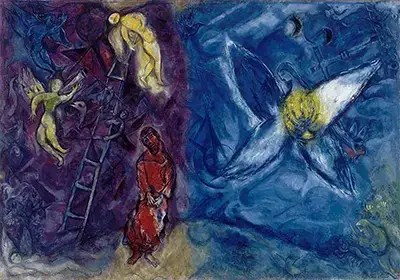
This sermon was originally preached on the Eighth Sunday After Pentecost in Year A (July 23, 2023) at St. David’s by the Sea. The lectionary texts were: Genesis 28:10-18; Psalm 139:1-11, 22-23; Romans 8:12-25; Matthew 13:24-30, 36-43.
**Pastoral Disclaimer: After hearing the last few verses from our Gospel reading, you may have images of fire, weeping, and gnashing teeth in your head. You may even feel on edge. I want to reassure you: this is a sermon about hope. Hope is the foundation of our passages this morning. I will unpack that all for all of you in the next 20 minutes, but I wanted you to be fore-armed with comfort and assurance.**
Let us pray.
Heavenly Father, this is your world. You are the source of all comfort, the author of all life, and the giver of all good things; you are both promise maker and promise keeper. We come before you with deep gratitude for giving us the spirit of adoption and making us joint heirs with Christ of your eternal kingdom. Bless this time, O Lord, and open your scriptures to us and us to your scriptures that we might know who you are, who we are, and whose we are. We ask this all in the name of our savior, Jesus Christ. Amen.1
Henry “Harry” Sheperd Date, immigrated to Chicago, Illinois with his family in 1861 when he was 13. Irrevocably injured by a childhood fall, Date wanted to be a preacher but could not afford seminary, thus became a Methodist evangelist instead, as you do.
Upon founding the Epworth League, a Methodist organization, Date realized the need for a songbook. Just as with seminary, Date lacked the funds to complete the project. With money loaned by his brother, he was able to publish 64 “Advance Pages” of a hymnal. Hundreds and thousands of orders poured in and the funds allowed him to finish the production and publication of “Pentecostal Hymns,” a 224-page hymn book which became an instant success. It was the birth of Hope Publishing Company.
Established in 1902 and still operating today, Hope “continues to carry on its rich legacy, providing quality music publications and worship resources to the church.” You’ve likely never heard of Harry Date, but you have heard of Hope’s most famous acquisition: Great is Thy Faithfulness.
When reflecting on the company’s founding, Date remarked: “I had very limited funds but a great deal of hope..In fact, all I had was hope and that is how the company got its name.”2
I love that line: But a great deal of hope, in fact, all I had was hope.
Hope makes all the difference because hope changes everything.
Actually, let’s clarify that: hope in the resurrection changes everything.
Our lessons this morning are undergirded with hope. We’re going to start in Genesis and then move into Matthew before finishing with Romans. If you’re ready, turn to Genesis 28 in your Bibles.
(Teaching Moment: I know we print the lessons in the bulletin so you can easily follow along during the readings, but as Christians we are called to be a people of the book and we need to use our Bibles more and more, not less and less.)
Affectionately known as Jacob’s Ladder, this story is often misunderstood. For many, the focus has been placed exclusively on the angels ascending and descending a ladder. The reality is that the focus is neither the ladder nor the angels, but the One standing next to the ladder. With that in mind, I want to show you three things: what Jacob saw, what Jacob heard, and what Jacob did.
But before we get there, we need just a smidgen of background.
Jacob is the son of Isaac and the grandson of Abraham, making Jacob the third patriarch in Israel’s history. Last week we recounted how Jacob stole his brother’s birthright in exchange for a bowl of lentil soup. Years later, he would also steal Esau’s blessing from Isaac.
Esau lost everything and he was not a happy camper, to put it mildly. Actually, we’re told that Esau “hated” Jacob. After the days of mourning for Isaac he intended to kill Jacob. Their mother, Rebekah, discovered Esau’s plot to kill Jacob and she instructed Jacob to flee and find refuge and marriage in Haran where her brother, Laban, lived. Isaac blesses Jacob again with the words of the Abrahamic covenant, telling Jacob that he will be the inheritor of the three promises.
Remember what they are? A people, a land, and a blessing.
It is during his journey to Haran, in his effort to escape his brother’s wrath, that Jacob, a wifeless, childless, landless, hopeless wanderer, stops for a night and has a dream.
We pick the story back up in verse 11. Jacob did not know where he was stopping. He had not called ahead to the Marriott to book a room or found an Airbnb with a superhost. He simply stopped for a sleep and a dream.
Here is what Jacob saw.
He saw a ladder leading up to heaven with angelic envoys on it. These are not the winged-angels that we encountered in Isaiah 6 two weeks ago, for if they had wings they would have been flying. They ascended and descended, taking the prayers and concerns of humanity to the throne room of Almighty God and returning as agents of God’s will.
The ladder functions as an “attention-getter,” just as the burning bush in the Exodus story. The ladder gets Jacob’s attention but then fades into the background because it is something, or rather, someone else who captivates him.
Jacob sees Yahweh standing at the bottom of the ladder. Yahweh, the Creator of all that was, and is, and ever shall be. The Almighty, the omnipotent, omnipresent, and omniscient. The immortal, invisible, God only wise.
You may recall that Yahweh told Moses that no man could see him and live; Isaiah only saw the train of Yahweh’s robe; Jacob’s grandfather, Abraham, only saw Yahweh in the form of a smoking pot. But in dreams the rules don’t apply. So what does Jacob see? He sees the One and Only, the first and last, the alpha and omega, the beginning and end, the one who was, and in, and is to come.
Here is what Jacob heard.
Yahweh speaks to Jacob. First, he introduces himself. “I am the LORD, the God of Abraham and the God of Isaac.” Yahweh is saying, “I’m not just their God, I am your God, too.” With this introduction, Yahweh reminds Jacob of his history with Abraham and Isaac. Jacob would have remembered it easily because it was his family story!
You can imagine Isaac, Rebekah, Jacob, and Esau sitting around the table and sharing stories, “Remember that time God told grandpa Abe that he’d have a child at 100? Remember how granny Sarah laughed at God?” Yahweh is known to Jacob not just because he has seen him in a dream but because he heard of his mighty deeds.
Yahweh then makes promises. The first promise is land. He says, “the land you are lying on, I will give to you.” This is the land that Jacob is sleeping on as he leaves the promised land to escape his brother, land that he fears he may never say again but God promises to give it to him! And not just to him, but to his offspring as well!
Only one problem, Jacob has no children.
He doesn’t even have a wife.
But thanks be to God that his promises are always greater and stronger than our human limitations and circumstances.
Can I get an amen?!
Yahweh goes further. He says, “your offspring shall be like the dust of the earth, and you shall spread abroad to the west and to the east and to the north and to the south, and all the families of the earth shall be blessed in you and in your offspring.” It’s the creation mandate, the command to Adam and Eve, all over again: Fill the earth, be fruitful and multiply. But it’s also more than that. Yahweh makes the same promises to Jacob that he made to his grandfather Abraham and his father Isaac. In his infinite wisdom, Yahweh has chosen this family to be the vessel of his amazing grace, abundant goodness, and faithful promises for the world.
If Yahweh is for him, if Yahweh is his promise-maker and promise-keeper then Esau can’t harm him. But Yahweh isn’t done! In verse 15, Yahweh makes even more promises. He says: Know that I am with you and will keep you wherever you go and will bring you back to this land, for I will not leave you until I have done what I have promised you.
Yahweh promises to be present with Jacob, to provide safety, and to bring him back to the land. He promises to fulfill everything. He promises to remain with Jacob while he fulfills all that he has promised, just as he was with Abraham and Isaac.
These words would hold and keep Jacob during his journey out of the promised land and back into it. They would keep Jacob safe and secure as his sons grew up, after Joseph was lost, and as a famine hit the land forcing them into Egypt. They would give him hope, even when the odds were against him. Yahweh’s promises would remain steadfast and true because Yahweh is steadfast and true.
Finally, here is what Jacob did.
Based on Yahweh’s promises, Jacob responds with faith and worship. Jacob wakes from his dream and immediately realizes that the LORD was “in this place.” He had faith that God was who he said he was and that he would accomplish all he had promised. Jacob recognized the spot of his encounter as a thin place; a place where heaven and earth have met, where the lines betwixt the two are blurred. God is uniquely present in his creation and with his people.
After marking the place with the stone, Jacob pledges himself to God since God has pledged himself to him. He says, “then the LORD shall be my God.” He accepts the promise of covenant fidelity and gives himself fully to the LORD. Finally, he offers a tithe, 10 percent of all he has, to Yahweh. Tithing is not a suggestion or a manmade idea but a biblical principle. It is worship. Throughout Scripture we see women and men giving 10 percent to the LORD as an acknowledgement that everything belongs to God but that he allows us to live on what he has given.
Jacob moves forward in hope because Yahweh has strengthened him with his steadfast love, his life giving presence, and his promise to fulfill all that he has said. It will take years and years, even decades, for Jacob to see much of this come to fruition, and then it will be thousands of years before the promises are fully fulfilled in Jesus, but Jacob is given hope.
And as I said, hope changes everything.
Let’s hold tightly to that hope and jump forward to our Matthew passage.
Jesus remains where we left him last week: still in a boat teaching a crowd on the beach while also giving private instruction to his disciples. He is still teaching in parables and using agrarian imagery. If the first parable focused on the soil, this parable focuses on the seed(s) planted.
Jesus tells the story of a sower who sowed good seed in his field but while everyone was sleeping, and therefore least attentive and least expecting it, an enemy came and sowed weed-seed in his field alongside his good seed. This was actually a common practice during this time. In fact, there was a Roman law which prohibited citizens from revenge-sowing in their enemy’s fields. This story would have been very familiar to the listeners.
Why would this be so awful? I’m so glad you asked. The seed in question here was darnel, a poisonous weed which mimics the growth of wheat. What makes darnel such a threat is its toxicity. In fact, the Latin name for darnel, Lolium temulentum comes from the word for “drunk,” referring to the sensation that comes from ingesting the plant. If the seeds are ingested, it can cause dizziness and nausea, and a large enough dose can even be fatal.3
In early growth, wheat and darnel look so similar that you can’t differentiate them until they begin to reach maturity. Wheat will droop because the grains on the head are too heavy, but darnel will stand straight up. At that point you are faced with a catch-22: rip up the darnel or let it grow and separate it out at the harvest. If you ripped it up early you would rip up most of your good crop because their roots were intertwined. If you waited until the end, the darnel would have contaminated the wheat, ruining both crop and field. In short, the sowing-enemy almost always won.
The slaves in the parable understood this and they wanted to save some of the wheat by ripping up the darnel before all was lost, but to their great surprise the sower told them to wait. Miraculously, the wheat is separated from the darnel and then gathered in his barn because this is what the Kingdom of God is like.
The disciples wait until they have private time with Jesus and then they ask him to explain. The sower is the Son of Man.
Stop. Who is the Son of Man? Jesus is the Son of Man! He refers to himself as such throughout Matthew; the phrase originates in the OT book Daniel and denotes the one who is to come with universal authority, sovereignty, and divine judgment over all things. God in the flesh.
The sower of the bad seed is Satan. He is revenge-sowing because he lost heaven and his heavenly status. Satan is presented as a spoiler, a rotten stinker with no authority of his own right, having to slink in the darkness to do his misdeeds. As followers of Jesus, we need to be attentive, constantly vigilant for his lies and schemes!
The field is the world. Because of Satan’s mischievous sowing, the righteous and unrighteous exist alongside one another in this world. Indeed, we have righteousness and unrighteousness coursing through our hearts and minds at any given point.
The wheat is the children of the kingdom, that is, the righteous. Whose kingdom is this? The kingdom belongs to the Son of Man! This is Jesus’ Kingdom! This is the kingdom that he has announced and inaugurated: freedom to the captive, release to the prisoner, sight to the blind, life to the dead. The kingdom is the place of God’s reign and rule, the place where God has dominion and domain. Just as Yahweh was present in Bethel with Jacob, just as Yahweh promised to be ever present with Jacob, so too is Yahweh present in the world through Jesus.
The darnel represents the children of the evil one, that is all that is evil and horrendous and sinful and treacherous in the world. As children of the kingdom, you have possibly wondered why God hasn’t already judged the world, why he hasn’t made things right yet. The fact is that through the cross and resurrection, the judgment of the world has taken place and things are being put to rights, but we now have the task of cooperating with the Holy Spirit in the hopeful conversion of all creation.
Yes, there will be a day of final judgment but there are two hopeful things to be gleaned here: first, we are not given the job of judging between wheat and darnel. Our job is to grow up to full maturity in Christ and to allow our seeds of faith to propagate and germinate in others. Second, the one to judge is the Son of Man and we know him to be kind, good, loving, tender-hearted, and full of compassion. This is not a cause for fear but a reason for faith, worship, and hope.
If Genesis and Matthew show us who God is, then who are we? Paul makes this explicit in Romans 8: we are daughters and sons of the kingdom and the king! Through Christ, you have been adopted into God’s family, into the promised-and-blessed tribe of Abraham, Isaac, and Jacob. We have been given the spirit of adoption not of slavery, peace not fear, spirit not flesh, righteousness not lawlessness. We are called to shine in this world with the love and worship of God, indeed the world is even looking for the children of the kingdom to appear!
While the world swirls around us, ever-changing and full of turmoil, trial, and tribulation, Paul tells us that there is no comparison between that and the glory to be revealed. The glory is Christ and his Kingdom! And it is there that our hope is to be found!
I heard the story about Harry Date from my grandmother, Elizabeth Turner Taylor, who died last month at the age of 90. Mumsey, as she was known to me, told me about Date because her mother was Elizabeth Date Turner, daughter of Harry Date. Harry Sheperd Date, Elizabeth Date Turner, and Elizabeth Turner Taylor all lived and died in the sure and certain hope of the resurrection. Because hope in the resurrection changes everything.
The resurrection means that what is now will not be; the sad things will come untrue; the injustices of the world will be turned upside down, the wrongs will be righted, the mourning will be comforted, the broken made whole; the lost saved; the dead brought back to life. The resurrection means that we are founded on, sustained by, and committed to hope. Christian, may your hope be set upon Christ, resting in his glorious passion, and may you go forth from this place planting, propagating, and germinating that hope throughout the whole word. Amen.
NOTES
1. I wrote this collect for this sermon. The prayer collects various aspects of the lectionary texts and some of the hymns which we sang on Sunday. You are welcome to use it.
2. https://www.hopepublishing.com/content/AboutUs
3. https://www.atlasobscura.com/articles/wheats-evil-twin-has-been-intoxicating-humans-for-centuries
 Porter C. Taylor