
This sermon was originally preached at St. David’s by the Sea in Cocoa Beach on Pentecost Sunday (A), May 21, 2023. The lessons were Numbers 11:24-30; Acts 2:1-21; John 20:19-23; Psalm 104:25-35, 37.
I fell in love with a Converse Girl.
Rebecca’s alma mater, Converse College, was founded in 1889 as one of the first 15 women’s colleges in the country. Now a co-ed university, Converse continues to enjoy an illustrious history of developing gifted leaders, brilliant minds, and culture shapers.
One of Rebecca’s friends, another Converse alum, Niki Coffman, made national news this week. The TODAY Show shared a heart-warming story featuring Niki, her son, and Fisher-Price. Unable to have children naturally, Niki and her husband, a white couple, adopted a baby boy with brown skin and red hair. They named their son Archer.
Friends, I have met Archer and he is full of life, energy, and joy. You cannot help but smile and laugh after spending time with Archer–his joie de vivre is infectious!
To celebrate his fifth birthday, Niki asked friends and family members to donate “diverse and inclusive” toys, books, and art supplies to Archer’s predominantly white preschool. Niki has searched for toys, books and holiday decorations that look more like her son, a boy with brown skin and red hair. “When a company succeeds in providing diverse toys and products, she contacts them to say thank you. When a company fails, she sends a letter politely asking them to ‘do better.’”1
Most of the toys given were made by Fisher-Price in their “Little People” series, featuring “children with different skin tones, hair textures and physical abilities.” True to form, Niki wrote a letter to Fisher-Price thanking them for their work and including a post-script: “‘If you ever decided to design a Little Person with brown skin and red hair, please let us know.’”
Gary Weber, Vice President for Design, responded to Niki’s letter, a letter which was shared with everyone who worked on the Little People figurines. He said, “You and Archer have inspired us!” Weber asked for the Coffmans’ home address to “make sure Archer and his school have the full representation of our Little People figures.”
The promised box had more than Little People toys. It included a note, signed by every member of the design team, which said: “In your letter, you enclosed a picture of Archer and the suggestion that we might consider a Little People figure inspired by him. We loved that idea! So, we decided to create an Archer Little People figure, just for you. And we included a few more so you can share with your friends and family. We hope this brings you the same joy your story has brought our team.”
Sweet, vivacious Archer now has “an army of Archers” to play with.
And all because Niki wrote a thank you note.
All because of the fierce, steadfast love of a mother.
All because Niki wants Archer to understand that he is “fearfully and wonderfully made.”
Whatever Niki’s intended goal or preferred outcome may have been, Fisher Price’s response was beyond her wildest expectation and the power of their response was life-changing.
The same is true of Pentecost.
While the disciples waited in Jerusalem to be “clothed with power from on high,” the descent and blowing of the Holy Spirit this way was beyond their wildest expectations and collective thinking. We aren’t told what the disciples expected to happen, but we already know just 10 days before the disciples asked Jesus if he was restoring the kingdom of Israel…so its safe to say they weren’t prepared for this.
Before we can discern and discover what the outpouring of the Spirit in Acts means for us, we need to read it and see it in context. To borrow from Richard Hays, we have to “read backwards” before we can move forward. Or, in the words of Karl Barth, “Let us begin, as it quite often advisable in explaining the Bible, at the end, so that starting from there we may understand the beginning.”2
So this is your warning that while Acts 2 is our primary passage, we will be traversing hither and yon in Scripture before turning our focus back to Cocoa Beach on May 28, 2023.
Turning in your bulletin or your Bible to Acts 2 (page 882), the outpouring of the Spirit at Pentecost represents one of the most climactic moments in the post-resurrection New Testament. Willie Jennings describes it as “the moment that will define the drama of Acts,” and Craig Keener labels it “pivotal for Luke.”3 Pentecost is the hinge upon which Luke-Acts and the New Testament turn. There are 25 chapters in Luke-Acts before Pentecost, and 26 chapters after. The New Testament is even structured with the Gospels and Epistles separated by Acts.
We start off in verse 1 with “when the day of Pentecost had come” and immediately we need to stop. 😜
We cannot, we must now rip Pentecost out of its Jewish soil. Christians didn’t invent it! For thousands of years the Jewish people had been celebrating the Feast of Shavuot, one of the three highest and holiest feasts of the year. Shavuot occurs 50 days after Passover, the Greek term for this being Pentecost. Shavuot is a harvest festival in which the people pray for rain to pour out upon their crops and they celebrate the giving of the Law by Moses at Mount Sinai. YHWH instructed his people, a people already redeemed, at Sinai–he set them apart, consecrating them as a holy people, before he descended in fire and cloud.
The connection with Shavuot is significant.
Luke then tells us that “they were all together in one place.” All of Israel was gathered in Jerusalem for Shavuot. The disciples were certainly together, having come back to Jerusalem after the Ascension at Jesus’ instruction. Luke tells us as much as he describes the disciples’ actively waiting-by-praying time in the upper room during the 10 days between Ascension and Pentecost.
The disciples were in Jerusalem with Jews from every nation for the Feast of Shavuot. They were praying for power from heaven, the power which Jesus promised would be poured out. “They may have asked for the Holy Spirit to come, but they did not ask” for it this way.4 This display of God’s power was beyond their expectations.
During the festivities, there “came from heaven the sound of a violent rushing wind” which “filled the entire house.” The Old Testament is replete with references to violent noises and rushing winds coming from heaven. Heavenly displays of power were part and parcel of Israel’s relationship with YHWH. “Wind and fire…harken [sic] back to Moses and Israel’s beginnings in miraculous displays of divine power.”5
Think burning bush;
Think Pillar of Cloud by day and fire by night;
Think parting of the Red Sea;
Think YHWH’s descent upon Sinai in thunder, lightning, and smoke.
Echoing Isaiah 64, O that YHWH would rend the heavens and come down! Only, he has rent the heavens once and come down in as the divine logos, the word of God made flesh, and now the heavens are rent asunder again as the Spirit descends. “This is God’s doing: no one helped, no one assisted, everyone only tarried. The waiting in prayer has not come to an end. It has only moved forward into an action fully of God.”6
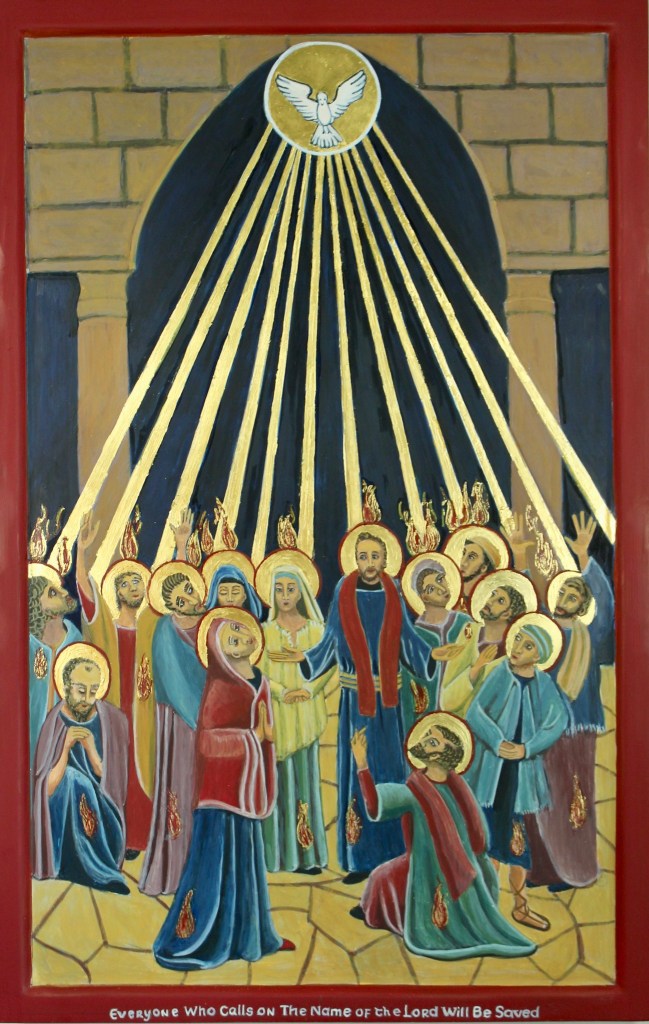
Divided tongues of fire appeared and rested among them.
The language here is very important. The Spirit goes and blows where the Spirit will. According to Andrew McGowan, what we discover in the story of Pentecost is that “we do not have the Spirit, the Spirit has us.”7 We are not the recipients of “a commodity or object” but are rather “drawn into the life of God in a new way.”8
Our understanding of the Holy Spirit, what we call pneumatology, is often so limited, so short-sighted, so anemic. We absent-mindedly use language suggesting that we can somehow harness or direct the power of the Spirit, a Spirit who comes at our beck and call.
But they are not taking the Spirit in, rather the Spirit takes them in, joining them to the Father, to the Son, and to each other in an unprecedented and unanticipated manner.
This is fire that would burn-but-not-consume;
This is Burning Bush fire;
This is Pillar of Fire by night fire;
This is Holy Spirit fire.
And this is not the first time in Scripture that the Holy Spirit has rested on individuals.
Numbers 11 recounts the moment when YHWH shared the Spirit-resting-upon-Moses with 70 elders. As the Spirit rested on the elders they began to prophesy. The prophesying was temporary, it had a definite start and stop, and it was the result of the Spirit. But two men who remained in the camp received the Spirit and prophesied in the camp.
At that time, Moses had an assistant named Joshua. Joshua would go on to lead the promised people into the Promised Land as Moses’ successor, full of strength and courage, but in this moment Joshua operates out of a jealousy-based defensiveness. We might call this a “righteous zeal” on Moses’ behalf. Joshua tells Moses to stop Medad and Eldad because they’re doing what he assumed only Moses could do. Joshua doesn’t want anyone diminishing the work of his mentor. I know this will surprise you, but Christians leaders often fall victim and prey to fear and insecurity. The scandalous horror! Thankfully, Moses doesn’t let Joshua’s insecurity on his behalf affect him.
“Are you jealous for my sake? Would that all the Lord‘s people were prophets, and that the Lord would put his spirit on them!”
Moses understands a deep and eternal truth which we must commit to memory. We do not have the Spirit, the Spirit has us. Moses wants all of God’s people to have the Spirit, to prophesy, to be prophets. He has no ownership over his giftedness or leadership. He has not determined that “having the Spirit” is his turf. This is not an instance where the minister ministers and the congregation congregates.
There is a similar story in Mark 9. After the Transfiguration, Jesus is approached by John the beloved disciple. John tells Jesus that they tried to stop a man casting out demons in Jesus’ name. Why? Because that is Jesus’ job…because what if Jesus finds out that someone else is doing it…because we’ve never done it that way before…because that is so-and-so’s ministry…because that’s my pew…starting to sound familiar? Jesus rebukes this short-sighted, narrow-minded spiritual greediness.
We live in a world that tells you to “go out and get yours” as though there is a limited amount of goodness to go around. This prevailing mindset of scarcity and lack leads to selfishness. But we are called to live a different way, a new way, the Kingdom way. We worship the God of abundance not of scarcity, the God whose love will never run dry and whose grace will never be exhausted. The gifts of the Spirit are neither perishing nor depleting; they are sufficient and satisfying.
Echoing Numbers 11, the reception and resting of the Spirit leads to the disciples speaking in other languages as the Spirit gave them the ability. We could get fixated on speaking in other languages as though that is the point of Pentecost, but to do so would be to miss the forest for the trees. The Spirit is the primary mover, shaker, and actor in this scene. The disciples had not been taking Rosetta Stone languages or using Duolingo on their iPhones, mind you. In fact, this wasn’t the most well-read, highly educated group of men and women in the world. This is new, this is other, this is beyond all expectations.
Remember, the Jews gathered in Jerusalem for Shavuot are diaspora Jews; Jews who had been flung to the corners of the Mediterranean by successive foreign empires; Jews from every tribe and tongue imaginable, and each hears the Gospel in their own language.
The power of the Holy Spirit is displayed in the reversal of Babel. In Genesis 11, humans wanted to make a name for themselves so they stayed in one place and built a tower to give God easier access to come down from heaven. They ignored their God-given mandate to “be fruitful, multiply, and fill the earth. God confused their language, scattering them to the corners of the earth that they might do the work he had given them to do. On Pentecost, the one Gospel of Jesus Christ is translated into the multiplicity of languages that they might all become one body, one people, one Church, and that they might do the work Jesus had given them to do!
No wonder a crowd began to gather with amazement and astonishment! The Gospel was made personal, it was made intimate as each heard it in their own tongue, in the languages that they would speak at home. Friends, this presentation of the Gospel in their tongue was not a gimmick, it was not a bait and switch, it was not an erasure of their cultural identities as they are absorbed into the body of Christ but rather a celebration of who they were as they are drawn in and joined to the body by the Spirit.
Now, someone in the crowd…because there’s always one wise-guy, suggested the disciples were drunk, saying, “They are filled with new wine.” 50 days after Shavuot is the Feast of New Wine…but this guy thought the disciples had somehow imbibed the new wine early. The irony is that “the new wine [of the Spirit] has been poured out on those unaware of just how deeply they thirsted.”9
Peter has clearly never been to an AA meeting, because he innocently thinks that 9AM is too early for drunkenness and debauchery. To borrow from Farmers Insurance: we know a thing or two because we’ve drunk a thing or two…
But he is right. They have not gotten into the new wine, rather they have been filled with the power of the Holy Spirit. Peter’s speech points us to mission, just as Jesus’ words in John 20 do. And in these verses we discover the goal or telos of Pentecost: there is no separation between mission and identity.10 Jesus gives the Spirit to his disciples in John 20 and then invites them into the ministry of reconciliation. While only the Son of God has the power to take away the sins of the people, we are given the ministry of forgiving sins in his name. Forgiven ones forgiving others.
You have been empowered by the Holy Spirit, consecrated for mission and ministry as people already redeemed. You have received power from on high, clothed and cloaked with the powerful presence of the Spirit, not for your own benefit but for the goodness and wellbeing of those around you. Like the prophet Isaiah whose lips are touched with a burning coal, whose response is “Here I am, send me,” we are sent with love “into the far country”11 to share the love and forgiveness of God with every woman, man, and child. “The sending of the Son into the world both establishes and demands the sending of the disciples within the world.”12
Notice Peter’s use of Joel in Acts 2:16-21. The point is not the fruit or manifestation of the Spirit, but the timing of the Spirit. In the last days, says Peter, says Joel. The coming of the Spirit means that time’s short and the stakes are high.
Pentecost means that we have been empowered beyond our wildest expectations. The fierce and steadfast love of the Father has resulted in the great gift of the Spirit for his children, just as the fierce and steadfast love of a mother resulted in the great gift of a personalized toy for her son. The outpouring of the Holy Spirit is a sign of God’s power, his promise, his presence, and his purpose.
We are called to be Spirit-filled people because we are on a Spirit-led mission. The mission is to preach the Good News of Jesus Christ to everyone we meet that they might come to believe in the saving love and amazing grace of the incarnate, crucified, resurrected, and exalted One.
NOTES:
1. https://www.today.com/parents/family/mom-asks-toy-looks-adopted-son-rcna86230
2. Barth, “Carry” in Call for God, 98.
3. Jennings, Acts, 27 and Keener, Acts, 121.
4. Jennings, Acts, 28.
5. Jennings, Acts, 28.
6. Jennings, Acts, 28.
7. https://abmcg.substack.com/p/pentecost-stories-of-the-spirit
8. Ibid
9. Jennings, Acts, 27.
10. Marianne Meye Thompson, John, 421.
11. Barth.
12. Schnelle, as quoted in Thompson, John.
 Porter C. Taylor