
This sermon was originally preached at St. David’s by the Sea Episcopal Church in Cocoa Beach, Florida on Sunday, May 14, 2023 (Easter 6A). The lectionary texts for the day were: Acts 17:22-31, 1 Peter 3:13-22, John 14:15-21, and Psalm 66:7-18.
Lord Jesus Christ, you stretched out your arms of love on the hard wood of the cross that everyone might come within the reach of your saving embrace: So clothe us in your Spirit that we, reaching forth our hands in love, may bring those who do not know you to the knowledge and love of you; for the honor of your Name. Amen.
The year: 1966.
The day: April 8th.
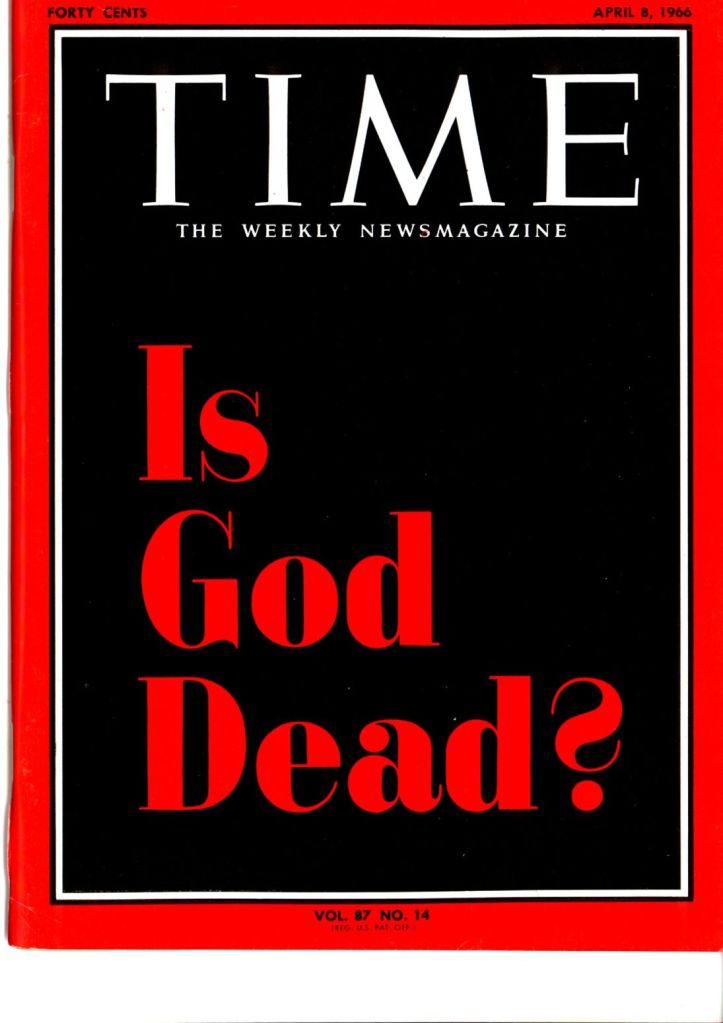
TIME magazine had just published one of their most controversial and iconic covers ever. It was the first time they had ever printed text-only on a cover. The cover was a black background with three words, in red ink, stacked on top of one another: Is God Dead?
The response was swift: angry sermons were preached two days later. 3421 angry letters to the editor were submitted to TIME. And for one 12-year old boy, Don Hamilton, it led to awkward, probing questions at school.
Why? Don’s father, William Hamilton, was prominently featured in the article. Don was asked by a friend, “Does your father really believe God is dead?” to which he had to reply, “Yes.” It was awkward because William Hamilton was “a tenured professor of church history at a small divinity school in Rochester [New York]” and he believed that God was dead.
No one was perhaps more surprised by this national notoriety than the Rev. Dr. Hamilton. TIME had not informed or forewarned Hamilton that this was coming. Hamilton had recently co-edited a volume of essays with his friend and colleague, Thomas J.J. Altizer, entitled, “Radical Theology and the Death of God.” The volume was published 3 months before the article. Ultimately, Hamilton would resign from his tenured professorship due to the flack, pushback, and havoc stemming from the article.
Hamilton and Altizer were part of the “Death of God” movement. The “founder” of the movement was none other than German philosopher Friedrich Nieztche who, in the previous century, had famously written, “Gott ist tot” or “God is dead.” The idea being that the notion of God is neither helpful nor realistic; while God may have existed, he is certainly no longer involved in the affairs of humanity…we are left down here, on earth, alone, with only ourselves to trust. God is dead. And we killed him.
While this may sound completely absurd, it is more prevalent today than it was 57 years ago. Our society is fraught with Moralistic Therapeutic Deism, universalism, pantheism, panentheism, the rise of the Nones, new age spirituality and more. Fleetwood Mac summed up the zeitgeist accurately with their title, “Go your own way.”
The “Death of God” movement, as it were, flew in the face of Orthodox Christianity. It had only been 4 years since TIME had featured the great Swiss theologian, Karl Barth, on its cover with the quotation, “The goal of human life is not death but resurrection.” How the times had changed.
The theological gauntlet had been thrown, thrusting the Church into a unique position: how should she respond? This was neither the first time, nor the last time, that the church was faced with a new belief or ideology which sat in direct contradiction to the gospel.
This is the very situation Paul was dealing with in Acts 17. And Paul’s response to the situation is not only something for us to emulate, it is an imperative for evangelism, for the Christian life.
Turn in your Bibles to page 898. Your bulletin starts in verse 22 but I need you to see this passage in context, beginning in verse 16. While you’re turning there, it must be noted that while we are looking at Paul in Acts 17, it was only last week that we were introduced to Saul the persecutor of Christians in Acts 7. Between last Sunday and today…
Saul has encountered the risen Jesus on the road to Damascus;
Saul has been baptized by Ananias;
Saul has become Paul;
The Pharisee of pharisees has become an apostle of the crucified Lord;
The Hebrew of hebrews has become the apostle to the Gentiles;
Paul is now in Athens, a Greco-Roman city of learning. Not only was it a city of learning, it was also a city wholly devoted to false gods, deities, and idols. It was a culture opposed to the claims of Christ, his cross, and his kingdom. Paul lamented over this. In verse 16, Paul waits for his companions and co-laborers, Timothy and Silas, to join him and “he was deeply distressed to see that [Athens] was full of idols.” Upon reading that, you might expect Paul to have a “come to Jesus talk” with the Athenians wherein he reads them the riot act for their blatant idolatry…I mean, Paul isn’t particularly known for his finesse. Only, that’s not what we read. Yes, he debates with the Jews, Epicureans, and Stoics in the marketplace, but when it comes time for his public defense of the faith, we observe a Paul who has adopted the mentality and mannerisms of a pastoral evangelist.
One last piece of information that you need before we dive into our proper lesson. Look at verse 21: Paul is in a city completely obsessed with the latest philosophy or ideology of the day. The Athenians and foreigners living there did nothing but tell or hear something new. What is the newness of Paul’s message? The resurrection of the son of God.
So when Paul finally gets to the Areopagus with the Athenians, he begins with a compliment, “I see how extremely spiritual you are in every way.”
These are the same Athenians with whom he is so distressed because of their idolatry, but he doesn’t lambast, judge, or rebuke them. Neither does he bring in his prayer book, his bible, his evangelism tract, or his copy of the catechism. Instead, he approaches them persuasively, from the French word meaning with sweetness, and he begins to build rapport.
Paul’s next evangelistic move is to find common ground. Building on the compliment already paid, Paul mentions that he came across an altar with the inscription, “To an unknown god.” This is not an obscure reference but rather something that everyone would have known about. It would be like me preaching to a group of Cocoa Beach-ians and saying, “I noticed a statue of a surfer in front of a gas station…” Everyone would know what I was talking about!
Paul has the rapt attention of his audience because:
he is talking about something new,
he has paid them a compliment,
and he has established a common ground.
Paul has neither made any compromises nor has he betrayed his convictions by speaking in a language they would understand. As an evangelist, his goal is to discern where the Holy Spirit is already, actively at work in Athens and then point these people to Jesus using familiar terms and ideas. And it’s not just the altar to the unknown god, later Paul will use some lines from an Athenian poet to further illustrate his point. The whole “in him we live and move and have our being” is known to us as Scripture but it originated as part of a non-Christian poem. He takes from the host culture that which can be used to point them to Jesus and he does so with an ease and fluidity that we can emulate.
Paul’s next apologetic move is to pivot from what the Athenians know (an unknown God) to what they do not know (the God who is known). He reveals to them who this unknown god really is because God is not unknown at all. To be clear: this altar wasn’t actually dedicated to the Triune God, but rather Paul uses it as a prop to point to the God who is Father, Son, and Holy Spirit.
Paul is doing in Rome as the Romans do, as it were. He is in a city devoted to new ideas, and so he takes an old idea and spins it in a new way, in order to tell them who this God is.
Going back to TIME magazine and the death of God, we need to ask ourselves the most existentially significant questions possible: who is this God? Can God be known?
As part of ascertaining or discerning whether God is dead (or not) we need to understand which God we are talking about. We have to ask this question because, as Karl Barth said, “The word ‘God’ is used so much, and has become so worn, like an old coin, and everybody understands something different by it. And there are really so many gods too.” There really are so many false gods, deities, and idols masquerading and parading themselves around as though they are the one true god…
Here are some of the gods, we see in culture today:
There is the watchmaker god who set the world in motion and has stepped out of the picture;
There is the magnifying-glass god who is experimenting with humans like a child with a magnifying glass seeing what he can burn up;
There is the cosmic vending machine god who exists solely to do our bidding, giving us whatever we need whenever we demand it;
There is the god of moralistic therapeutic deism who wants us all to be good and to be happy;
There is the bootstraps god, the one who wants us to pull ourselves up;
There is the DIY god, the one whom you find deep inside yourself through exploration;
There is the universalism god, the one who says all roads lead to him and it doesn’t matter which one you take as long as you take it with sincerity;
There is the god of health, wealth, and prosperity, the one who blesses the blessed;
There is the god of white Christian nationalism, the one who hates everyone who doesn’t look like us;
There is the god of the mighty, the powerful, and the victor, the one by whom those in control gain and remain in control;
There is the god of the nation state, the one who makes manifest our destiny;
There is the political god, the one who baptizes all that we vote for;
There is the god who is dead, who remains dead, and we have killed him.
Some of these were funny and outlandish, others more subtle and seductive, but all of whom are false, fake, faulty, and fallacious. This is the world we live in, friends! This is what we are up against and the stakes are so very, very high.
If not one of those, then, who is this god??
Our lessons this morning, and the whole of the biblical witness, tell us exactly who this God is.
Paul tells the Athenians that this God is known. While their understanding of god was distant, the one true God is immanent, intimate, and incarnate. God is made known, is revealed, through Jesus. This is why Jesus says that he is in the Father and we are in him so therefore we are in the Father. God can indeed be known. No, even better, God wants to be known! Isaiah tells us to seek God while we wills to be found, to call upon while he is near.
Not only can God be known, this is the God who knows. God knows us through and through. He knit us together in our mother’s wombs, he knows every hair on our head, every scar on our skin, every hurt to our hearts. He knows your hold ups and your hopes, your longings and your laments, your fears and your fascinations. He knows us, he gets us, and he draws near to you. He knows that we are nothing more than ragamuffins, scalawags, and sinners who walk with limps and even still he comes near to us.
He comes near to us, this God who is known and who knows, because he is the God who loves. In John 14, Jesus tells his disciples about the love that the Father and Son have for each other…and the love that the Father and Son have for them. God loves because God is love. You do not, you cannot do anything to earn or achieve God’s love. It is given to you. How? Through the life, death, resurrection, and ascension of Jesus. Jesus lays down his life for the world, he pours out his love on the cross that we might know and be known by God. The Psalm says blessed be God who has not withheld his love from me. Friends, you are loved with an everlasting, steadfast, unrelenting, and perfect love.
The God who is known, who knows, and who loves is also the God who hears. This is what we find out in Psalm 66:17. God hears our cries, he hears our prayers, he hears our hearts, and he acts on our behalf. In the Bible, to hear is not to receive sound into the ear but rather to hear and to do. God has heard our cries and in Christ he has acted decisively on our behalf.
Jesus makes his 7 famous “I am statements” in John’s gospel. These statements reveal who this God-in-Christ is. Jesus says:
I am the bread of life
I am the light of the world
I am the door (sheep’s gate)
I am the good shepherd
I am the resurrection
I am the way, the truth, and the life
I am the vine
Paul tells the Athenians that God can be known because of the resurrection. Some Christians decided to respond to Nietzche and the “God is dead” movement with a quippy bumper sticker. The sticker included two quotations and attributions:
“God is dead” – Nietzsche, 1883
“Nietzche is dead” – God, 1900
Hilarious? Yes.
Will it bring people into the Kingdom? Probably not.
But there is another alternative, a more captivating option which could lead to curiosity, conversation, and conversion. This response was evangelistic and compassionate in nature and it was modeled by Jurgen Moltmann: find common ground with those opposed to Jesus and then build from that commonality toward salvation. Moltmann would publish his famous book, The Crucified God, in 1973 in which he argues that God did die because Jesus, the Son of God, the second person of the Trinity died.
But he would not remain dead. God would raise him from the dead. And it is for this reason that Christians have hope. And it is this hope which we offer to the world.
Friends, we are living before the Areopagus on a daily basis. The nation and the world are becoming increasingly secular. More and more people are rejecting God. We could throw a massive pity party, a woe-is-me session worthy of Eeyore.
We could.
But we won’t.
We worship the Living God, the one who was crucified on the cross and then raised from the dead.
We worship the God who is known, who knows, who loves, who hears, who always provides.
We worship the God who is the first and the last , the alpha and the omega, the beginning and the end.
And because we worship the one true God, and because God is very much not dead, very much alive and active and present then our task is simple: to make the unknown known throughout the world.
Paul was deeply distressed by the idols of Athens and yet he approached them with sweetness as he pointed their culture to the King of kings and Lord of lords. We ought to be deeply distressed over the idolatry of our day, but we do not retreat from society. We are not called to abandon, neglect, forget, ignore, or destroy culture but rather to point culture to the Kingdom of God by bearing witness to Jesus.
Jesus tells his disciples that those who love him will obey what he commands. What has he commanded us to do? To go forth into the world proclaiming his love and his truth that others may believe. Friends, this is an evangelistic sermon on evangelism. And friends, the stakes are high.
Is God dead? Absolutely not.
To whom are you called to go? Absolutely everyone.
And what will you say to them? That Christ is alive and his love in death shall never die.
 Porter C. Taylor