
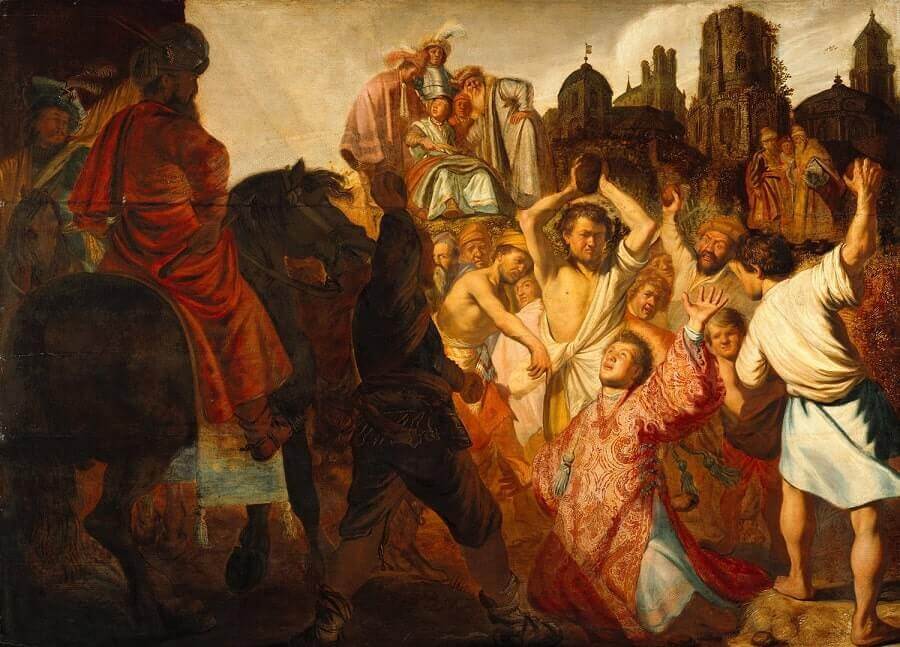
Creator: Rembrandt Harmensz van Rijn
Date Created: 1625
Physical Dimensions: H 89 ; L 123 cm
Provenance: Acquis en 1844
Medium: Oil on canvas
This sermon was first preached at St. David’s by the Sea in Cocoa Beach on May 7, 2023 for the fifth Sunday of Easter (5A)
If I may borrow from the great American theologian, Alec Baldwin: what a time to be alive!
Two monumental moments occurred in the last 48 hours.
First, the World Health Organization officially declared the end of the “global health emergency” known as Covid-19. It was a moment we have been longing for, crying out for, wondering if it would ever, ever come. I remember the earliest days of Covid when we would say things like, “Life will be back to normal in 2 weeks,” or “There’s no reason to play a shortened baseball season,” or “Next year will be the year!” 1190 days after declaring an international health emergency, 3 years and 3 months of life being turned upside down, we have been told by WHO that this crisis is over. Pandemic has become endemic.
Second, millions watched the coronation of King Charles III yesterday. 90% of the world had not yet been born before the last coronation, that of the late Queen Elizabeth in 1953. The liturgy was at once both ancient and modern. It was unashamedly Anglican and thoroughly Christ-centered. The music included pieces composed four centuries ago and others commissioned for this very event. We witnessed history as for the first time 3 female bishops participated in the coronation. King Charles was anointed, crowned, and enthroned. The Gospel was proclaimed as the Archbishop of Canterbury preached about Christ who was enthroned on the cross, wearing a crown of thorns, and the regalia of one awaiting execution.
And the best news of the day: Harry was absent from the balcony!
We had two historic days of hope, of joy, of anticipation, of excitement…What a time to be alive, indeed!
But after all of that;
After the proclamation that the global emergency is over;
After the pronouncement that Charles is King and long may he live;
After the pomp and circumstance;
We woke up today and the world still turns, Covid still remains, 6.9 million people have still died from Covid;
We woke up today and there is still war in Ukraine; still fear of a recession; still a gap between rich and poor; still 9 people dead and 7 injured in Allen, Texas.
Friends, we woke up today with one question in front of us: how now shall we live?
The good news is that Jesus is still seated on the throne. The cosmic king of the universe, the one who is reigning and ruling over all things, is still firmly in charge, in control, in command.
But we are here, in Cocoa Beach, Florida attempting to discern and fulfill “the work God has given us to do.” How now shall we live?
Borrowing from the coronation liturgy, which in turn borrowed from 1 Kings 2:2, I offer to you King David’s final words to his son, King Solomon, as a guide for holy living:
Be strong, and show thy worth:
Keep the commandments of the Lord thy God, and walk in his ways.
Be strong.
Keep God’s commandments.
Walk in his ways.
This is precisely the message that Jesus gave his disciples in John 14. This scene takes place after the Last Supper and the washing of feet and before Jesus’s betrayal and arrest in the Garden of Gethsemane. John 14-17 represents Jesus’ last words to his followers before the crucifixion.
Jesus begins with his own version of be strong as he says, “Do not let your hearts be troubled.” He is forewarning his friends of what is to come and he knows that they will lose heart, lose face, lose faith. He will repeat this sentiment routinely after his resurrection with his comforting pronouncement: do not be afraid. Even on the eve of his death, we find Jesus reaching out to his followers in tender compassion, the consummate Good Shepherd constantly caring for his flock.
Jesus then makes a collection of colossal claims in rapid succession. First, he says, “Believe in God, believe also in me.” As we will see throughout this passage, the imperative to believe in God and in Jesus is essential: Jesus and the Father are one. And if they are one then Jesus is, in fact, divine. This passage, therefore, assaults all of the modern and postmodern proclivities which run rampant throughout society: outside of the Church it is no longer acceptable to see Jesus as divine.
A good man, sure.
A good teacher, yup.
A revolutionary leader, perhaps.
Fully God and fully man…no thank you, if you please.
That’s the world we inhabit. But Jesus dispels us of that notion: to believe in him as they, as we, believe in God is to see him as he truly is: the second person of the Trinity, the God-man.
Second, Jesus tells them that he is going to prepare a place for them and that he will come back again to take them to their newly prepared home. That where I am there you may also be. In this season of Eastertide, we already know that Jesus would later ascend to the right hand of the Father where he is seated in power, glory, and majesty. We know that he will come again to judge the quick and the dead. He tells us has prepared a home for those who believe in him in the presence of God, in the household of God, and that one day he will take them there. What a time to be alive!
But then he says, and you know the way to the place where I am going, and their hopes falter. Thomas gives voice to their deflation and confusion: we don’t know where you’re going so how can we know the way? At first glance it feels like a fair question, but it launches Jesus into a discussion of ways and means through which we find out just how misguided the question actually is.
In terms of ways, Jesus says, “I am the way, the truth, and the life.”
In terms of means, he proclaims, “And no one comes to the Father but through me.”
There is no other way to the Father except through Jesus. He is the way, he is the sheep gate. In fact, the earliest believers were called “The Way” before they were called Christians or the Church. The language here is not wishy-washy or squishy, it is abundantly clear: Jesus is THE way. Not a way or one way or maybe the way. And Jesus is the image of the Father because by knowing Jesus they know the Father.
Now it is Philip’s turn to be dissatisfied with the answer. He says to Jesus, “Show us the Father and we will be satisfied.” This is similar to when the religious leaders or the traveling crowds ask Jesus for a sign. Jesus has already shown the Father! Sometimes, and by sometimes I mean almost all the time, we ask God for a sign after he’s already given us sign after sign. We distrust or ignore our own discernment, our own “sign seeing,” and we begin to put restrictions or expectations on how God should reveal himself to us…and so we miss his presence and his work altogether.
Jesus explains that his words and his works are not his own but those of his Father. If you have seen Jesus’ works and have heard his words then you have seen and heard the Father in the world. There is no separation of Father from the Son or Son from the Father. And then Jesus comes full circle by explaining what it means to believe in him (remember, belief was the substance of verse 1). To believe in Jesus is to do the works that Jesus has done, is doing, and will do. This is the “keep God’s commandments and walk in his ways” portion of the story.
Notice that Jesus goes a step further when he tells the boys that some will do greater works than what he has done. Does this somehow mean that his work is incomplete, inadequate, or insufficient? By no means! Rather, the word “greater” here can refer to an amount or number…the disciples, the church, therefore, will do a greater number of works than the Son because the Son is going to the Father to prepare a place for us.
We have been given the Spirit to do these works for we cannot do them under our own steam or with our own strength. Our mortal strength says things like, “Show us the Father” or “We don’t know the way,” but through the Holy Spirit we can boldly pronounce Christ as our strength and Christ as the way.
What has God commanded?
What ways are we to walk in?
What works has he given us to do?
The work we are commanded to do is to bear witness to Jesus as a royal priesthood. We do this by walking as he walked, where he walked, and with whom he walked, through the guidance and powerful presence of the Holy Spirit.
The Greek word, martus, which we translate in English as martyr can also be translated as witness. In our passage from Acts 7, we discover Stephen, one of the first deacons turned the first martyr of the church, reenacting Jesus’ passion.
He is martyred because he bore witness to the redeeming work of Jesus…
And those who are gathered in the scene bear witness to his martyrdom.
[R] Jesus was accused of blasphemy & killed by the religious leaders.
[L] Stephen was accused of blasphemy & killed by the religious leaders
[R] Jesus said, “Father forgive for they do not know what they do.”
[L] Stephen said, “Lord do not hold this sin against them.”
[R] Jesus commended his Spirit to the Father.
[L] Stephen commended his Spirit to the Father.
Through word and deed, Stephen bore witness to the unrelenting love of Jesus by doing the things that Jesus did. He testified to the one who is the way, the truth, and the life, and then he surrendered his life by speaking the truth and walking in the way of Jesus. Bearing witness to Jesus is costly, discipleship is costly, because it will always cost you your life. Maybe not the way that Stephen gave his life up through public death, but in Christ your life is not your own. When we receive the mercy of God, as described in 1 Peter, we are redeemed and we no longer live our lives for ourselves but for God and for others.
Bearing witness is what those who have “tasted and seen that the Lord is good” do publicly. One cannot say, “Come and see” until and unless one has seen with one’s own eyes. But once you have seen the glory of God in Christ, once you have seen that God is good all the time and that all the time God is good, you cannot help but go and tell others, gossiping the good news about the goodness of God.
And I have to believe that one of the many seeds planted that day, that horrible day of stoning, was a seed deep into the heart of a zealous Pharisee named Saul. Saul was there, holding the coats of those who did the stoning, bearing witness to what he thought was right in the punishment of a blasphemer…only he would later be struck blind, brought to his knees by the dazzling light of Christ on the road to Damascus and his life would be changed forever…in fact, his encounter with Christ would cost him his life.
1 Peter 2 describes the way we are called to walk, the means by which we keep God’s commands. Peter invites the church to be a royal priesthood and this is charged language for it was Israel who was called and commanded to be a royal priesthood and holy nation back in the wilderness narrative. The church does not replace Israel, but rather joins the holy task given to Israel by God. The holy and royal priesthood has but one assignment: to proclaim the mighty acts of him who called you out of darkness into his marvelous light. And to proclaim is to publicly bear witness by showing forth, telling forth, showing out.
How we discern and determine to concretely and tangibly proclaim those mighty acts is part and parcel of the Christian life. We gather every Sunday to proclaim, or bear witness, through song, Scripture, sermon, and sacrament. We bear witness through our acts of service, through servant leadership, through incarnational love, through mercy, forgiveness, peacemaking, reconciliation, the refusal to cease suffering, and every other good work God has called us to. We proclaim through word and deed, through voice and action. It is never an either/or but always, always, always a both/and.
We are a royal priesthood because we serve the one who is the Great High Priest and Cosmic King. You are heirs of the kingdom and priests of creation, returning praise to the Creator. Yesterday’s coronation was the tiniest glimpse of a royal priesthood as the king was ordained, set aside for a servant ministry. You have been anointed with oil and set apart for mission and ministry through your baptism and baptismal covenant. You have been charged with bearing witness to the “cornerstone whom the builders rejected” by being yourself a “living stone which is built up into a spiritual house.” You have been called to serve God and to serve others in his Kingdom, through the Spirit, and for his glory.
And it is the powerful presence of the Holy Spirit which makes all of this possible. Our Acts passage does not make sense apart from the Spirit’s powerful presence. It is literally the first phrase of the first verse: Filled with the Holy Spirit. Luke routinely tells his readers that the disciples were filled with the Spirit and that once filled with the Spirit they performed and accomplished great works. And if the Spirit makes it possible it means that you need to be filled with the Spirit! These are Spirit-filled and Spirit-informed and Spirit-initiated works. These are not works which are relegated to Scripture as though the Bible is a history book cataloging all that God did in the past tense. These are works, as Jesus told us in John, that are happening in the present and future tense. If only there was a day in the church calendar where we celebrate the outpouring of the Spirit most fully…
The works outlined in Acts are “ask anything in my name and I will do it” works.
Beloved, Jesus is not a cosmic vending machine. You cannot insert your request, press F5, and then receive at the bottom of the dispenser. This verse, and those like it, is one of the most misunderstood and misused verses in the New Testament. It has given rise to a “name it and claim it theology” which suggests that if we ask for it, it is already ours. The problem with this is that it misses the mark entirely, it misses the “if in my name” clause.
Jesus’ name cannot, must not, will not be aligned with malice, guile, insincerity, envy, and slander. Jesus’ name will not be aligned with greed, injustice, hatred, bigotry, violence, or evil.
Friends, we are living in unprecedented circumstances. What a time to be alive, indeed. The question truly is, as Chuck Colson posited, how now shall we live?
Be strong, do not lose heart.
Keep God’s commandments by doing the works God has given us to do.
Walk in his ways by following the one who is the Way.
Bear witness to Jesus as a royal priesthood. Walk as he walked, where he walked, and with whom he walked, through the guiding, powerful presence of the Holy Spirit. Amen.
 Porter C. Taylor