
This sermon was preached during the Great Easter Vigil on April 8, 2023 at St. David’s by the Sea.
Araminta “Minty” Ross was born in Maryland around 1822. Her parents Rit Green and Ben Ross were both enslaved. Minty eventually married a freed-man named John. She took her husband’s last name, Tubman, and she exchanged her first name for her mother’s name: Harriet. Harriet Tubman thus burst onto the scene.
Harriet would escape slavery up to Philadelphia. Over the next 10 years she would lead 13 missions back to Maryland, using the underground railroad to bring freedom to the enslaved. It is estimated that the UGRR was used to free 100,000 slaves. Her bravery and commitment to freedom during these rescue missions led to people calling her “Moses.” She had come to deliver her people out of their Egypt and into their Promised Land. She was known to sing “Go Down Moses” and “Bound for the Promised Land” as a signal to others.
Tubman freed 70 slaves during her rescue missions. She would go on to lead an armed expedition during the civil war, liberating an additional 700 slaves. Eventually she would become a landowner in New York and she would become part of the suffrage movement; not just for women but for minorities, the disabled, and the aged. Harriet Tubman was the first great American freedom rider, her brave and courageous efforts reminding us of Moses, the deliverer with whom she is compared.
Moses also delivered his people from slavery in Egypt and took them to the Promised Land.
The example of Harriet points us back to Moses, and the example of Moses propels us forward to the second deliverer, to the Great Redeemer, to the one who has led his people out of slavery and into freedom, out of captivity into redemption, out of oppression into deliverance. The Great High Priest who has offered himself as the paschal lamb that we might be led “out of error into truth, out of sin into righteousness, out of death into life.”
The entire narrative of salvation history has been presented to us in the form of the liturgy, music, and nine Old Testament lessons tonight. We heard about creation, fall, covenant, and the hope of redemption. The story of how the God-who-always-provides provided a way for humanity to be reconciled to him.
God always provides.
Jesus is the one foretold in the Old Testament as the one who has come to fulfill the vocation of the Faithful Israelite, the one who will keep the covenant with YHWH, the one who has provided new life for his people. The one who has been raised from the dead.
It is for this reason that we are able to offer our joyous Easter proclamation, our never-gets-old victory cry. Let’s try it:
Alleluia! Christ is risen!
The Lord is risen indeed, Alleluia!
In the beginning God created and it was good. God’s presence and creative energy were in creation, the Son was involved as the word going forth from God’s mouth. God gives humanity a vocation in creation: stewards of all that is, directing the praise of creation back to the Creator. But things soon fall apart. Sin relationship.
But God would provide. God always provides.
Genesis 8 tells us of YHWH’s covenant with Noah after the flood. YHWH sets his warrior bow in the sky as a sign of the covenant between them, but the bow points upward not down. The implied meaning here is that YHWH would not break the covenant and if the covenant were to be broken, YHWH would pay the price, he would provide the covenant-keeping. Jesus is the fulfillment of this covenant as he is both the cosmic king of the universe who has stooped down to earth and he bore the punishment of our covenant breaking.
YHWH reiterated the covenant with Abraham. Abraham was promised a people as numerous as the sand and stars, a land flowing with milk and honey, and to be a blessing to the nations of the world.
Only, Abraham didn’t have a son.
But God would provide. God always provides.
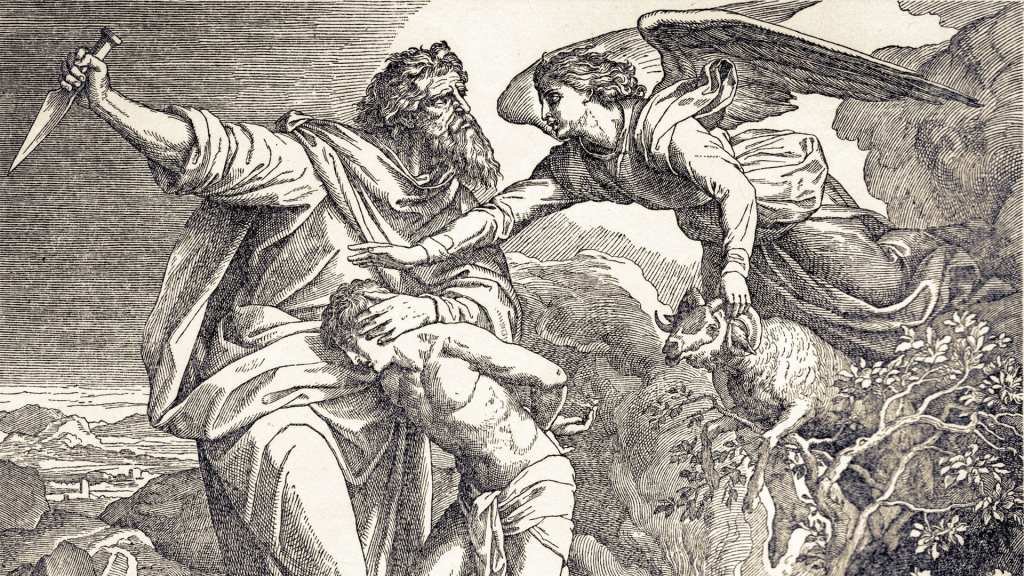
Isaac was born 25 years after that promise. YHWH-the-covenant-maker would eventually ask Abraham to sacrifice Isaac, his son, his only son, the son whom he loved. Abraham obeys. He takes the boy to Mt. Moriah. They leave the servants behind because he and the boy are going to worship and then they will come back. Isaac carries the wood for the offering, for himself, foreshadowing Jesus carrying his own cross. Isaac eventually asks his father where the sacrifice is…and Abraham’s response is the faith-filled response of a faithful follower full of hope that perhaps there is another way.
God would provide. God always provides.
Abraham acted in faith. God provided the sacrifice: a ram caught in a thicket. Jesus is the promised son, the only son, the son whom God loved who and was sent as the sacrifice; he is the provided lamb caught in the thicket.
The next lesson depicts the crossing of the Red Sea. YHWH had already provided a free passage out of Egypt with the Passover. YHWH provided silver and gold for his people as the Egyptians were willing to give up anything to get the Israelites and their plagues and their God out of their land. But Pharaoh’s softened heart hardens once more. He realizes his mistake in allowing Israel to leave so he hotly pursues them.
The Israelites start…what’s the theological term for it?…oh right, they start freaking out! They accuse Moses of bringing them into the wilderness because it will be easier to kill and bury them there. Moses tells the people to fear not because YHWH will fight for them. He will protect and shield them as the pillar of cloud by day and fire by night. YHWH stood guard, shielding the Israelites throughout the night with his very presence. But they still needed an escape route.
God would provide. God always provides.
YHWH provided the dry escape route, parting the Red Sea with Moses’ raised staff. He alone won victory against Israel’s enemies because “the LORD is a mighty warrior, YHWH is his name.” Israel responds with praise and worship, led by Miriam and the women (because the women are always first!), before the men join in. Just as Israel was delivered from slavery into freedom, Jesus delivers us from the bondage of sin and death into life and righteousness. We are washed in baptism and cleansed by his blood, we are redeemed from the hands of sin, Satan, and death and ushered into eternal life by the Lord of life.
Our next five passages move from the narrative to the prophetic. In each instance, God provides new life and covenant keeping for his people. Each passage anticipates the work of Jesus. In skipping from Moses to the prophets we must keep in mind that the situation for Israel went from good to bad to worse because of their sins. The prophets warned Israel to return to God and promised that one day the sad things will come untrue, Israel will be restored.
The first Isaiah passage foretold the day when YHWH would restore Israel by cleansing their sins and providing a shaded covering for them. YHWH would once more provide his people with his powerful and protective presence in the form of cloud by day and fire by night. Jesus is Emmanuel, God-with-us, the one who stooped down from heaven, put skin on, and moved into the neighborhood to dwell among us.
The second passage depicts YHWH’s offer of salvation to all people in fulfillment of the Abrahamic covenant. He will provide salvation to Jew and Gentile through his very word. His word does not return empty but does precisely what it was sent to do. Jesus is that salvation, he is that ever-sufficient and always-accomplishing word of God.
Ezekiel 36 describes the day when YHWH will gather his scattered-people and return them to their promised land. He would provide a sin-cleansing, a new heart, and a new spirit. He would be their God and they would be his people. Jesus is the enfleshment and fulfillment of this promise, he is the new covenant, the new cleansing, the new heart, and he sends the Spirit to his people at Pentecost.
In Ezekiel 37, the prophet is shown a vast valley of very dry and dead bones, and he’s asked if they can live. YHWH provides life for the bones through the ruach, the Holy Spirit. YHWH promises to provide his Spirit for his people and the land for them to inhabit. He promises the provision of restoration. This story foreshadows Matthew’s description of the temple curtain being torn in two and the tombs of the saints being opened as they are raised from the dead. It also foreshadows the resurrection of the body at the Last Day when Christ shall come again in power and glory.
Sin, Satan, and death will no longer have the last word, they will no longer have mastery or command over humanity.
God would provide. God always provides.
The message of provision, restoration, rescue, and redemption is found also in Zephaniah. Israel is promised the provision of victory from YHWH, the renewal of love, the vanquishing of oppressors, the changing of shame into praise. After all of the heartache of humanity’s betrayal, after the sins and the rejection of their true King, YHWH would still fulfill the covenant, providing the means for his people to be saved and restored. This would happen in and through Jesus.
Finally we are ready for Matthew’s resurrection story.
We enter the story without the hint of an alleluia.
Just women going to a tomb.
Matthew tells us that after the Sabbath, on the first day of the week, Mary Magdalene and the other Mary went to see the tomb. The women aren’t traveling with the expectation of resurrection but the intention of preparing Jesus’ body for burial. They waited for Sabbath to end because no one could do work on the day of rest. Luke tells us that the women had actually gone to the tomb on Friday, to see where two of Jesus’ disciples, Joseph of Arimathea and Nicodemus had laid his body. They then went home to prepare burial spices and ointments before Sabbath started.
Their sabbath rest, Jesus’ sabbath rest in the tomb, mirrors the sabbath rest performed by YHWH after creation. YHWH would later institute the concept of Sabbath for Israel to rest, worship, and pursue holiness. That Sabbath took place between the crucifixion and resurrection is significant: it means that a new week was starting, a new creation, a new world was dawning, a world of resurrection.
The women arrived at the tomb and there was an earthquake. An angel of the Lord descended and rolled the stone away. As the youths would say: the guards were dead. They weren’t actually dead, but they were stunned-like-death. The women were not! The angel gives the women the standard angelic greeting–“Do not be afraid”–and then tells the women that Jesus is not dead but has been raised. Angelic pronouncements of good news serve as bookends in the gospels: both the incarnation and the resurrection are announced by angels to humans and then the humans are commissioned to go and tell others about it.
The women are told to “come and see” where he was laid, and then they are commanded to tell the others to “come and see” the Lord in Galilee, the others would tell Thomas, “come and see.” God provided a vindicating and victorious resurrection for his Son, he provided new life for his people, and he also provided the words and means by which they are to gossip the good news with others.
God always provides.
The women run. We’re told they run with great fear and joy, overwhelmed by their angelic encounter, overwhelmed by the empty tomb, but full of belief. In that moment they become apostles, evangelistic heralds of the resurrection, sent out ones with the task of proclaiming the greatest news the world has ever and will ever hear:
Alleluia! Christ is risen!
The Lord is risen indeed, Alleluia!
As they are going they encounter Jesus, the Risen One, the Lord of life, the conqueror of death, the almighty and all-glorious Son of God. Matthew subtly says that Jesus met them. That’s how it always is, Jesus is always the initiator, always the provider. And the women do the only thing one can or should do when encountering the Risen Lord: they fall down at his feet and worship. They worship him because he is Lord, they worship him because he is alive, they worship him because he has trampled down death.
In Romans 6, Paul tells us what the resurrection means. As Christians, we have been crucified with Christ through the waters of baptism and we have been raised to new life with him by his resurrection. This is why we renew our baptismal covenant at the Easter Vigil, this is a baptist liturgy. Resurrection means that God has provided us with new life, resurrection life, everlasting and eternal life in the here and now because of what he has done in Christ, because of what God has done in, through, and for him.
Death has lost its sting, it has been undone;
Sin has lost its power;
Satan has lost the battle.
Christ the Victor is triumphant over all;
Christ has redeemed us inviolably.
Paul explains that if Christ was not raised from the dead then we are still dead in our sins. The crucifixion is the atoning sacrifice of the paschal lamb, but the resurrection is the acceptance of the sacrifice, the validation and vindication of the one who is both victim and Great High Priest.
You have come tonight to keep watch at the tomb. You have come with the expectation and anticipation that you would greet the Risen Lord. You have heard the greatest story ever told, the story of the God who provides, the God-who-always-provides. You have worshiped the Risen Lord.
And now you have one job simple job to do: like the women, you are commissioned to go and tell others about it. Tell others about the Greatest News in the world: the Son of God, the King of kings and Lord of lords, has died for the sins of the world and he has burst forth from the grave, trampling down death by his own death, and ushering in his kingdom of new life and love.
God has provided a way for us to be redeemed and restored. Even when we were still enemies of God, living in our sins, living out of alignment with his holy will, he provided his Son as “the means of grace and hope of glory.” God will provide because he is the God-who-always provides.
Alleluia! Christ is risen!
The Lord is risen indeed, Alleluia!
 Porter C. Taylor
One thought on “The God Who Always Provides”