
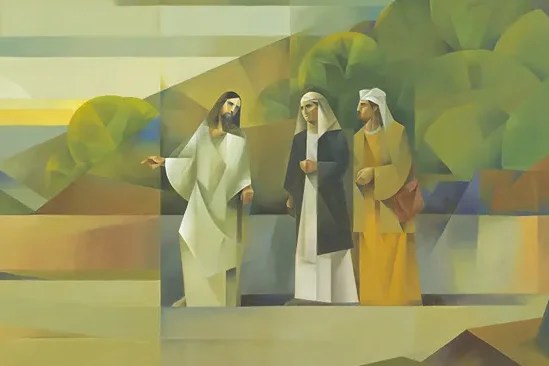
This sermon was preached at my parish, St. David’s by the Sea, where I am the rector. The lessons were those appointed for the Third Sunday of Easter (Year A). Audio will be uploaded tomorrow.

Be present, be present, O Jesus, our great High Priest, as you were present with your disciples, and be known to us in the breaking of bread; who live and reign with the Father and the Holy Spirit, now and for ever. Amen.
Groucho Marx once quipped, “I never forget a face, but in your case I’ll be glad to make an exception.”
Facial recognition has become a hot topic in science, technology, and medicine recently with the fast-paced evolution of facial recognition software and the development of a facial recognition spectrum for humans. Less than 2% of the world’s population falls into the category of “Super Recognizers.” Super Recognizers have the super power of recognizing faces years later, often with just a quick glimpse of the face or a facial feature, and even with the ability to accurately age someone in their mind. One such “Super Recognizer” is Andrew Pope, a police officer in the West Midlands. Pope has identified more than 2000 suspects over the last decade because of his unique ability.1
For these people it can truly be said that they never forget a face.
On the other end of the spectrum, however, is an additional 3% of the world’s population who have what is officially known as prosopagnosia or face blindness. You may have heard of this because Oscar-winning actor Brad Pitt has gone public with his own struggle with prosopagnosia. For those living with this condition, they are unable to recognize faces, even faces which are familiar to them. In an interview with GQ, Pitt opened up about the reputation he has gotten for being detached, rude, egotistical, and conceited because he doesn’t remember faces.2 Pitt shares that he can’t “grasp a face” and it has been very lonely and isolating for him. Pitt “wants to remember the people he meets and he’s ashamed that he can’t.”
Ironically, while Pitt cannot recognize faces his entire life has been devoted to creating visually aesthetic art mediums: acting and sculpting.
The interview was actually very moving and well-worth the read, Pitt even waxes eloquent about a paper sculpture of the crucified Christ by Charles Ray in Paris which caught his eye and captivated his imagination.3 At one point the interviewer admits that she thinks her heart may be broken. Pitt then drops a massive truth bomb. He says, “I think all of our hearts are broken.”
There are certainly deep philosophical underpinnings and existential ramifications to such a statement, but Pitt’s comment struck a deep chord within me as I read our passage from Luke 22 throughout the week. Imagine it, two disciples are walking the walk of shame back to Emmaus as they escape the terror of Jerusalem.
Their hearts were broken as they traveled.
They are shattered, gutted, dismayed.
But an encounter with a stranger leaves those broken hearts “burning within them.”
I think Pitt is on to something. Each of us carries wounds from the past. We have been hurt by relationships, bruised and let down by those around us. We have been scarred in some cases and in others the cut is so fresh, so real and present, that it hasn’t even scabbed over. Part of being human, part of being created in the image of God is the ability to love and be loved. And this is beautiful but it is also a very risky business because love carries the inherent risk of being hurt.
But in each and every instance, our Lord, the Lord of Love, walks with us through the pain and hurt and he leaves us saying, “Were not our hearts burning within us?!” He turns our sorrow to joy, our mourning to laughing, our hurt to wholeness and happiness. It is only through the healing and loving touch of Jesus that we can say, “My heart has been broken, but he is making all things new.”
The only way to move from pain to joy or from Paradise Lose to Paradise Restored is to go through it. And that is the invitation in front of us all this morning in the form of Luke 22.
For the third week in a row, we are occupying space on the original day of resurrection. Two of Jesus’ disciples, one named Cleopas and one unnamed, are walking back to Emmaus from Jerusalem. Emmaus was a seven mile journey from Jerusalem, the scene of the crucifixion, from the shattering of their expectations, hopes, and longings. For them, it was truly the Boulevard of Broken (Messianic) Dreams because the prevailing wisdom of Israel’s prophetic tradition said a dead messiah was no messiah.*
Cleopas and his companion were discussing all of the details of the previous days in Jerusalem. We know these details all too well because we have just lived and experienced them liturgically: we recall the cries of “Hosanna! Blessed is he who comes in the name of the Lord” and the shouts of “Crucify him!” We remember the clearing of the Temple, the washing of feet, the breaking of bread, the betrayal with a kiss, the interrogation, and the crucifixion.
It is as they are discussing “these things” that a stranger “came near and went with them.” And they don’t recognize him. Actually, the text tells us that their eyes were kept from recognizing him.
It is not too hard to understand why their spiritual eyes were blind to seeing the risen Lord: they did not understand the scriptures, so how could they properly grasp this corporeality of Jesus in the flesh? Remember that spiritual blindness was a particularly important theme for Luke in both Luke and Acts. Luke will re-imagine this scene in Acts 8 as Philip travels alongside the Ethiopian Eunuch, breaking open the meaning of Isaiah and resulting in faith and baptism.
The best analogy I can offer on this point is the story of proposing to Rebecca. After a week in London, Rebecca and her family had a day to see Paris before flying home. Unbeknownst to her, I boarded a plane from Atlanta to Paris. I coordinated her movements with my father-in-law. I took up my spot, leaning against a lamppost in the Place Vendome. As Rebecca and her family approached me our eyes met. I smiled at Rebecca with all of the joy that a romantic heart can contain…and she looked back at me…and she looked away.
She knew my face but she had no reason to expect to see me there, and so for the briefest of moments she did not recognize me.
The analogy breaks down because Rebecca quickly realized who I was. But the travelers did not see Jesus that fast. They were kept from recognizing Jesus even though they had known him intimately for several years.
And in this meeting and divinely-appointed facial blindness we are offered the first point of grace in the passage: Jesus draws near to people even when they are blind to his really real presence. You do not have to do anything to earn his drawing near, in fact you cannot do anything to earn it. It is and always will be grace, a free gift that he draws near to you. And he is always the first mover. Praise be to God!
And then Jesus asks the first of two ironic questions, as though he is having them on. First it was Mary to whom he said, “Woman, why are you weeping?” and to these disciples it was, “What are you talking about?” Cleopas answers with vigor: “Are you an idiot? Have you been living under a rock??” (To which Jesus replies: “Not under but behind one for three days…)
Jesus asks his second goading question: what things? Though I don’t think that Jesus is only having them on at this point. The question feels sarcastic but it also has significance. Jesus is trying to lead his disciples out of spiritual blindness into the light of truth. They need to verbalize their sadness and dejection. They need to understand the full extent of their blindness in order to accept the full reality of Jesus’ resurrection.
So Cleopas gives the stranger the rundown of this mighty prophet Jessus. He tells how they had believed..nay, how they hoped and longed, that Jesus was the one who would redeem Israel. And the hope that Cleopas shares with Jesus is not a present or future tense hope, it is the past tense.4 As in, they HAD hoped but those hopes were no more. They were shattered and crushed by the cross. Within their limited understanding of the fulfillment of the covenant, there was no room for death, and certainly not for the cursed death of crucifixion.
That the disciples had missed all of Jesus’ comments foretelling his death and resurrection, that they had missed the connection between Isaiah’s Suffering Servant and the Messiah was bad enough, but they add insult to injury with the next pronouncement:
But some of the women from our group found the tomb empty.
And in fact they saw angels who said Jesus was alive.
So Peter ran to the tomb to see with his own eyes.
And Peter also found the tomb empty.
And we heard all of this and we still decided that it would be a good idea to skip town for Emmaus.
We heard all of this and we still hope in the past tense.
Why is it in the past tense? Because an empty tomb did not automatically mean resurrection. The most likely explanation for resurrection was that some person or persons unknown had rolled the stone away and stolen the body.
They disregarded the possibility of resurrection and left the city without hope. Imagine the situation they were walking back into. They had to go back to their hometown and face the music with their friends and families, they would have to explain to their weird Uncle John that they had gotten it wrong, that they had followed a rabble-rousing revolutionary who met a tragic end and nothing more. Imagine the “I told you so’s” that they would receive.
Now do you understand why Jesus says, “Oh, how foolish you are and how slow of heart to believe all that the prophets have declared! Was it not necessary that the Messiah should suffer these things and then enter into his glory?”
Despite this, Jesus draws close to his disciples once more and he painstakingly walks them through the entirety of Israel’s scriptures, beginning with Moses and the prophets, to show them, to teach them, to disciple them. He breaks the Scriptures open to them, revealing how Jesus was the great prophet foretold by Moses, how he was the Messiah and Suffering Servant, and how his death and glorification were predicted.
And even still, their eyes were not opened at this point.
They received the greatest living Bible Study of all time but it did not result in opened eyes. But something was kindled inside of them, there was some stirring of longing or companionship because they asked Jesus to stay with them. Jesus’ nearness begets more nearness.
Jesus moves from guest to host. Your bulletin says that he “took bread” but the ESV gets it right: he took the bread. Jesus is NOT breaking bread with the disciples in the same way that we say “let us break bread together.” By that we mean hospitality, fellowship, and a shared meal. Luke is not saying here. As Andrew McGowan quite rightly points out: there is no concept of “breaking bread together” in this sense in 1st century Israel, in either Aramaic or Greek.5
The language is very technical and precise: Jesus took the bread, he blessed it, he broke it, and he gave it to them.
Jesus took, blessed, broke, and gave the bread, just as he took, blessed, broke, and gave the loaves of bread when he fed the 5000 in Luke 10 and just as he took, blessed, broke, and gave the bread during the Last Supper in Luke 22. This is also the meaning of Acts 2:42 when Luke tells us the church devote themselves to the breaking of bread.
It is all Eucharistic. Luke is intentionally and not-so-subtly pointing us to the Last Supper. We participate in the four-fold action of the Eucharist just as Jesus commanded us to do at the Last Supper: do this in remembrance of me. Jesus does with and for them precisely what he had commanded them to do!
And their eyes were open.
They could see him clearly and plainly, recognizing him as their Lord.
And then he disappears.
Can you even imagine?!
It was in the Eucharistic action of breaking bread, by participating in the remembrance of Christ’s death that they recognized the Risen Lord.
They said to themselves, “Were not our hearts burning within us?!”
These broken hearts have now been set on fire with hope, with joy, with delight, with utter amazement. And their burning hearts cannot be contained! The fire overflows and so the disciples book it back to Jerusalem, going back the exact way they came, only to find that the Boulevard of Broken Dreams had been repaved by the Lord of life, a foretaste of the place where the streets have no name. Their pain had turned to joy, their sorrows and sadness to a restored hope and faith.
The disciples shared with the other disciples all that they had seen and heard. They tell of the Risen Lord. And then Luke makes a point of saying that the disciples told the disciples that Jesus had been made known to them in the breaking of the bread.
And that is true of us today.
That is true for us today.
We are here at the church gathered and soon we will share in the breaking of the bread and Christ will be made known to us! Jesus makes himself known to you…and then you go out and make him known to the world. Do you remember back in the 1990’s when every Episcopal church who adopted a new mission statement went with “To know Christ and make him known”?It may seem tired now, but there was a reason for this: our job is to know him and make him known!
This passage outlines our own liturgy. Jesus draws near to the assembly; his mighty acts are recounted; he breaks open the Scriptures to them; he walks with them in peace; he breaks the bread with them; and then he departs and they are sent on mission. It is our liturgy from start to finish! And we are to celebrate it, proclaiming his death and resurrection until he comes again.
In all of his gracious goodness, Jesus is willing to travel miles with his disciples to show them who he is and what he has done. Jesus always draws near because he is Emmanuel, God with us and he is always near to us. He meets the disciples in their grief and walks with them through it, turning their broken hearts into burning hearts.
Our faith and hope should be set on Christ because God raised him from the dead and has ransomed us by his blood. When the crowd in Jerusalem heard the Gospel on the first Pentecost, we are told that they were cut to the heart by their own guilty and sin and that they were invited to repent and believe. And they did. To the tune of 3000 people coming to faith. The purpose and point of the Jesus story is always to draw people into repentance and belief. Cleopas and his friend certainly confessed and believed on the road to Emmaus. That is certainly the cry of our collect: open our eyes that we might behold his redeeming work.
Are our hearts burning within us?
The Good News of the Gospel is so overwhelming, so magnificent, so life-changing and history-altering, that it should set our hearts ablaze. The presence of Christ through Scripture, sermon, song, and sacrament should satisfy and nourish, lighting the fire within us. The Christian life isn’t about comfort and safety, it is about traveling with the Risen Lord to destinations unknown and being faithful and obedient as he leads us with his gospel fire.
May we be a people whose hearts are burning within us.
May we be a people who spread that Gospel fire.
May we be a people who know Christ.
May we be a people who make him known in all the world.
FOOTNOTES:
1. https://www.washingtonpost.com/science/super-recognizer-facial-memory/2021/10/29/4cf80caa-2159-11ec-b3d6-8cdebe60d3e2_story.html?pml=1
2. https://www.gq.com/story/brad-pitt-august-cover-profile
3. https://www.pinaultcollection.com/en/boursedecommerce/charles-ray
4. Imperfect indicative
5. https://abmcg.substack.com/p/emmaus-breaking-bread
* I am indebted to the Rev. Cynthia P. Brust for first using the title of Green Day’s “Boulevard of Broken Dreams” in relation to Jesus and the disciples.
 Porter C. Taylor